

On this page
Building a strong vocabulary is one of the most common hurdles in exam preparation. Whether you are tackling reading comprehension passages or trying to write a persuasive essay, finding the right word at the right time matters.
Many students rely on reading widely to pick up new words. While reading is a great way to encounter vocabulary, treating it as your only study method is a trap. You might recognise a word when you see it on the page, but find your mind goes blank when you try to use it in an exam.
Why isn't reading enough to learn new words?
When you encounter an unfamiliar word in a book or an article, your brain usually relies on the surrounding text to guess its meaning. This is called incidental learning.
However, a 1989 study by researcher Batia Laufer found that a reader must already know 95% of the words in a text to have a good chance of understanding it. If there are too many unfamiliar words, the context clues break down, and you are more likely to guess wrongly. Laufer, 1989
Even when you do guess the meaning correctly, it rarely sticks in your long-term memory. A 2003 study by Rob Waring and Misako Takaki tracked students learning new vocabulary through reading. They found that without further practice, students forgot the meaning of 24 out of 25 new words after just three months. To permanently retain a word from reading alone, the study estimated a student would need to encounter it more than 20 times. Waring & Takaki, 2003
How to improve vocabulary for English exams?
If reading alone is too slow and passive, the solution is to switch to active production.
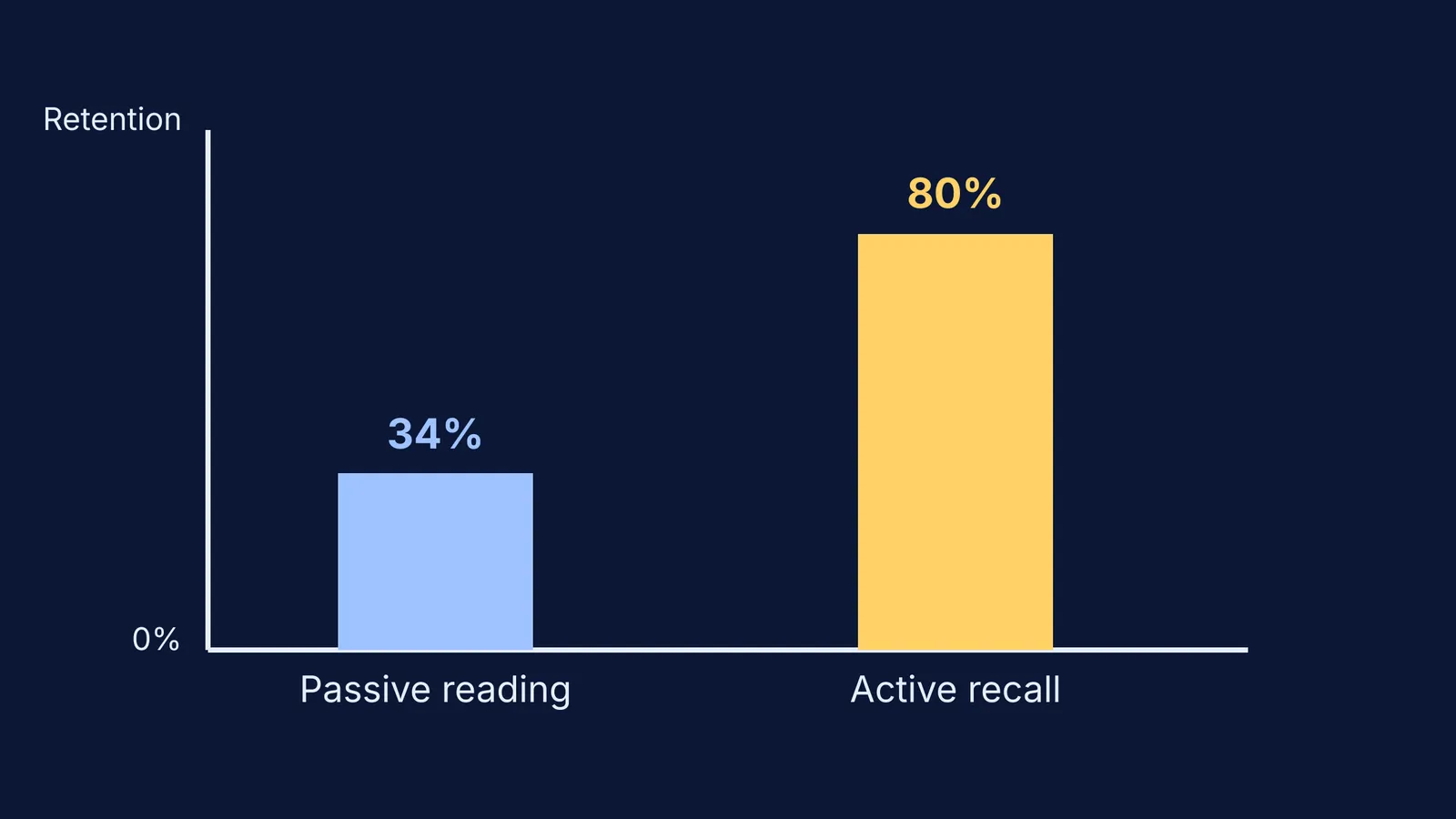
To move a word from your receptive vocabulary (words you understand when others use them) to your productive vocabulary (words you can write or speak), you have to force your brain to retrieve and apply it. A landmark 2008 study by Jeffrey Karpicke and Henry Roediger showed that students who used active recall—testing themselves on what they had learned—retained 80% of the material after a week, compared to just 34% for those who only reread the text. Karpicke & Roediger, 2008
When you are studying complex ideas, active recall helps ensure the concepts are actually sinking in. If you are learning challenging scientific concepts in a second language, Fermi's AI tutor holds a line of reasoning across a session and checks your understanding as it goes, deciding whether to explain, ask or show to make sure you are actively engaged.
How do you use the active recall framework?
Instead of skimming past new words or passively copying dictionary definitions, use this three-step routine. It works well whether you are reading the news or working through previous exam papers.
1. Note the word in its original context When you find a new word, write it down along with the exact sentence where you found it. The context provides crucial clues about the word's tone and grammar. For example, "mitigate" means to make something less severe, but seeing it in the phrase "mitigate the effects of climate change" teaches you how it behaves in a sentence.
2. Write your own sentence Do not just copy the definition. To trigger active recall, you must generate a brand new sentence using the word correctly. Tie the sentence to your own life or your exam syllabus. If you are preparing for a biology exam, you might write: "The thick fur of the polar bear helps to mitigate the extreme cold." This forces cognitive involvement, which builds a stronger memory trace. Writing a sentence also forces you to check the prepositions that often travel with the word. For example, you "abide by" a rule, but you "comply with" it. Passive reading rarely highlights these small, easily forgotten connections, but constructing a sentence makes the gap in your knowledge obvious immediately.
3. Test yourself over time Review your list of words a few days later, but cover up your sentences. Look at the word and try to recall both its meaning and how to use it in a phrase. If you want to know how to build a study routine that lasts longer than a week, keeping a dedicated vocabulary notebook that you test yourself from every Sunday is a simple, effective habit.
When preparing for exams, it is tempting to cram lists of advanced vocabulary in the final weeks. However, cramming only builds fragile recognition memory. This deliberate approach takes more effort than just reading a chapter and hoping the words sink in. However, building a strong, reliable vocabulary is a process of quality over quantity. Taking the time to actively learn five new words a day will leave you far better prepared than passively reading fifty.
If you are a parent supporting a child through this process, resist the urge to turn every reading session into a vocabulary test. How parents can help children learn without adding pressure is often about encouraging them to read subjects they enjoy, and letting them choose which words they want to master. And if you are studying science in English when you think in another language, this active sentence-building method will help you master both the science and the language at the same time.


