On this page
Somewhere around Class 9, many conversations at home shrink to marks, meals and screen time. Reading the same book as your teenager gives you both a third thing to talk about: a character's bad decision, a twist neither of you saw coming, an idea one of you finds silly. For a while, you are two readers comparing notes, not a parent checking up.
Why read the same book as your teenager?
Talking with teenagers about ideas is linked to how well they read. In an OECD brief on PISA 2009 data, 15-year-olds whose parents discussed political or social issues with them weekly or daily scored 28 points higher in reading, on average, than those whose parents did so less often or not at all. After accounting for socio-economic background, the gap fell to 16 points but did not disappear.
The same brief found that "discussing books, films or television programmes" and "spending time just talking with one's children" were also associated with better reading, and it puts the point plainly: "Students are never too old to benefit from their parents' interest in them."
This is an association, not proof that book talk raises marks. But the OECD notes that many of the parent-child activities linked to better reading "involve relatively little time and no specialised knowledge", while demanding "genuine interest and active engagement."
Timing matters too. In the UK National Literacy Trust's Children and young people's reading in 2025 report, just 32.7% of 8- to 18-year-olds said they enjoyed reading in their free time. Only 18.7% read something daily in their free time, and the report says the drop in enjoyment over the last year was especially steep among boys aged 11 to 16. That is UK data, not Indian, but it is a warning that the habit can slip in the early teens.
How do you choose a book you will both read?
Let your teen choose, or offer three options and let them pick. A book you assign feels like homework.
Aim for a book you can both finish in a month. A 200 to 300 page novel works well.
Any language counts. A Hindi, Marathi or Tamil novel is as good as an English one.
Graphic novels, memoirs and popular science all count.
Skim a few pages first. If your teen picks something you find too adult, our guide on what to do when your child wants to read adult books explains how to check, read along and talk.
A four-week plan for reading together
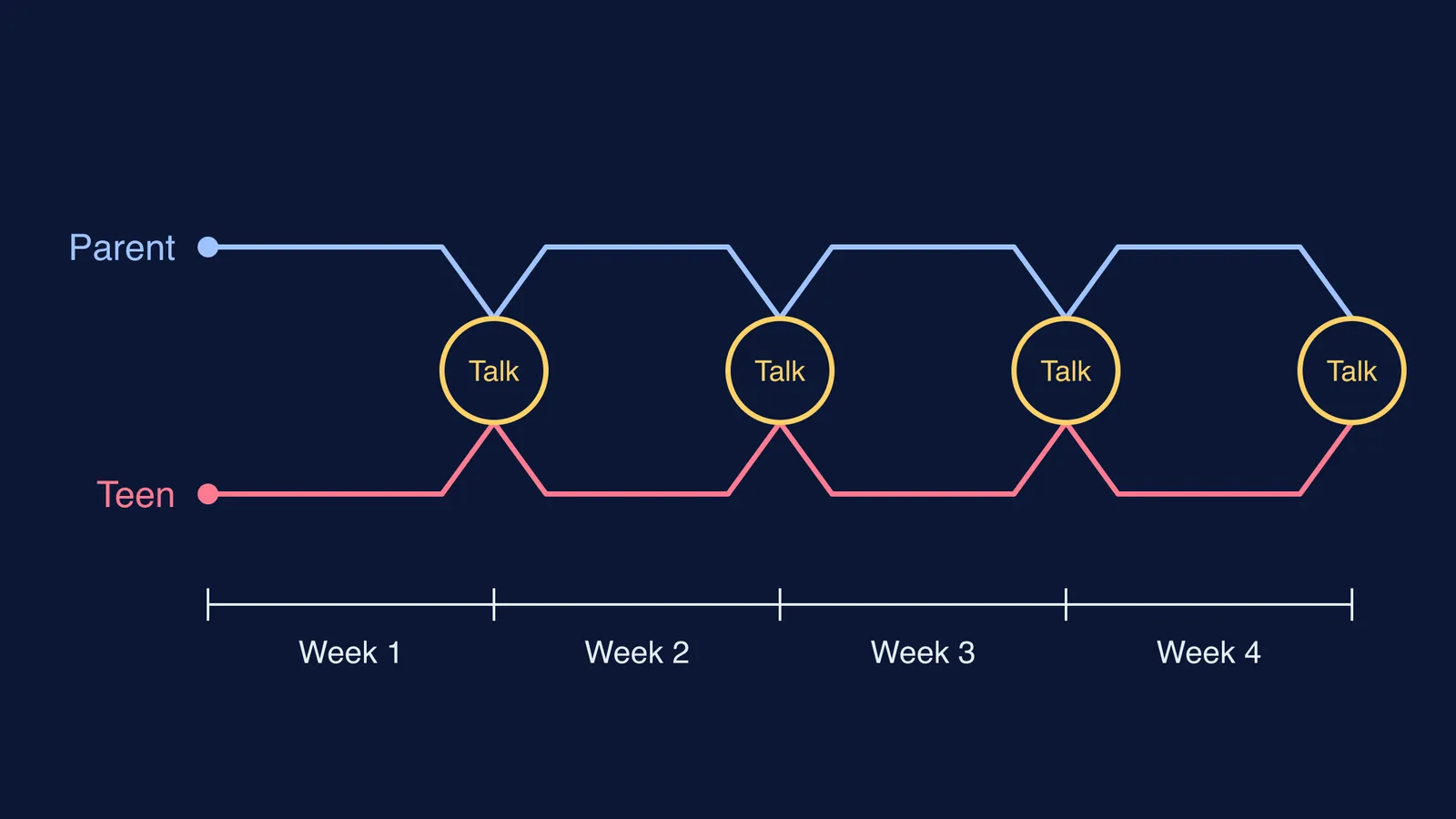
Day 0: agree the book and the slot. Pick one fixed 20-minute slot a week, such as Sunday evening chai, and keep it even in busy weeks.
Split the book into four parts. Use the chapter break nearest each quarter.
Read separately. No reading aloud and no checking each other's bookmarks. Each of you marks one passage you liked or disliked.
Meet after each part. Talk only about pages you have both read, and let your teen speak first.
Week 4: decide together. Next book, a break, or watch the film version and argue about which was better.
For a 240-page novel, that is 60 pages a week, or about 9 pages a day.
What do you ask when you talk about the book?
Open with a question you would ask a friend, then answer it yourself too.
"Which character would you not want as a friend? Why?"
"Was there a moment you thought the author got it wrong?"
"What would you have done in that situation?"
"Did anything in this part remind you of school, or of us?"
"Which line would you have underlined?"
If you get one-word replies, do not push: "Fair enough, I nearly skipped that bit too" keeps the door open for next week. For more on listening without correcting, see what to say when your teenager complains about studies.
Resist using the book to slip in a lesson about marks. Keep that for another day, and see how to talk to your teenager about their future without lecturing.
What if your teen is busy preparing for board or entrance exams?
Shrink the book, not the habit. Short stories or essays let you read one piece a week, and an audiobook fits a commute. Popular science connects to the syllabus without being one more chapter to revise. If a book raises a question neither of you can answer, such as why planets move in ellipses, look it up together in the Fermi Concept Library, which has a lesson for each concept in physics, chemistry, biology, mathematics and computing.
Some books deal with grief, bullying or self-harm, and a discussion can touch something your teen is going through. Listen first. If they seem low for weeks or talk about hurting themselves, speak to a mental-health professional or call Tele MANAS, the free 24x7 national mental-health helpline, on 14416 or 1800-891-4416.
Start tonight: ask your teen which book they would pick if you promised to read it too.