On this page
A loom weaves cloth by passing a weft thread, carried in a shuttle, back and forth through the lengthwise warp threads. Toyota's own history explains why a broken thread was such a problem: if the weft or the warp broke and the machine was not stopped immediately, the loom kept going and turned out damaged fabric (Toyota, 75-year history). So someone had to watch every machine, all the time.
Sakichi Toyoda (1867-1930) made the machine watch itself. The idea now runs through Toyota's factories, and it works at your study table too.
What did Sakichi Toyoda's loom do when a thread broke?
Sakichi Toyoda built Japan's first power loom in 1896, and with it introduced inventions such as a device that stopped the machine automatically when the weft broke (Toyota Commemorative Museum of Industry and Technology). Toyota's history describes this weft halting device as stopping the loom when the weft thread broke or ran out, and a warp halting device as shutting the machine down when a warp thread broke (Toyota, 75-year history).
Toyota says part of what drove him was wanting to make things easier for his mother, who worked late into the night on a manual loom (Toyota Production System). Earlier inventors had made looms faster, as with John Kay's flying shuttle, or programmable, as with the Jacquard loom's punched cards. Toyoda made the loom stop.
What was the Toyoda Type G automatic loom?
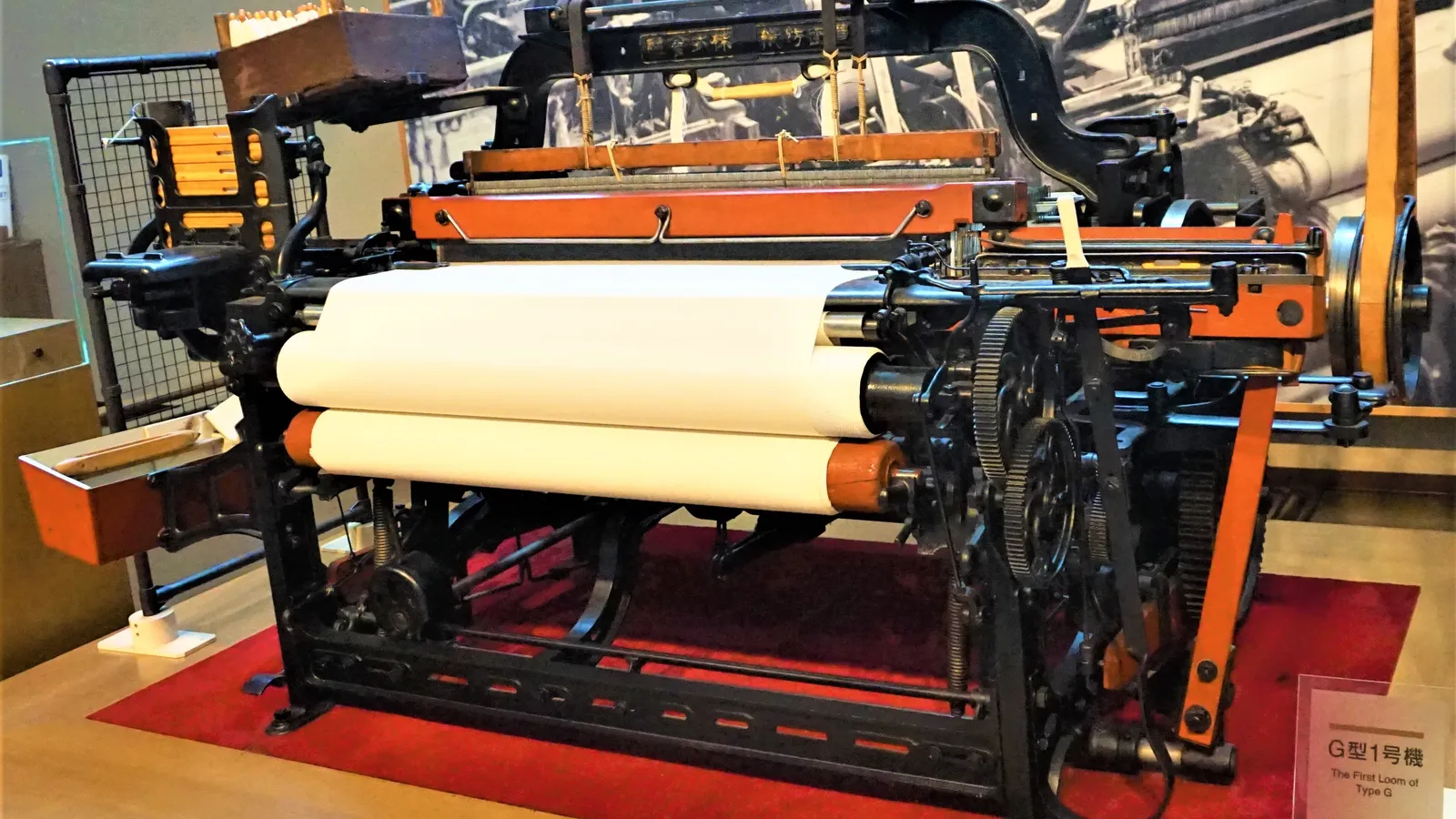
The Type G of 1924 could change shuttles and refill the weft thread while running at high speed, without slowing down (Toyota Commemorative Museum). The Japan Society of Mechanical Engineers lists it as Mechanical Engineering Heritage No. 16 and notes that it also stopped when a warp or weft yarn broke, combined 25 automation, protection, safety and cleaning mechanisms, and drew on more than 50 of Sakichi's inventions (JSME). The JSME says productivity rose at least 20 times.
The Type G made it possible for one factory worker to operate 30 to 50 looms at a time (Toyota Commemorative Museum). A machine that stops itself needs no one standing guard.
In 1929 his son Kiichiro Toyoda signed an agreement transferring the automatic loom patents to Platt Brothers of Britain for 100,000 pounds in four instalments, later cut to a total of 83,500 pounds (Toyota, 75-year history).
What is jidoka in the Toyota Production System?
Toyota describes jidoka as "automation with a human touch": when something goes wrong, the machine detects it and stops automatically, or a worker stops the line by pulling a stop cord (Toyota Production System). An andon board lights up to alert workers to the problem. Toyota names two benefits: defective products do not flow down the line, and problems, once clearly detected, can be prevented from recurring.
Notice the order: detect, stop, fix, prevent. The loom did not mend the thread; it simply refused to keep weaving bad cloth.
How can students use jidoka when practising problems?
Most of us race through a full exercise and check answers only at the end. A sign wrong in question 3 is probably wrong again in 7, 12 and 19: a long strip of faulty cloth, and the mistake practised several times.
Try a stop-cord rule instead:
Check your answer after each question, or each short block, not at the end of the paper.
When an answer is wrong, stop. Do not start the next question.
Find the broken thread: the first line where your working went wrong. Not "silly mistake", the exact step.
Fix that line and redo the whole question without looking at the solution.
Prevent a repeat: write one line in an error log saying what went wrong and what you will do instead. Read the log before your next session.
Only then move on.
A worked example
A ball is thrown straight up at 20 m/s. How long does it take to reach the top? Take g = 10 m/s².
Say you write v = u + at with a = +10 m/s². At the top v = 0, so 0 = 20 + 10t, and t = -2 s. A negative time is your andon light. Stop here.
The broken thread is the sign of a. With upward positive, gravity must be a = -10 m/s². Then 0 = 20 - 10t gives t = 2 s. Your log line: "Pick a positive direction first; anything pointing the other way gets a minus sign." The next three projectile questions now carry the fix instead of the fault.
If you cannot find the line where it went wrong, the Fermi Problem Library has worked problems with a step-by-step solver that explains the reasoning, so you can compare your working line by line.
For whole papers, see our guide on how to review an olympiad paper you did not clear. Next time you practise, pull the cord at the first wrong answer.