On this page
John Kay, born in 1704 at Walmersley near Bury in Lancashire, patented a "wheeled shuttle" for the hand loom in 1733, according to his biography on Wikipedia). It was a small change to one tool that shifted the pressure in the cloth trade from the loom to the spinning wheel.
How did John Kay's flying shuttle work?
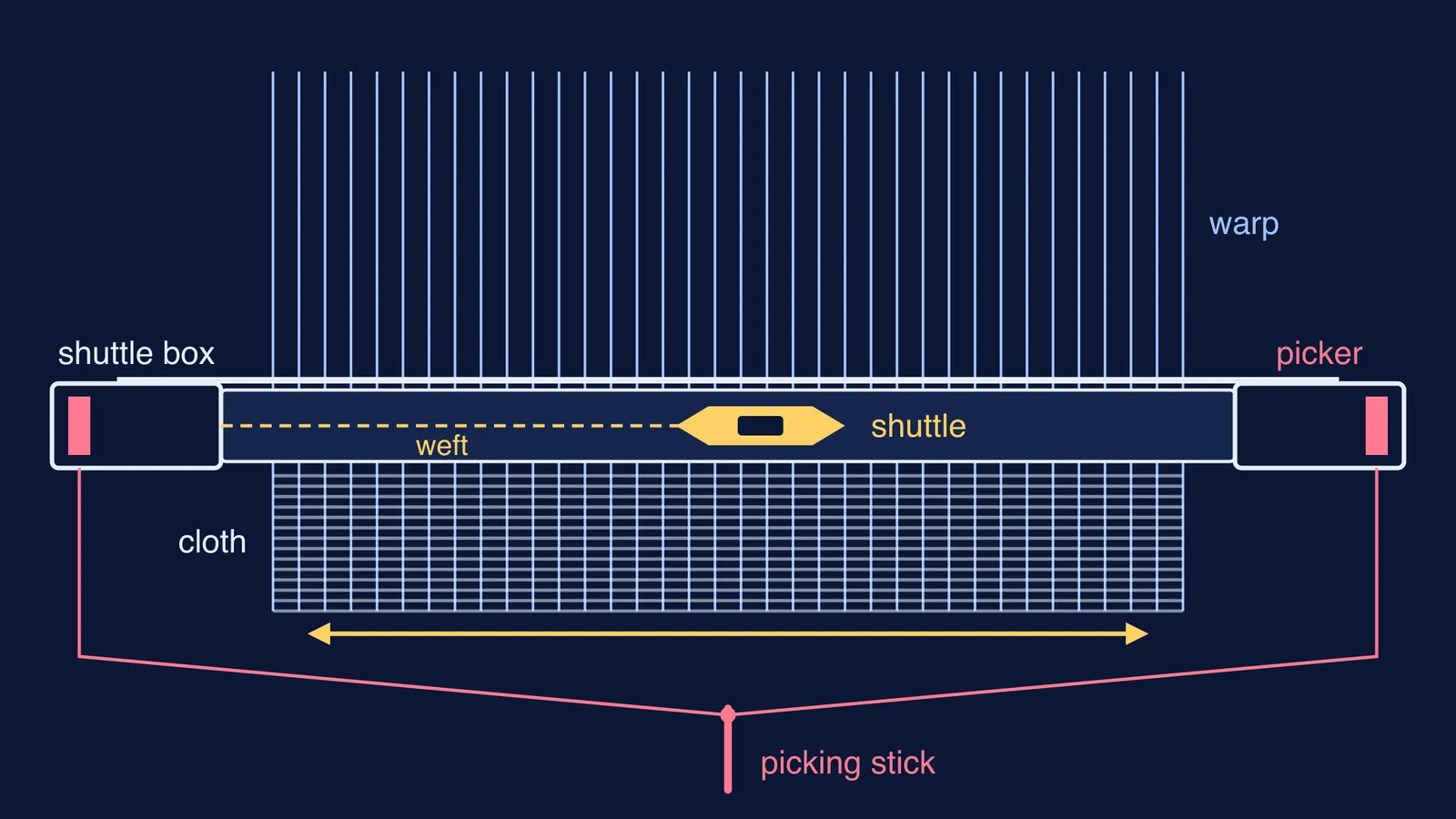
A loom stretches lengthwise threads, the warp, and the weaver passes a crosswise thread, the weft, over and under them. The Science Museum Group puts it simply: a shuttle carries the weft back and forth across a loom, weaving cloth as it passes over and under the warp threads.
Before Kay, the weaver threw the shuttle by hand. Weaving wide cloth required two operators working in tandem, one at each side, passing the shuttle between them.
Kay's version added three parts:
A race board: a smooth track along the front of the beater that the shuttle runs on.
Shuttle boxes: one at each end, to catch the shuttle and hold a picker that sends it back.
A picking stick: a handle with cords to both pickers, so one hand can fire the shuttle either way.
The historian Edward Baines described the weaver giving the cords "a slight and sudden pluck" with a peg held in the hand, as quoted by Spartacus Educational. Eighteenth-century shuttles of this type in the Science Museum Group collection are tipped with iron at both ends and run on rollers to reduce friction.
What changed for weavers after 1733?
The flying shuttle let one weaver work a broad loom alone, with no second worker needed to catch the shuttle. Kay's invention doubled weaving productivity without changing the rate at which thread could be spun).
Not everyone welcomed it. By September 1733, weavers in Colchester had petitioned the King to stop Kay's inventions. Kay moved to Leeds in 1738 to collect royalties, but manufacturers formed "The Shuttle Club" to pay the legal costs of anyone he sued, and the lawsuits nearly bankrupted him; he left for France in 1747 (Wikipedia)).
The shuttle still spread. One account says it had spread widely across English weaving districts by the 1750s. Richard Guest, writing in 1823, said it was not much used among cotton weavers until 1760, as quoted by Spartacus Educational.
Why did the flying shuttle create demand for faster spinning?
Cloth is only as fast as its slowest step. Weaving a piece needs a fixed amount of yarn, and spinning that yarn by hand was slow. In the home-based trade before spinning machines, it took up to three spinners to provide the yarn for one weaver; another account puts the figure at four.
Here is a worked example, taking the lower figure:
Say one weaver uses the yarn of 3 spinners.
The flying shuttle roughly doubles what that weaver produces.
Doubled cloth needs doubled yarn: 3 × 2 = 6 spinners' worth for the same weaver.
Spinning speed has not changed, so either three more spinners are found, or looms stand idle waiting for yarn.
That gap is what inventors went after. The flying shuttle, as the spinning jenny's history notes, had increased weavers' demand for yarn by doubling their productivity. James Hargreaves built the spinning jenny in 1764–1765 in Lancashire, and the first one had eight spindles.
Looms kept changing too. Decades later, the Jacquard loom used punched cards to control patterns, and on the raw-cotton side, Eli Whitney's cotton gin sped up separating cotton fibre from its seeds.
How can you use Kay's bottleneck idea when you study?
The lesson of 1733 is not "go faster". It is "find the slow step". Your study routine is a chain too: read, practise, check, fix mistakes, revise. Speeding up one link only helps if it was the one holding you back.
Try this one-week check:
Write down the steps you follow for one chapter, in order.
For a week, note roughly how long each step takes and where work piles up.
Pick the single step where things wait. That is your spinning wheel.
Fix only that step for the next week.
Check again. When one step gets faster, the strain moves to the next one, just as faster weaving moved it onto spinning.
If your slow step is understanding why a method fails, the Fermi Problem Library has worked problems with a step-by-step solver that explains the reasoning rather than printing an answer. If it is a concept you never quite got, such as impulse and momentum in the shuttle above, the Fermi Concept Library gives each concept its own lesson and its place in the map.
Next time you see a handloom at work, watch the shuttle and ask which step in the chain has to keep up.