On this page
In 1793, at Mulberry Grove, a plantation near Savannah, Georgia, owned by Catharine Greene, Eli Whitney built a machine that pulled cotton fibre off its seeds, according to the New Georgia Encyclopedia. Its effect was terrible: it made cotton so profitable that slavery in the United States expanded for nearly seventy years, until the Civil War.
What problem was the cotton gin solving?
The cotton that grew well inland in the American South, called upland or short-staple cotton, had green seeds that clung tightly to the fibres and had to be separated by hand, the New Georgia Encyclopedia explains. That made it hard to grow at a profit.
The National Park Service notes that each enslaved worker forced to pick out seeds by hand could clean only about one pound of cotton a day.
How did Eli Whitney's cotton gin work?
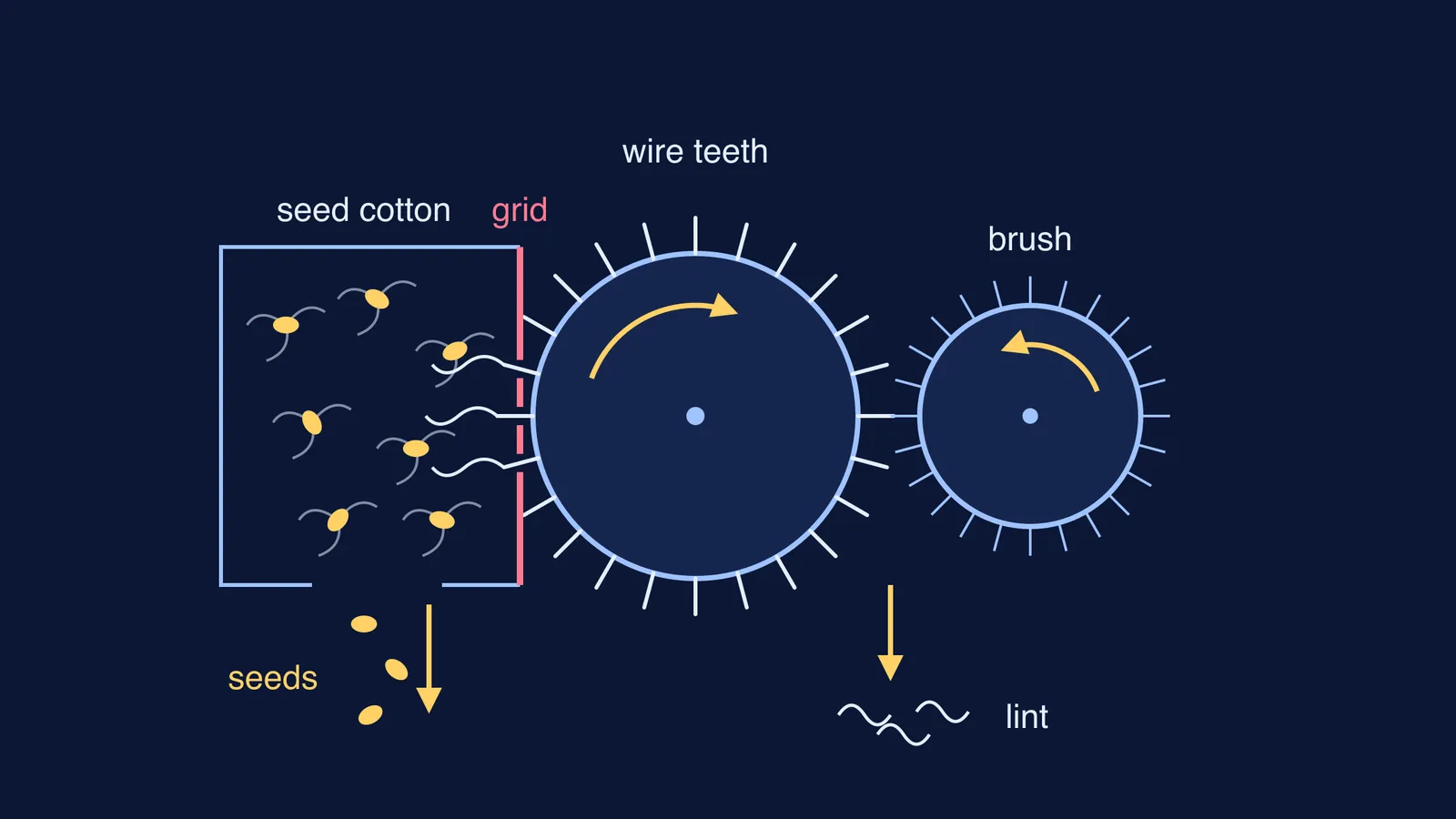
The New Georgia Encyclopedia's entry on cotton gins describes wire teeth on a cranked cylinder that pulled fibre through small grates, with a rotating brush clearing lint off the teeth to avoid jams. Step by step:
Seed cotton goes into a hopper on one side of a grid of closely spaced bars.
A wooden cylinder studded with wire teeth turns just behind the grid, with its teeth poking through the gaps.
The teeth hook the fibres and drag them through the gaps.
The seeds are too big to fit through, so they are held back and fall away.
A second cylinder with brushes, turning in the opposite direction, wipes the lint off the teeth.
A small gin could be turned by hand, and larger ones could be driven by a horse or by water power, says the US National Archives. Whitney received his patent on 14 March 1794, according to the National Archives' Prologue magazine. Other makers quickly replaced the wire teeth with a series of circular saws, the design known as the saw gin (New Georgia Encyclopedia).
How much faster was the gin? A worked example
The National Park Service says a hand-cranked gin could remove the seeds from fifty pounds of cotton in a day, against about one pound by hand.
Planters produced 48 million pounds of cotton in 1801, against just 2 million pounds a decade earlier, says the New Georgia Encyclopedia. Here is a rough calculation using those figures:
By hand: 48,000,000 pounds at 1 pound per person per day = 48 million person-days, or about 131,500 people working every day of the year.
With gins: 48,000,000 pounds at 50 pounds per gin per day = 960,000 gin-days, or about 2,600 gins running all year.
Real gins did not run every day, so this is only a rough estimate. Still, it shows why upland cotton suddenly paid.
How did the cotton gin lead to the growth of slavery?
The gin cut the labour of removing seeds, but not the number of enslaved labourers needed to grow and pick the cotton (New Georgia Encyclopedia). The National Park Service adds that the gin made cotton so profitable that planters needed more labourers to plant and harvest it. In the American South, those labourers were enslaved people.
According to the New Georgia Encyclopedia, southern cotton output passed one billion pounds a year by the eve of the Civil War. The census numbers show the human cost. The enslaved population counted in the US census was 697,681 in 1790 and 3,953,760 in 1860 (NCpedia table of US census data).
The US National Archives lists more of the change. There were six slave states in 1790 and 15 in 1860. Southerners imported 80,000 Africans between 1790 and 1808, when Congress banned the slave trade from Africa. By 1860, about one in three Southerners was enslaved.
Whitney gained little: illegal copies spread across the South before his own gins arrived, and although he had as many as 60 lawsuits pending at one time, he won few (New Georgia Encyclopedia). In a letter to his father, quoted by the National Archives, he wrote: "One man and a horse will do more than fifty men with the old machines." The letter counts the labour the machine saved, not the labour it would create in the fields.
How can you study an invention like the cotton gin?
These four questions work for almost any invention:
Bottleneck: What step was slow or expensive? Here, removing seeds by hand.
Mechanism: Which physical difference does the machine use? Here, the difference in size between a fibre and a seed.
Scale: What changed in the numbers? Here, 1 pound a day by hand against 50 with a gin, and cotton output rising 24 times in ten years (New Georgia Encyclopedia).
Who paid: Which work grew because of the machine, and who was made to do it?
If moving parts are hard to picture from text, the Fermi Simulation Lab has interactive simulations for ideas that are easier to see than to read.
Next, read why black soil suits cotton, or two other textile machines: how the Jacquard loom's punched cards inspired the first computer and why Elias Howe put the needle's eye at the point.