

On this page
Before the 1840s, inventors trying to build a sewing machine made a common engineering mistake: they tried to build a mechanical human hand. A hand-sewer uses a needle with the eye at the blunt end. They push the point through the fabric, let go of the needle, catch it on the other side, and pull the entire length of thread out.
This works beautifully for a person, but it is a nightmare to mechanise. A machine pulling a long, loose thread constantly tangles. If the machine instead holds the thread taut, it can only sew with very short pieces of thread, requiring constant re-threading. For decades, early sewing machines failed because they could not escape the assumption that a needle must pass completely through the cloth.
Why did Elias Howe put the needle's eye at the point?
To make mechanical sewing continuous, the needle could not pass all the way through the cloth. It had to pierce the fabric, drop a segment of thread, and come straight back out.
On September 10, 1846, Elias Howe was granted U.S. Patent No. 4,750 for a machine that solved this by inverting the tool. He moved the eye away from the blunt end and placed it at the very tip. In his patent specification, he described the eye as being within "a small distance—say, an eighth of an inch—of its inner or pointed end."
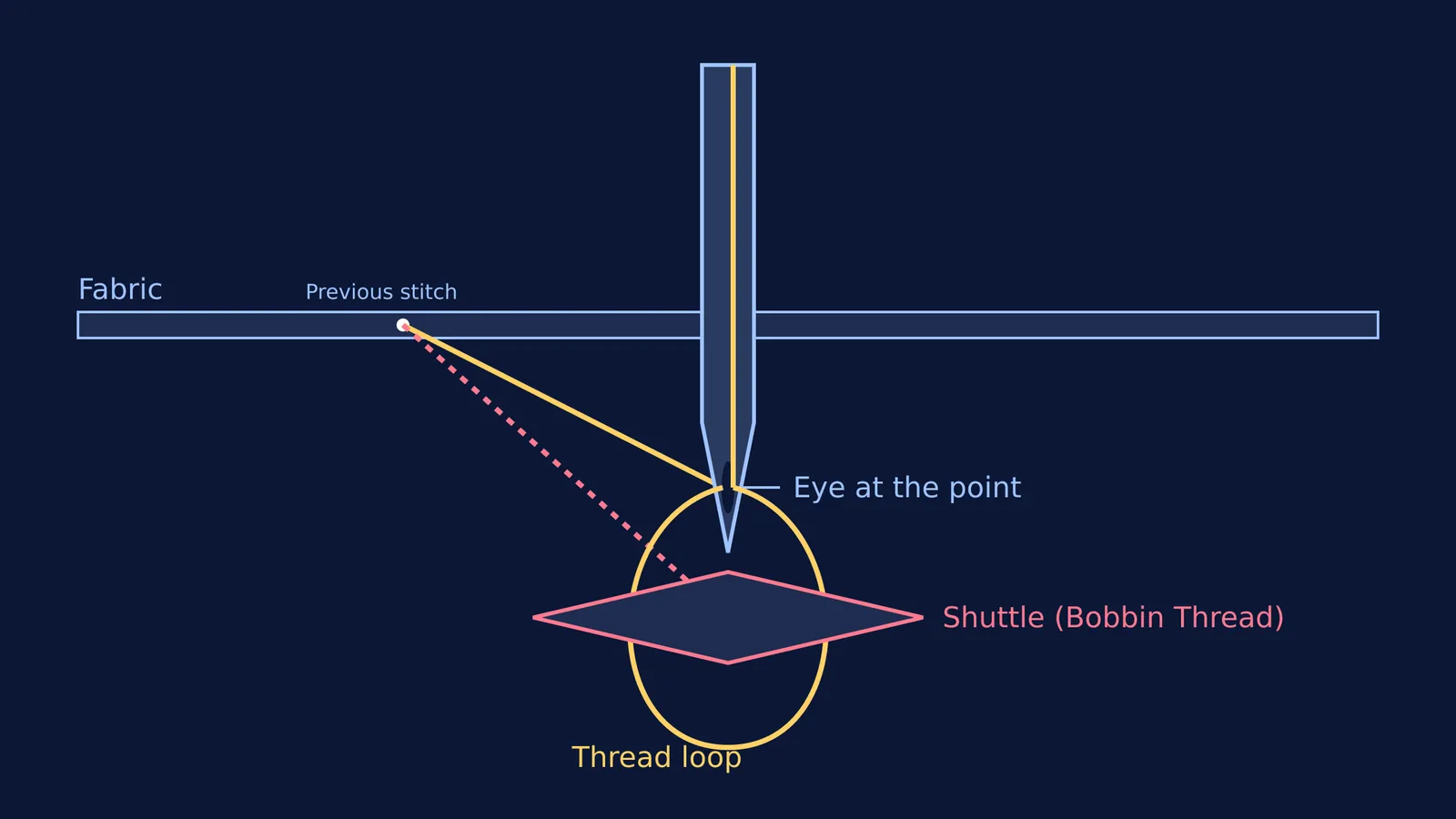
Because the eye was at the tip, the machine did not have to pull the entire spool of thread. Instead, it pushed only a small loop of thread through the fabric, while the rest of the spool stayed above.
How does a lockstitch machine work?
Howe's eye-pointed needle was only half the solution. A loop pushed through the fabric will just pull right back out when the needle retracts unless something catches it. Howe's machine used two separate threads to form a "lockstitch".
The pierce: The curved, grooved needle pushes the top thread through the cloth. A groove along the side of the needle protects the thread from the friction of the tight fabric on the way down.
The loop: When the needle reaches its lowest point and begins to rise, the thread rubs against the cloth. This friction causes the thread to bow outward, forming a small open loop below the cloth.
The shuttle: A small boat-shaped shuttle, carrying a second spool of thread (the bobbin), passes straight through this open loop. The timing must be perfect, as the shuttle darts through the gap in a fraction of a second.
The lock: When the needle pulls all the way up, it tightens the loop, locking the two threads together tightly in the middle of the fabric.
If you are studying mechanics or physics and find it hard to picture how moving parts like these interact, the Fermi Simulation Lab provides interactive simulations for ideas easier to see than read. You can watch a mechanism step by step to understand the timing of the gears and shuttles.
What happened to Elias Howe after the 1846 patent?
Despite the brilliance of the eye-pointed needle and the lockstitch, Howe's machine was not an immediate commercial success. It was extremely expensive for its time and faced fierce resistance from professional tailors who feared a machine that could outpace them.
Howe travelled to England to find investors, but upon returning to the United States, he found that other inventors had begun copying his design. The most famous of these was Isaac Singer, who built a highly successful machine that relied entirely on Howe's patented eye-pointed needle.
Howe launched a series of patent infringement lawsuits that became known as the Sewing Machine War. Because his patent clearly covered the fundamental mechanism of the needle, the courts eventually ruled in his favour.
This agreement meant that anyone building a lockstitch machine had to pay Howe a royalty, ultimately making him one of the wealthiest inventors of his era.
A framework for overcoming engineering bottlenecks
Howe's breakthrough is a classic example of overcoming a design bottleneck by challenging basic assumptions. The history of technology is full of these shifts. Just as Otto Wichterle and the soft contact lens spun from a gel moved away from rigid glass, and Denis Papin and the pressure cooker of the 1600s reimagined the boiling pot by trapping steam, Howe had to completely rethink the needle.
When you are stuck on a difficult physics or engineering problem, try this checklist to find your hidden assumptions:
Are we copying a manual method? (Hand sewing requires pulling the whole thread; machines do not).
What is the fundamental physical constraint? (To lock a stitch securely, you must either pass the entire spool through the fabric, or use two spools and pass one through a loop of the other).
Can we invert the tool? (Move the eye from the back of the needle to the front).
By stopping the machine from acting like a human, Elias Howe created a stitch that a human hand could never replicate. His needle, with its eye at the point, remains the fundamental component of almost every mechanical sewing machine built since 1846, building the foundation of the modern garment industry.


