On this page
NASA's Perseverance rover landed in Jezero crater on Mars in February 2021 carrying working microphones. A year later, Sylvestre Maurice and colleagues published what those microphones heard in Nature (2022) (free full text on PubMed Central). Sound on Mars is slower than on Earth, it fades much faster, and it travels at two different speeds depending on pitch. All three results follow from formulas you already use for JEE and NEET: v = √(γRT/M) and the idea of acoustic impedance.
Is there sound on Mars at all?
Yes. Sound needs a medium, and Mars has one: a thin atmosphere that is about 95% carbon dioxide. At Jezero the pressure is about 0.6 kPa, roughly 1/170 of Earth's 101 kPa, and during one recording the air 1.45 m above the ground was between 232 K and 240 K (both figures from the Maurice et al. paper). Thin air still carries sound; only a near-vacuum cannot. Why space itself is silent is covered in why there is no sound in space, so this post starts where that one stops.
How fast does sound travel on Mars?
For an ideal gas the speed of sound is v = √(γRT/M), where γ = Cp/Cv, R = 8.314 J/mol K, T is the temperature in kelvin and M is the molar mass in kg/mol. Pressure does not appear: in an ideal gas, lowering the pressure lowers the density in the same proportion.
Two things slow sound on Mars. The air is cold, and the main gas, CO₂ (M = 0.044 kg/mol), is about 1.5 times heavier per mole than Earth air (0.029 kg/mol). How v grows as √T in ordinary air is worked in how temperature and humidity change the speed of sound. The other input is γ, which for CO₂ is not a simple textbook fraction. If you want to see how γ is read back from a measured speed, see finding gamma from the speed of sound.
Worked example: the speed and loudness of sound on Mars
Take pure CO₂ at 240 K and 610 Pa. The molar heat capacity of CO₂ is about 37 J/mol K at room temperature and falls to roughly 34.3 J/mol K at 240 K (approximate; tables differ slightly), because fewer molecules are vibrating in the cold.
Find γ. Cv = Cp − R = 34.3 − 8.314 = 26.0 J/mol K. So γ = 34.3/26.0 ≈ 1.32.
Find v. v = √(1.32 × 8.314 × 240 / 0.044) ≈ 245 m/s. Units: (J/mol K × K)/(kg/mol) = J/kg = m²/s², so the square root is in m/s.
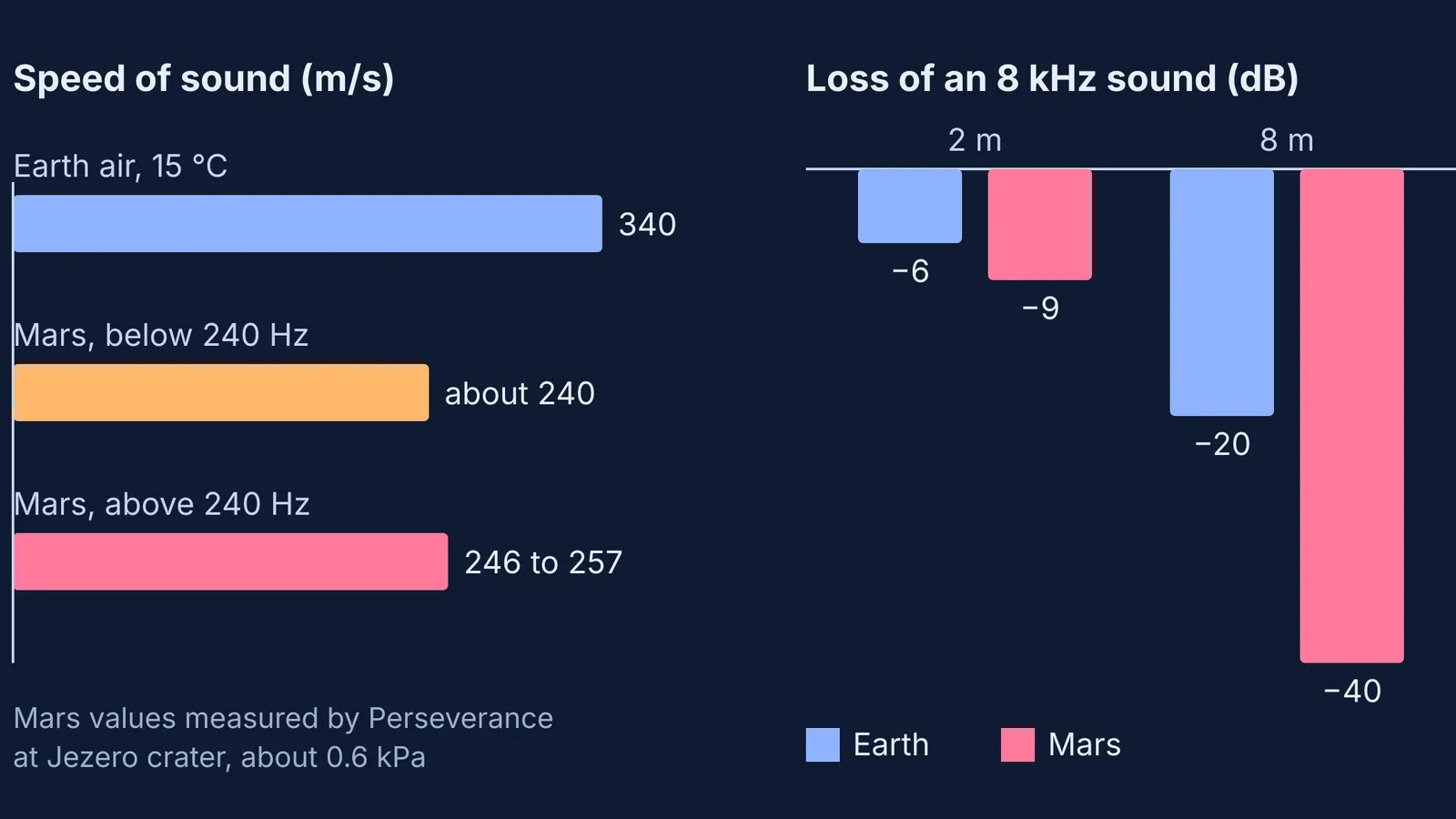
Compare with Earth. Air at 15 °C with γ = 1.4 and M = 0.029 kg/mol gives about 340 m/s. A shout across 100 m takes 100/245 ≈ 0.41 s on Mars and 100/340 ≈ 0.29 s on Earth.
Check against the measurement. Perseverance timed the hum of the Ingenuity helicopter, at 84 Hz, and found 237.7 ± 3 m/s. Our 245 m/s is close; the real air is slightly colder near the ground and is not pure CO₂.
Find the density. ρ = pM/RT = 610 × 0.044 / (8.314 × 240) ≈ 0.0135 kg/m³, about 1/90 of Earth's 1.225 kg/m³.
Find the acoustic impedance. Z = ρv = 0.0135 × 245 ≈ 3.3 kg/m² s on Mars, against 1.225 × 340 ≈ 417 kg/m² s on Earth, a ratio of about 127.
Turn it into decibels. A loudspeaker cone vibrating at the same speed u sends out intensity I = ½Zu², so the intensity on Mars is about 127 times smaller: 10 log₁₀(127) ≈ 21 dB quieter.
The paper did the same estimate with ρ = 0.02 kg/m³ and c = 238 m/s, getting Z = 4.76 kg/m² s on Mars against 413 on Earth, and concluded that sounds from the same source are roughly 20 dB weaker on Mars. Our 21 dB agrees. The exact number depends on what you hold fixed (the cone's motion, the power fed in, or the pressure), so treat "about 20 dB" as the answer.
Why do high notes travel faster on Mars?
This is the result nobody had measured before. Perseverance found two speeds about 10 m/s apart, one below and one above roughly 240 Hz. Low sounds such as the helicopter hum went at about 240 m/s. The sharp clicks of the rover's rock-zapping laser, which are rich in higher frequencies, gave 246 to 257 m/s in the daytime.
The cause is how CO₂ stores energy. A sound wave squeezes and stretches the gas. Some of that energy goes into making the molecules vibrate, but a molecule only gains or loses vibration in a collision, and that takes time.
Slow squeezes (low notes). The vibrations keep up. CO₂ behaves as a gas with many ways to store energy, γ is about 1.3 and v is about 240 m/s.
Fast squeezes (high notes). The vibrations cannot follow. The gas acts as if it had only translation and rotation, so γ moves towards 1.4. With γ = 1.4 at 240 K, v = √(1.4 × 8.314 × 240 / 0.044) ≈ 252 m/s.
The switch-over frequency depends on how often molecules collide, which is proportional to pressure. The paper gives about 240 Hz at 0.6 kPa. Earth's air is at about 170 times the pressure, so its molecules collide far more often and the same effect sits far above the range of hearing, which is why you never hear it at home. On Mars it falls in the middle of the audible range, so a voice's low and high parts would arrive at slightly different times over a long distance.
Why does sound fade so fast on Mars?
The quietness from impedance is only half the story. Sound also loses energy as it travels, and on Mars high pitches lose it quickly. The paper reports that an 8 kHz sound drops by 9 dB at 2 m and 40 dB at 8 m on Mars, against 6 dB and 20 dB on Earth. The same CO₂ relaxation that splits the speed also soaks up energy from each wave, and thin air makes it worse. So a friend talking on Mars would sound muffled as well as faint, with the hiss of "s" sounds disappearing first.
If you want to watch how frequency, wavelength and speed fit together before tackling these numbers, the Simulation Lab has interactive wave simulations you can adjust.
Quick checklist
Sound does travel on Mars: thin CO₂ air at about 0.6 kPa still carries it.
v = √(γRT/M); pressure cancels out, so low pressure alone does not slow sound.
Cold air and heavy CO₂ give about 240 m/s, against 340 m/s on Earth.
Low notes (below about 240 Hz) go at about 240 m/s; high notes at about 250 m/s, because CO₂'s vibrations cannot keep up.
Z = ρv is about 100 times smaller on Mars, so the same source is about 20 dB quieter.
High pitches fade fastest: 40 dB lost over 8 m at 8 kHz on Mars.