

On this page
If you have ever watched a science fiction film, you might have noticed that explosions in space are completely silent. This is not just a cinematic choice; it is a fundamental rule of physics taught in the Class 9 science syllabus.
What is a mechanical wave?
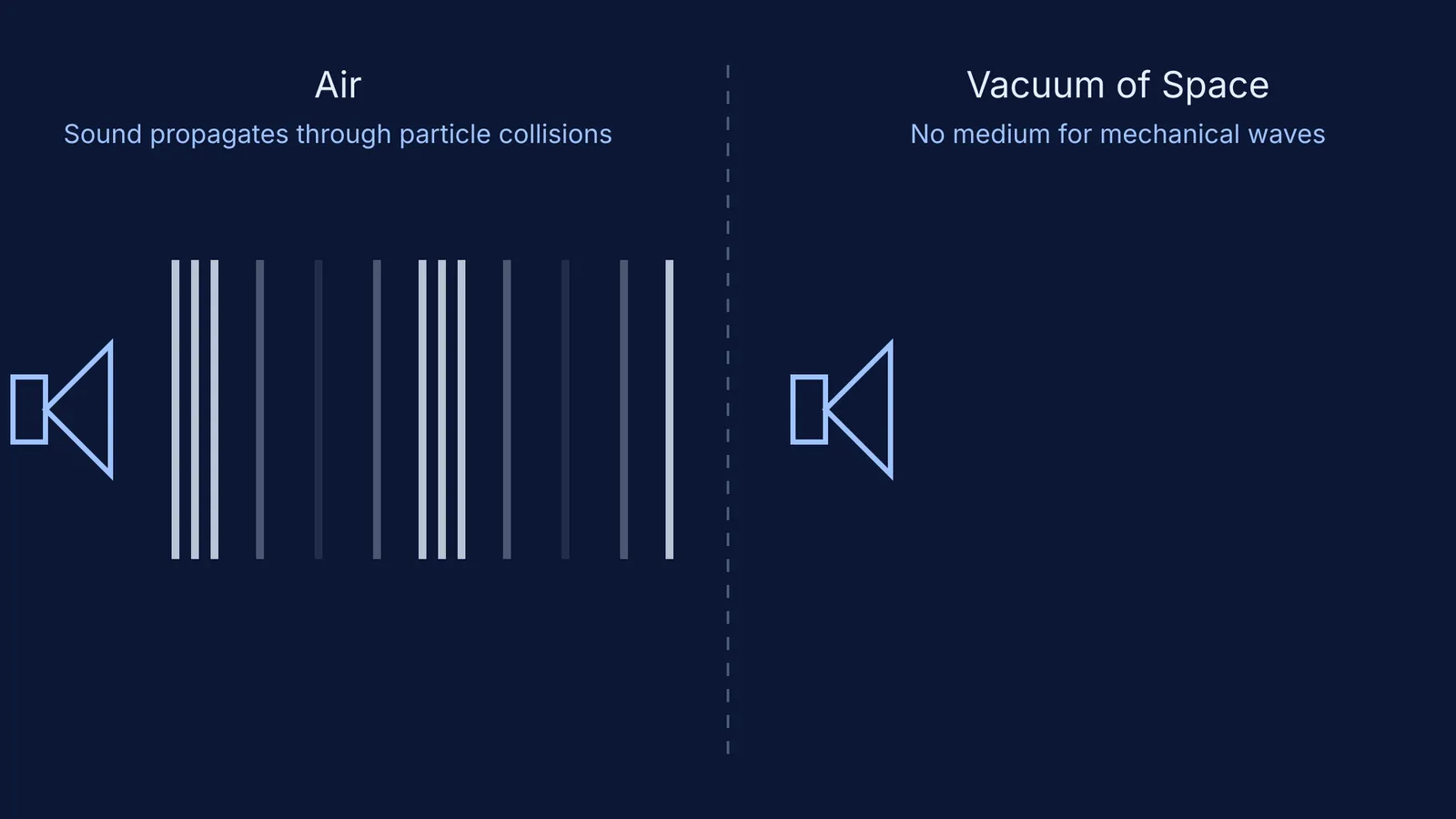
Sound is a mechanical wave. This means it travels by forcing particles of a medium—like a solid, liquid, or gas—to vibrate. When you speak, your vocal cords push against the air molecules in your throat. These molecules bump into their neighbours, which bump into the next set of molecules, creating a chain reaction called a longitudinal wave.
As the wave moves, it creates regions of high pressure (compressions) and low pressure (rarefactions). If you want to understand the mathematics behind this, you can read our guide to displacement and pressure waves. Because this entire process relies on particles colliding, sound cannot travel if there is nothing to collide with.
The speed of sound also depends entirely on how closely packed these particles are. In a dense solid like steel, sound travels at nearly 5,930 metres per second because the atoms are tightly bound (Wikipedia). In water, it travels at about 1,481 metres per second. In the air we breathe, it slows down to just 343 metres per second.
Why can there be no sound in space?
Space is essentially a vacuum, meaning it is incredibly empty. To understand the difference, consider the air around you. At sea level on Earth, there are roughly 2.69 × 10²⁵ particles in every cubic metre of air (Wikipedia).
By contrast, the average density of the interstellar medium is just one million particles per cubic metre (Wikipedia). That is about one particle per cubic centimetre. With the molecules spread so far apart, they almost never bump into each other. Without these collisions, the mechanical wave cannot propagate, and sound simply stops.
If you find it hard to picture how density affects wave propagation, the Fermi Simulation Lab provides interactive simulations for the ideas that are easier to see than to read.
What about other planets like Mars?
It is a common misconception that all of space is exactly the same. While deep interstellar space is a near-perfect vacuum, the space immediately surrounding planets often contains an atmosphere.
For example, Mars has a thin atmosphere composed mostly of carbon dioxide, where the particle density is far lower than on Earth. Because the density is so low, sound behaves very differently there. If you were to shout on Mars, the sound would barely travel, and the lower density would muffle high-pitched noises, making everything sound deep and quiet. On the Moon, which has virtually no atmosphere at all, it is completely silent.
How did scientists prove sound needs a medium?
Long before humans travelled to space, scientists proved this principle using the bell jar experiment, a classic demonstration in the Class 9 NCERT curriculum.
An electric bell is suspended inside a sealed glass jar, and a vacuum pump slowly extracts the air. When the jar is full of air, you can hear the bell clearly. As the pump removes the air, the sound becomes fainter, even though the bell's hammer is still visibly striking the gong. Once the jar is nearly empty, the sound vanishes entirely.
This simple experiment mirrors what happens as you leave Earth's atmosphere. As an object ascends into higher altitudes, the air pressure drops steadily. The particles become sparser, meaning any sound produced would become quieter and more muffled. By the time an object reaches the Kármán line, the widely accepted boundary of space located 100 kilometres above sea level (Wikipedia), the air is so thin that conventional sound transmission is entirely impossible. The bell jar effectively brings this extreme high-altitude environment into a controlled laboratory setting.
How do astronauts talk in space?
If sound cannot travel through the vacuum of space, how do astronauts communicate with Earth? They use radio waves.
Radio waves are a type of electromagnetic wave, much like visible light or X-rays. Unlike mechanical waves, electromagnetic waves do not need a material medium to travel; they can propagate perfectly well through a vacuum. Just as we can track light entering glass from empty space, astronauts' headsets convert their voices into radio signals. These signals are beamed across the void and converted back into sound inside the pressurised, air-filled cabins of their spaceships.


