

On this page
If you know the speed of sound through an unknown gas, you hold the key to identifying its molecular structure. Sound waves rely on the collisions between molecules to travel, meaning their speed depends on the gas's mass and how it stores heat.
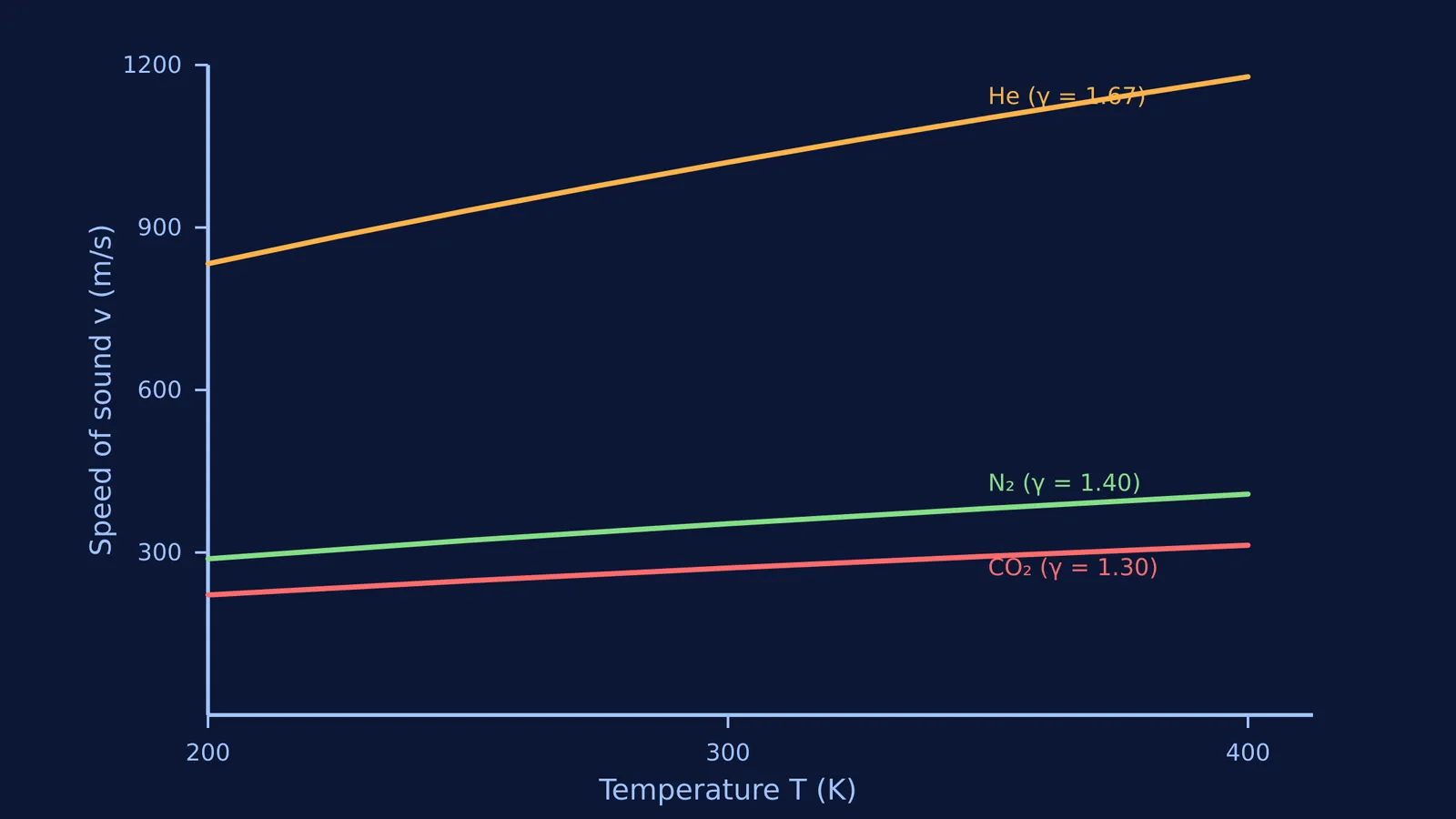
According to OpenStax University Physics, the speed of sound in an ideal gas is determined by v = √(γRT / M). Here, v is the speed of sound, R is the universal gas constant (8.314 J/(mol K)), T is the absolute temperature in Kelvin, and M is the molar mass in kg/mol. The final variable, γ (gamma), is the heat capacity ratio (Cp/Cv).
Because γ is linked to the degrees of freedom a molecule has, it acts as a structural fingerprint for the gas, according to its heat capacity ratio:
Monatomic gases (like helium and argon) have a γ of about 1.67.
Diatomic gases (like nitrogen and oxygen) have a γ of about 1.40.
Polyatomic gases (like carbon dioxide) have a γ of about 1.30.
How to find gamma from the speed of sound?
If you measure the speed of sound in a lab, you can rearrange the formula to find γ.
Square both sides of the equation: v² = γRT / M
Multiply by M and divide by RT: γ = Mv² / RT
Let's test this with the air around us. At 20 °C (293.15 K), the speed of sound in dry air is about 343 m/s, according to its standard measured properties. We know the average molar mass of a gas mixture for air is roughly 0.02896 kg/mol.
Plugging those numbers in: γ = (0.02896 × 343²) / (8.314 × 293.15) γ = (0.02896 × 117649) / 2437.2 = 1.398
This calculation rounds beautifully to 1.40, confirming that air behaves as a diatomic gas.
Is the gas monatomic or diatomic?
Imagine you are handed an unknown gas with a molar mass of 0.004 kg/mol. At 300 K, you measure its speed of sound to be 1019 m/s. Which category does it fall into?
Using the rearranged formula: γ = (0.004 × 10¹⁹²) / (8.314 × 300) γ = (0.004 × 1038361) / 2494.2 = 1.665
Because 1.665 is extremely close to 1.67, you can confidently identify this as a monatomic gas (which, given the molar mass, is helium).
Why do lighter gases carry sound faster?
Looking back at the formula v = √(γRT / M), the molar mass M is in the denominator. This tells us that, at a given temperature, sound travels faster through lighter gases and slower through heavier ones.
Helium (0.004 kg/mol) is much lighter than nitrogen (0.028 kg/mol). Even though helium's monatomic γ (1.67) is slightly higher than nitrogen's diatomic γ (1.40), the tiny mass of the helium atom dominates the calculation. A sound wave passing through helium at room temperature moves at over 1000 m/s — roughly three times the speed of sound in air.
This mass difference is why inhaling a harmless balloon of helium makes a person's voice sound incredibly high-pitched. The shape of the vocal tract stays the same, but because sound travels so much faster through the helium, the resonant frequencies of the voice increase drastically.
A checklist for speed of sound problems
If you are facing a question that asks you to find γ or identify a gas from the speed of sound, run through this checklist to avoid common calculation mistakes:
Check your temperature units: The formula requires absolute temperature. If the problem gives you 27 °C, immediately add 273.15 to convert it to 300.15 K.
Convert molar mass to kilograms: Standard chemistry problems often use grams per mole (g/mol). For the physics formula to output meters per second (m/s), M must be in kg/mol. Oxygen is 32 g/mol, which must be entered as 0.032 kg/mol.
Use the correct gas constant: Use R = 8.314 J/(mol K), not the atmosphere-litre version (0.0821).
Isolate before calculating: Rearrange the formula to γ = Mv² / RT algebraically before plugging in any messy decimals.
Sanity check the final number: Your calculated γ must fall roughly between 1.30 and 1.67. If you get 14.0 or 0.14, double-check your powers of ten.
Thermodynamics formulas are easy to mix up if you just memorise them without seeing the connections. If you get stuck applying them, the Fermi Problem Library has worked problems with a step-by-step solver that explains the reasoning rather than printing an answer, so you understand exactly why v or γ changes.


