On this page
The NMC's NEET (UG) 2026 syllabus lists respiration under Unit 4, Plant Physiology. Every rule and exception below comes from Chapter 12 (Respiration in Plants) of NCERT's Class 11 Biology textbook (Reprint 2026-27), with its section. We wrote all 12 questions; none is a past-paper item or prediction.
What are the NCERT exceptions in Respiration in Plants?
Animals have special organs for gas exchange. Exception: plants have none; stomata and lenticels do the job (12.1).
Each living plant cell lies close to the surface. Apparent exception: thick woody stems; NCERT answers that their living cells form thin layers under the bark, while the interior cells are dead and give only mechanical support (12.1).
Respiring cells must get O₂ by diffusion. Exception: in photosynthesising cells, O₂ is released inside the cell itself (12.1).
Carbohydrates are the usual respiratory substrate. Exception: proteins, fats and even organic acids in some plants, under certain conditions (chapter opening).
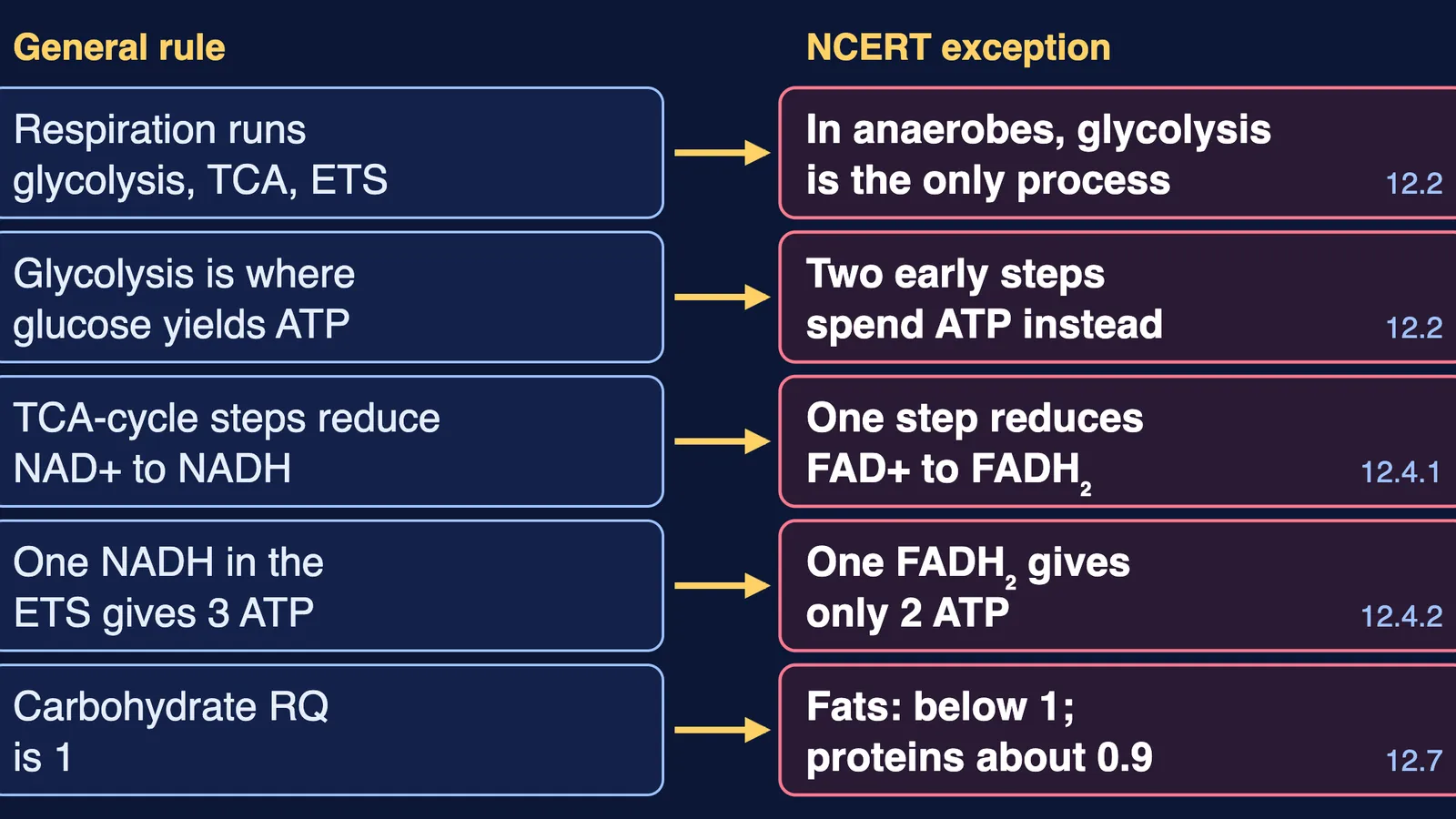
Respiration runs glycolysis, then the TCA cycle and ETS. Exception: in anaerobic organisms, glycolysis is the only process (12.2).
Glycolysis is where glucose yields ATP. Exception: two steps use ATP: phosphorylating glucose, and turning fructose-6-phosphate into its 1,6-bisphosphate (12.2).
Glucose is what enters glycolysis. Exception: sucrose is first split by invertase, and fructose enters too, sharing all later steps (12.2).
Yeast turns pyruvic acid into ethanol and CO₂. Exception: some bacteria, and muscle cells short of oxygen during exercise, make lactic acid (12.3).
TCA-cycle oxidations reduce NAD⁺. Exception: at one point FAD⁺ is reduced to FADH₂ (12.4.1).
One NADH oxidised in the ETS gives 3 ATP. Exception: one FADH₂ gives 2 (12.4.2).
Substrates enter respiration at its first step. Exception: fatty acids join as acetyl CoA, glycerol after becoming PGAL, and amino acids inside the Krebs' cycle or as pyruvate or acetyl CoA (12.6).
Fully oxidised carbohydrate gives an RQ of 1. Exception: fats give less than 1 (0.7 for tripalmitin) and proteins about 0.9 (12.7).
How do you handle odd-one-out and exception questions?
First name the property the four items might share: place, product, coenzyme or number. Test each item against it in one line. If two items fail, the property is wrong; pick another. For "NOT an exception" stems, restate the rule in your own words, then find the option that obeys it.
Odd-one-out questions
Q1. Judged by release of CO₂, which step is the odd one out? (1) Pyruvic acid to acetyl CoA (2) Isocitrate to α-ketoglutaric acid (3) α-ketoglutaric acid to succinyl-CoA (4) Succinyl-CoA to succinic acid
Answer: (4). It makes GTP; the other three are decarboxylations (12.4, 12.4.1).
Q2. Judged by role in NCERT's anaerobic routes from pyruvic acid, which enzyme is the odd one out? (1) Pyruvic acid decarboxylase (2) Alcohol dehydrogenase (3) Lactate dehydrogenase (4) Pyruvic dehydrogenase
Answer: (4). It forms acetyl CoA in the matrix, the aerobic route (12.3, 12.4).
Q3. Judged by entering through a glycolytic compound, which is the odd one out? (1) Fructose (2) Glycerol (3) Glucose (4) Fatty acids
Answer: (4). Fatty acids are degraded to acetyl CoA; glycerol becomes PGAL (12.2, 12.6).
Q4. Judged by RQ on complete oxidation, which substrate is the odd one out? (1) Glucose (2) Sucrose (3) Starch (4) A protein
Answer: (4). Carbohydrates give 1; proteins about 0.9 (12.7).
Which is NOT an exception?
Q5. NCERT says respiratory substrates are usually carbohydrates. Which is NOT one of the exceptions it names? (1) Proteins (2) Fats (3) Organic acids in some plants (4) Sucrose
Answer: (4). Sucrose is a carbohydrate (chapter opening, 12.2).
Q6. Aerobic respiration needs oxygen. Which of these is NOT an exception, that is, does use O₂? (1) Glycolysis (2) Alcoholic fermentation in yeast (3) Lactic acid formation in oxygen-short muscle (4) The last step of the ETS
Answer: (4). Oxygen acts only at the terminal stage, as the final hydrogen acceptor (12.4.2).
Q7. Rule: pyruvic acid is completely oxidised to CO₂ and water. Which case is NOT an exception? (1) Yeast in anaerobic conditions (2) Some bacteria making lactic acid (3) Muscle cells during exercise when oxygen is inadequate (4) A photosynthesising leaf cell, with O₂ released inside it
Answer: (4). O₂ is on hand there; the other three ferment (12.1, 12.3).
Two-statement and single-correct questions
Codes for Q8 to Q10: (1) Both correct (2) Only I correct (3) Only II correct (4) Neither correct.
Q8. I: Glycolysis runs in every living organism, obligate anaerobes included. II: Plant parts exchange large volumes of gas only while photosynthesising.
Answer: (1). NCERT says glycolysis is present in all living organisms, and that big gas exchanges happen only during photosynthesis (12.1, 12.2).
Q9. I: The interior cells of a thick woody stem respire actively. II: Photosynthesising cells have O₂ released within them.
Answer: (3). Those interior cells are dead (12.1).
Q10. I: In one TCA turn, NAD⁺ is reduced at three points and FAD⁺ at one. II: Pure fats are common respiratory substrates.
Answer: (2). NCERT says pure proteins or fats are never used (12.4.1, 12.7).
Q11. Which rule-exception pair matches NCERT? (1) Glycolysis is mitochondrial, except in anaerobes (2) NADH gives 3 ATP; FADH₂ gives 2 (3) Carbohydrate RQ is 1; fats give more than 1 (4) Respiration is catabolic except during fatty acid breakdown
Answer: (2). Glycolysis is cytoplasmic, fat RQ is below 1, and acetyl CoA is withdrawn to build fatty acids, making the pathway amphibolic (12.2, 12.4.2, 12.6, 12.7).
Q12. One turn of the TCA cycle, from acetyl CoA back to OAA, reduces NAD⁺ at three points and FAD⁺ at one. Using NCERT's figures, how many ATP does the ETS make from that turn's NADH + H⁺ and FADH₂ alone (leave out the GTP step)? (1) 9 (2) 11 (3) 12 (4) 14
Answer: (2). 3 NADH × 3 + 1 FADH₂ × 2 = 11; 12 wrongly adds the GTP-linked ATP, 14 adds the NADH from pyruvic acid to acetyl CoA (12.4.1, 12.4.2).
What should you do with your misses?
Missed Q1, Q10 or Q12: redraw the TCA cycle, marking each coenzyme and its ATP value. Missed Q3 to Q5 or Q11: list each food type's entry point and RQ. Missed Q6 to Q9: reread 12.1 to 12.3. More practice: respiration statement and match-the-list set, the respiration diagram-based questions, or the Respiration in Plants Class 11 notes.
Not sure which exceptions you keep forgetting? Fermi's AI tutor works out what you already know and builds a plan for the session.