On this page
This sheet collects every definition and counting result in Chapter 1 of the NCERT Class 12 Mathematics Part I textbook, Relations and Functions (Reprint 2026-27). Each group ends with a worked example and one mistake to watch for. For proof layouts and step marks, use our Relations and functions Class 12 board exam guide.
What does the 2026-27 syllabus cover in this chapter?
The CBSE Mathematics curriculum for 2026-27 lists two topics for this chapter: types of relations (reflexive, symmetric, transitive and equivalence) and one to one and onto functions. In the same document, Unit I (this chapter plus inverse trigonometric functions) carries 8 of the 80 theory marks.
Composition of functions and invertible functions still appear in section 1.4 of the textbook, but they are not named in the Class 12 syllabus for this chapter, so they are left out here.
Relations: what are the definitions you need to write?
Symbols: A is a set, R is a relation in A, and a, b, c are elements of A.
Relation in A: R ⊆ A × A. Write (a, b) ∈ R or a R b.
Empty relation: R = φ. Universal relation: R = A × A.
Reflexive: (a, a) ∈ R for every a ∈ A.
Symmetric: (a, b) ∈ R ⇒ (b, a) ∈ R, for all a, b ∈ A.
Transitive: (a, b) ∈ R and (b, c) ∈ R ⇒ (a, c) ∈ R, for all a, b, c ∈ A.
Equivalence relation: reflexive, symmetric and transitive together.
Equivalence class of a: [a] = {b ∈ A : (a, b) ∈ R}.
Partition rule: for an equivalence relation, any two classes are either equal or disjoint, and their union is A.
Worked example. Let A = {1, 2, ..., 12} and R = {(a, b) : 5 divides a − b}.
Reflexive: a − a = 0, and 5 divides 0.
Symmetric: if a − b = 5k, then b − a = 5(−k).
Transitive: if a − b = 5k and b − c = 5m, then a − c = 5(k + m).
Classes: [1] = {1, 6, 11}, [2] = {2, 7, 12}, [3] = {3, 8}, [4] = {4, 9}, [5] = {5, 10}. They are disjoint and cover A.
Watch for: R = {(1, 2), (2, 1)} in A = {1, 2} is not transitive, because (1, 2) and (2, 1) force (1, 1) into R and it is missing. Our equivalence relations explainer has more counterexamples.
How do you prove a function is one-one or onto?
Symbols: f : X → Y has domain X and codomain Y; x₁, x₂ ∈ X and y ∈ Y.
One-one (injective): f(x₁) = f(x₂) ⇒ x₁ = x₂, for all x₁, x₂ ∈ X. Otherwise f is many-one.
Onto (surjective): for every y ∈ Y there is some x ∈ X with f(x) = y.
Onto test in one line: f is onto if and only if range of f = Y.
Bijective: one-one and onto.
Finite set rule: if X is finite, f : X → X is one-one if and only if it is onto. This fails for infinite sets: f(x) = 2x on N is one-one but not onto.
Worked example. Take f : R → R, f(x) = 5x − 7.
One-one: 5x₁ − 7 = 5x₂ − 7 ⇒ 5x₁ = 5x₂ ⇒ x₁ = x₂.
Onto: for any real y, x = (y + 7)/5 is real and f(x) = y. For y = 8, x = 3 and f(3) = 8.
So f is bijective. With the same rule as f : Z → Z, f is still one-one but not onto, because f(x) = 0 needs x = 7/5, which is not an integer.
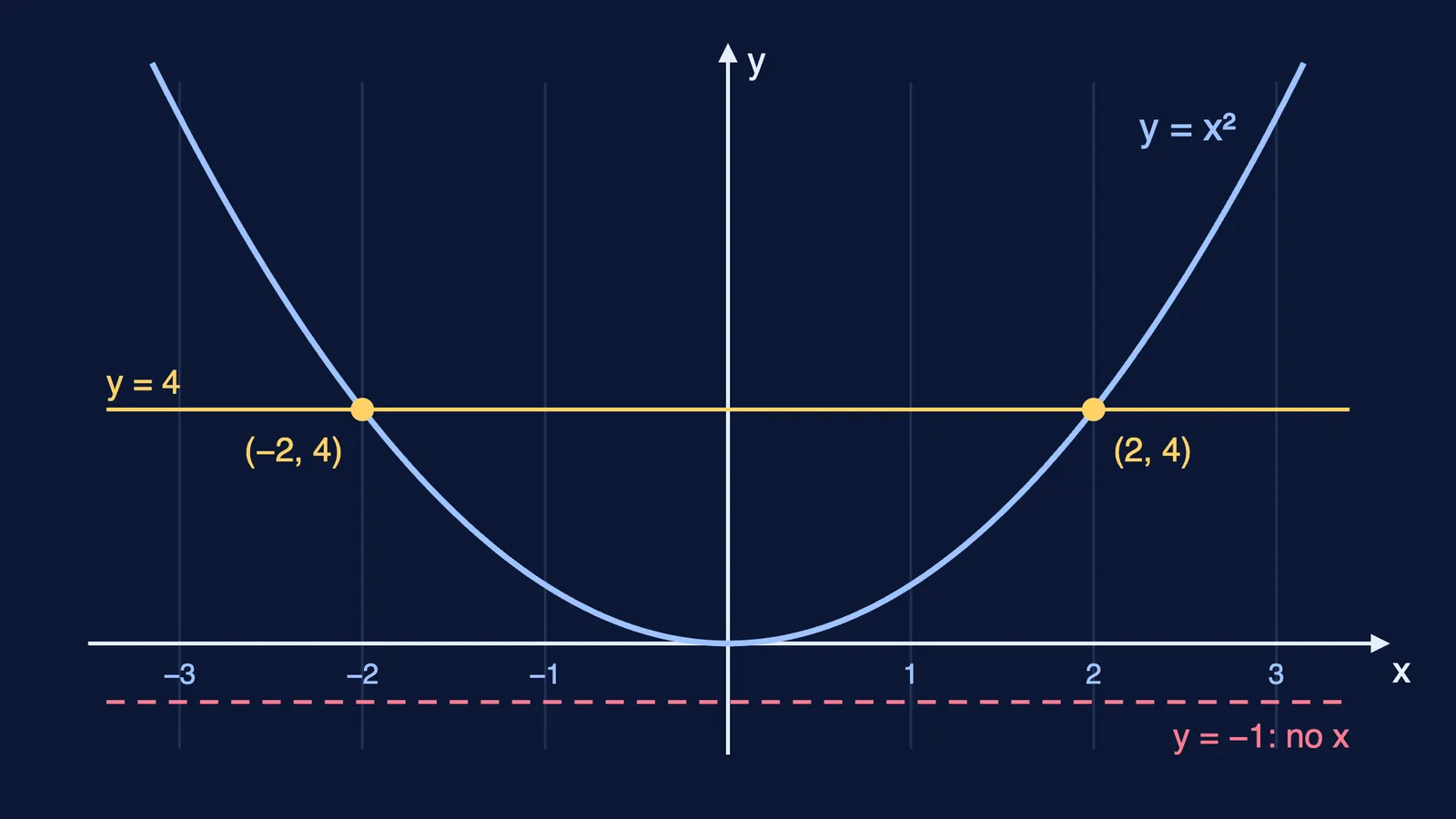
Watch for: the codomain decides onto. f(x) = x² on R → R is not one-one, since f(−2) = f(2) = 4, and not onto, since no real x gives −1. On [0, ∞) → [0, ∞) the same rule is a bijection.
How many relations and functions can you form between finite sets?
Symbols: |A| = m and |B| = n, with m, n ≥ 1. These follow from the definitions, and the textbook's Example 22 uses the last one (3! = 6 one-one maps from {1, 2, 3} to itself).
Relations from A to B: 2^(mn). Relations in A: 2^(m²).
Reflexive relations in A: 2^(m² − m).
Symmetric relations in A: 2^(m(m + 1)/2).
Functions from A to B: n^m.
One-one functions from A to B: n!/(n − m)!, when m ≤ n; there are none when m > n.
Bijections from A to A: m!.
Worked example. A = {1, 2, 3}, B = {p, q, r, s}, so m = 3 and n = 4.
Functions A → B: 4³ = 64.
One-one functions A → B: 4!/1! = 24.
Relations from A to B: 2¹² = 4096.
Reflexive relations in A: 2^(9 − 3) = 64. Symmetric relations in A: 2^(3 × 4/2) = 64.
Watch for: functions are n^m (codomain size raised to domain size), not m^n. Check on A = {1} and B = {p, q}: there are 2 functions, which is 2¹. For harder counts, see counting relations and functions between finite sets.
How to revise this formula sheet
Write every definition with its quantifier ("for every a ∈ A", "for all x₁, x₂ ∈ X").
Keep one counterexample per property ready: the textbook's perpendicular lines (symmetric, neither reflexive nor transitive) and its relation {(1, 1), (2, 2), (3, 3), (1, 2), (2, 3)} in {1, 2, 3} (reflexive, neither symmetric nor transitive).
Before any onto question, write the domain and codomain first, then solve f(x) = y for x and check that x lies in the domain.
If your proof steps go wrong in the same place, the Fermi Problem Library has worked problems with a step-by-step solver that explains the reasoning rather than printing an answer.