On this page
Chapter 12 of the new Class 9 maths book Ganita Manjari (Part II) is about 4-gons, focusing on parallelograms, midpoints and tiling. The terms below follow the NCERT chapter text and the 4-gons unit of the CBSE 2026-27 Class IX Mathematics curriculum. For proofs and exercises, see our Quadrilaterals Class 9 Ganita Manjari chapter guide.
What exactly counts as a quadrilateral?
Quadrilateral (4-gon): take four different points A, B, C, D in a plane, no three on one line, and join them in order by AB, BC, CD and DA. It is a quadrilateral only if every point on those segments, except the corners, lies on just one segment. Example: a square tile.
Collinear points: points that lie on one straight line. If three vertices are collinear, two sides lie along one line, giving a triangle or overlapping sides.
Vertices: the four points A, B, C, D. Adjacent vertices are the two ends of one side, such as A and B.
Sides (edges): the segments AB, BC, CD, DA. Adjacent sides share an endpoint (AB and BC); opposite sides share none (AB and CD).
Diagonals: AC and BD, which join non-adjacent vertices.
Internal angle: the angle at a vertex formed by the two sides that meet there. Adjacent angles sit at adjacent vertices (∠A and ∠B); opposite angles do not (∠A and ∠C).
Naming: start at any vertex and go either way round, so ABCD is also BCDA or DCBA, but not ACBD.
Convex, non-convex, self-intersecting or non-planar?
Convex quadrilateral: every internal angle is less than 180°; equivalently, the two diagonals cross each other. Example: any rectangle.
Non-convex quadrilateral: one internal angle is more than 180°, giving a dent; its diagonals do not cross. Example: an arrowhead shape.
Self-intersecting quadrilateral: a four-sided figure whose sides cross each other, like a bow tie. It is not counted as a quadrilateral unless stated.
Non-planar quadrilateral: a four-sided figure whose vertices are not all in one plane, like a bent card.
Linkage: hinged bars; a 4-bar linkage can pass through convex, non-convex and self-intersecting shapes.
How do you prove a quadrilateral is a parallelogram?
Parallelogram: a quadrilateral whose opposite sides are parallel. Rhombuses, rectangles and squares are special cases.
Converse: the statement made by swapping the "if" and "then" parts. It can be false even when the original is true: "if x = 3 then x² = 9" holds, but x² = 9 also allows x = −3.
Transversal: a line cutting two other lines. When AB is a transversal of BC ‖ AD, the interior angles on the same side add to 180°, so ∠A + ∠B = 180°.
Opposite sides test: if both pairs of opposite sides are equal, the quadrilateral is a parallelogram. Example: sides 5, 8, 5, 8 cm in order.
Opposite angles test: if both pairs of opposite angles are equal, it is a parallelogram. Example: angles 70°, 110°, 70°, 110°.
Diagonals bisect each other: if each diagonal cuts the other into two equal halves, it is a parallelogram. Don't confuse with: equal diagonals, which on their own do not make a parallelogram.
Equal parallel sides test: one pair of opposite sides that is both equal and parallel is enough.
Trapezium: the book calls a quadrilateral ABCD with AB ‖ DC a trapezium (End-of-Chapter Exercise 7), so one pair of parallel sides is enough.
What do the midpoint theorem and centroid say?
Midpoint: the point that splits a segment into two equal parts. To bisect means to cut into two equal parts.
Midpoint Theorem: the segment joining the midpoints of two sides of a triangle is parallel to the third side and half its length. Example: if BC = 10 cm, the midpoint segment PQ = 5 cm.
Converse of the Midpoint Theorem: a line through the midpoint of one side, drawn parallel to a second side, bisects the third side.
Auxiliary construction: an extra line added to make a proof work, like the line through C parallel to BA in the Midpoint Theorem proof.
Median: the segment from a vertex to the midpoint of the opposite side. Don't confuse with: the midpoint segment, which joins two midpoints.
Concurrent: passing through one common point. The three medians of a triangle are concurrent.
Centroid: the common point of the medians; it divides each median in the ratio 2 : 1, longer part at the vertex. Example: a 9 cm median splits into 6 cm and 3 cm.
Varignon parallelogram and tiling
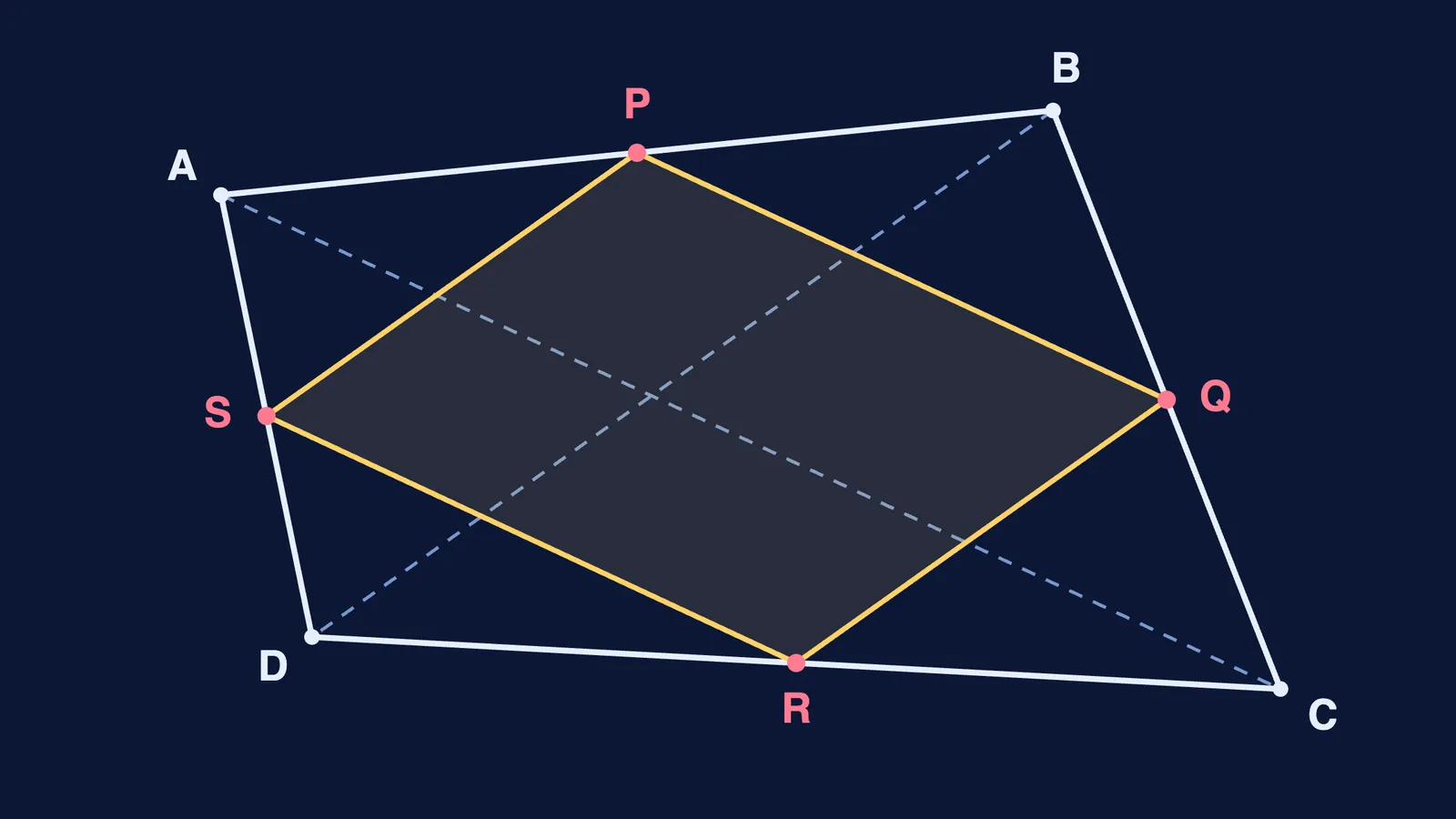
Varignon parallelogram: the figure made by joining the midpoints of the four sides of any quadrilateral, which is always a parallelogram (Theorem 9, the Midpoint Theorem for Quadrilaterals, also called Varignon's theorem). Example: if diagonals AC = 8 cm and BD = 6 cm, its sides are 4 cm and 3 cm, perimeter 14 cm.
Tiling: covering the plane with copies of a shape with no gaps or overlaps. The chapter shows any 4-gon, even a non-convex one, can tile the plane; the key idea is that its four angles add up to 360°, so four copies fit around a point. Counter-example: a regular pentagon cannot, since 360° is not a whole multiple of its 108° angle.
Aperiodic tiling: a tiling that goes on forever without repeating. The chapter describes the "hat" shape found in 2023 by Smith, Myers, Kaplan and Goodman-Strauss.
How to learn these terms
Draw one quadrilateral ABCD and label its vertices, adjacent and opposite sides, diagonals and angles.
Sketch convex, non-convex, self-intersecting and non-planar examples, and test convexity by checking whether the diagonals cross.
Write each parallelogram property and its converse side by side in "if ... then" form, and mark which one you are using in each proof. If a term stays unclear, look it up in the Fermi Concept Library, where every mathematics concept has its own lesson.
Cut a paper triangle along its midpoint segments, check the four smaller triangles match, then measure a median's 2 : 1 split.
Join the midpoints of a few odd quadrilaterals, including a non-convex one, and check you get a parallelogram. For a harder challenge, try our JEE-level post on counting triangles, diagonals and lines from points.