

On this page
PVC is more than half chlorine by mass. Each CH₂=CHCl unit weighs 62.50 g/mol, and 35.45 g of that is chlorine, so 56.7% of a PVC pipe started life as common salt. Our post on the products of the chlor-alkali process lists PVC as a use of chlorine in one word. This post follows the chlorine the rest of the way, and every step turns out to be a Class 11 or 12 reaction you already know.
How does chlorine from salt end up in PVC?
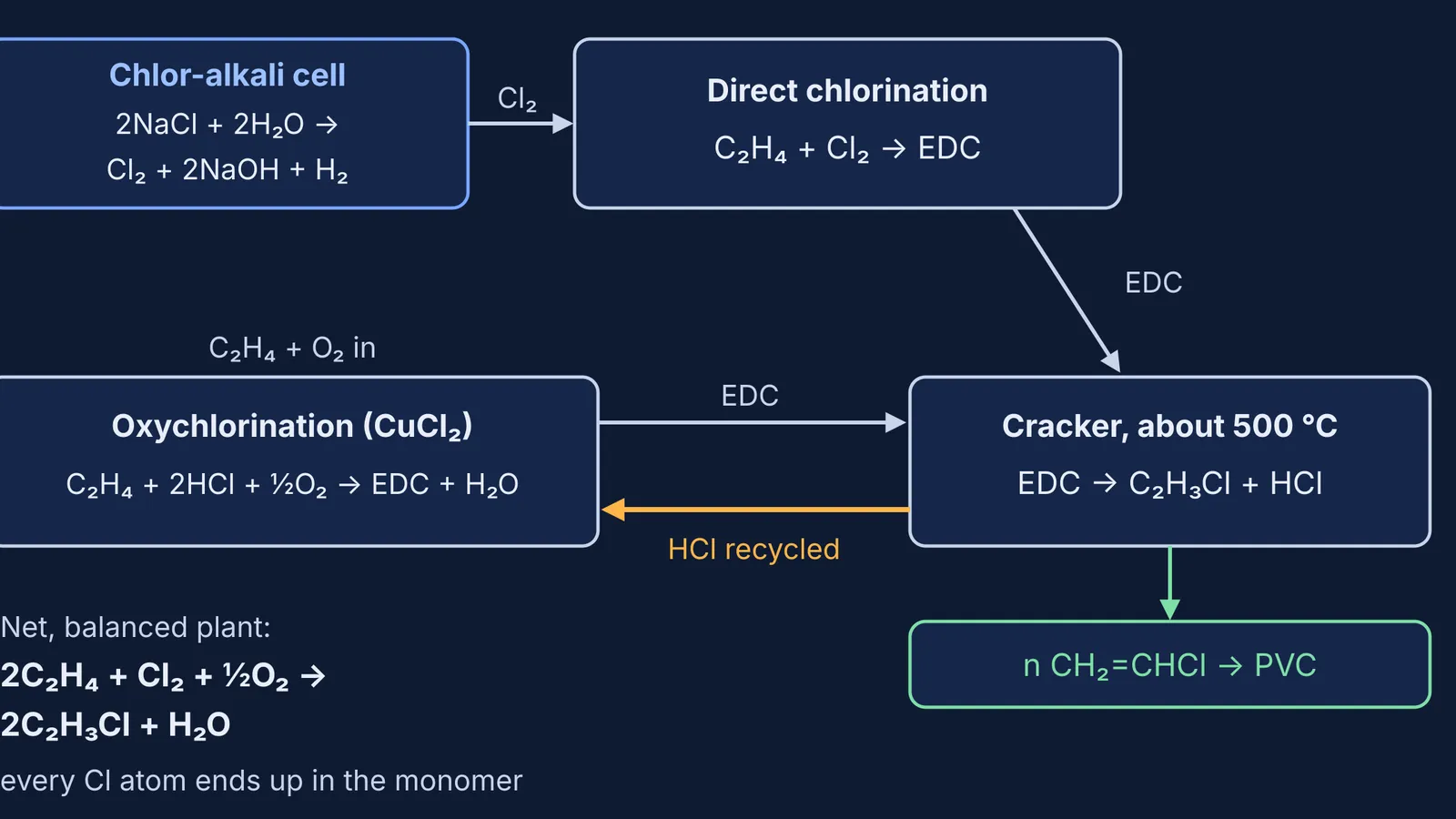
The chain has four links: brine → Cl₂ → 1,2-dichloroethane → vinyl chloride → PVC.
The chlor-alkali cell makes the chlorine: 2NaCl + 2H₂O → Cl₂ + 2NaOH + H₂. The chlorine is then added to ethene, the product is cracked to vinyl chloride (chloroethene, often called VCM, vinyl chloride monomer), and the monomer is polymerised: n CH₂=CHCl → (–CH₂–CHCl–)ₙ. PVC is an addition polymer, so the repeat unit has the same formula as the monomer.
Which reactions turn ethene into vinyl chloride?
Two textbook reactions do the job.
Direct chlorination. Halogen addition across the C=C bond: C₂H₄ + Cl₂ → ClCH₂CH₂Cl. The product, 1,2-dichloroethane (industry calls it EDC, ethylene dichloride), is a vicinal dihalide.
Cracking. Heat EDC and it loses HCl: ClCH₂CH₂Cl → CH₂=CHCl + HCl. This is dehydrohalogenation, the elimination you learnt for haloalkanes.
One difference from your textbook matters. In class, elimination from a vicinal dihalide uses alcoholic KOH, as in preparing alkynes from vicinal dihalides. Industry cracks EDC thermally, with no base at all. A patent on VCM furnaces describes conventional ones as running with gas temperatures of 480 to 550 °C and converting 50 to 60% of the EDC per pass (US patent 12,195,414); the unreacted EDC is separated and sent round again. KOH would turn the chlorine into KCl, a salt waste. Thermal cracking releases it as HCl gas, which can be used.
Add the two steps and the problem appears: C₂H₄ + Cl₂ → CH₂=CHCl + HCl. Half the chlorine that came out of the brine cell leaves as HCl.
Why do PVC plants add oxychlorination?
To put that HCl back into the product. In oxychlorination, ethene reacts with HCl and oxygen over a copper(II) chloride catalyst:
C₂H₄ + 2HCl + ½O₂ → ClCH₂CH₂Cl + H₂O
This is a cousin of the Deacon process, which oxidises HCl with oxygen over copper to give free chlorine (see Henry Deacon and the chlorine process). Here the chlorine never appears as Cl₂. It goes straight onto ethene.
Oxidation numbers show what is going on. Chlorine is −1 in HCl and still −1 in EDC, so chlorine is not the oxidant. Each carbon goes from −2 in ethene to −1 in EDC, and oxygen goes from 0 to −2 in water. Oxygen is the oxidising agent. In direct chlorination, by contrast, Cl₂ is the oxidant (0 → −1).
A plant that runs all three reactions with the HCl recycled is called a balanced plant. Add direct chlorination, oxychlorination and two crackings:
C₂H₄ + Cl₂ → EDC
C₂H₄ + 2HCl + ½O₂ → EDC + H₂O
2EDC → 2CH₂=CHCl + 2HCl
The two EDC and the two HCl cancel, leaving the net reaction:
2C₂H₄ + Cl₂ + ½O₂ → 2CH₂=CHCl + H₂O
Check: 4 C, 8 H, 2 Cl and 1 O on each side. Every chlorine atom now ends up in the monomer, and the only by-product is water. The atom economy is 125.0 ÷ 143.0 = 87.4%.
Worked example: how much salt, ethene and oxygen per tonne of vinyl chloride?
Molar masses: C₂H₃Cl 62.50, Cl₂ 70.90, HCl 36.46, C₂H₄ 28.05, O₂ 32.00, H₂O 18.02, NaCl 58.44, NaOH 40.00, C₂H₂ 26.04, CaC₂ 64.10, Ca(OH)₂ 74.09 g/mol.
Step 1: moles of product. 1 tonne = 1,000,000 g. 1,000,000 ÷ 62.50 = 16,000 mol of vinyl chloride. Each mole comes from one mole of EDC, so the plant handles 16,000 mol (about 1.58 t) of EDC.
Step 2: without oxychlorination. Each CH₂=CHCl needs one Cl₂ and gives one HCl.
Cl₂: 16,000 × 70.90 = 1.134 t
Ethene: 16,000 × 28.05 = 0.449 t
HCl left over: 16,000 × 36.46 = 0.583 t
Step 3: balanced plant. From the net equation, 2 mol of vinyl chloride need 1 Cl₂ and ½ O₂ and give 1 H₂O.
Cl₂: 8,000 × 70.90 = 0.567 t (half as much)
Ethene: still 0.449 t
O₂: 4,000 × 32.00 = 0.128 t
Water: 8,000 × 18.02 = 0.144 t
Mass check: 0.567 + 0.449 + 0.128 = 1.144 t in; 1.000 + 0.144 = 1.144 t out.
Step 4: back to the brine cell. 8,000 mol Cl₂ needs 2 × 8,000 = 16,000 mol NaCl, which is 16,000 × 58.44 = 0.935 t of salt. The same cell also makes 16,000 mol NaOH (0.640 t) and 8,000 mol H₂ (16 kg). So a tonne of vinyl chloride brings 0.64 t of caustic soda with it. Chlorine and caustic soda come out of the cell in a fixed ratio whether or not anyone wants both, which is why their prices tend to move in opposite directions.
Step 5: the acetylene route, for comparison. HC≡CH + HCl → CH₂=CHCl uses 16,000 mol of each: 0.583 t HCl and 16,000 × 26.04 = 0.417 t acetylene. Making that acetylene from calcium carbide, CaC₂ + 2H₂O → C₂H₂ + Ca(OH)₂, needs 16,000 × 64.10 = 1.03 t of CaC₂ and leaves 16,000 × 74.09 = 1.19 t of Ca(OH)₂ sludge.
If a step like the doubled cracking equation trips you up, the Fermi Problem Library has a step-by-step solver that explains the reasoning rather than printing an answer.
How is the acetylene route different?
This is the reaction in your NCERT chapter on hydrocarbons: HX adds to an alkyne. Industry stops after one HCl, at the vinyl halide. Add a second HCl and you get the geminal dihalide CH₃CHCl₂, for the reasons explained in why alkynes add HX to give gem-dihalides.
The catalyst has traditionally been mercury(II) chloride, so the route carries a mercury problem. The Minamata Convention on Mercury lists vinyl chloride production with mercury catalysts in its Annex B and requires countries to cut the mercury used per unit of product. The carbide route survives mainly where coal is cheap and ethene is not, China above all.
Is vinyl chloride itself safe?
No. Vinyl chloride is a known human carcinogen, linked to a rare liver cancer (US National Cancer Institute). The finished polymer is a different substance.
Not every PVC plant runs all three reactions either. Some buy EDC or vinyl chloride and only polymerise it, so a country that makes PVC does not necessarily make its own monomer.
Quick checklist
PVC is 56.7% chlorine by mass, all of it from salt.
Direct chlorination: C₂H₄ + Cl₂ → ClCH₂CH₂Cl (halogen addition).
Cracking at roughly 500 °C: ClCH₂CH₂Cl → CH₂=CHCl + HCl (thermal, not alcoholic KOH).
Oxychlorination: C₂H₄ + 2HCl + ½O₂ → ClCH₂CH₂Cl + H₂O over CuCl₂; O₂ is the oxidant.
Balanced plant: 2C₂H₄ + Cl₂ + ½O₂ → 2CH₂=CHCl + H₂O.
Per tonne of vinyl chloride: 0.567 t Cl₂, 0.935 t salt, 0.640 t NaOH as a co-product.
Acetylene route: HC≡CH + HCl → CH₂=CHCl, with a mercury catalyst and carbide sludge.


