

On this page
How do vicinal dihalides convert into alkynes in two steps?
A vicinal dihalide contains two halogens on adjacent carbons, typically prepared by adding bromine to an alkene. Converting a 1,2-dibromoalkane into an alkyne requires formally eliminating two equivalents of hydrogen bromide. In organic synthesis, this occurs via two sequential bimolecular elimination (E2) reactions, first systematised by E. D. Hughes and C. K. Ingold (Hughes & Ingold, 1941).
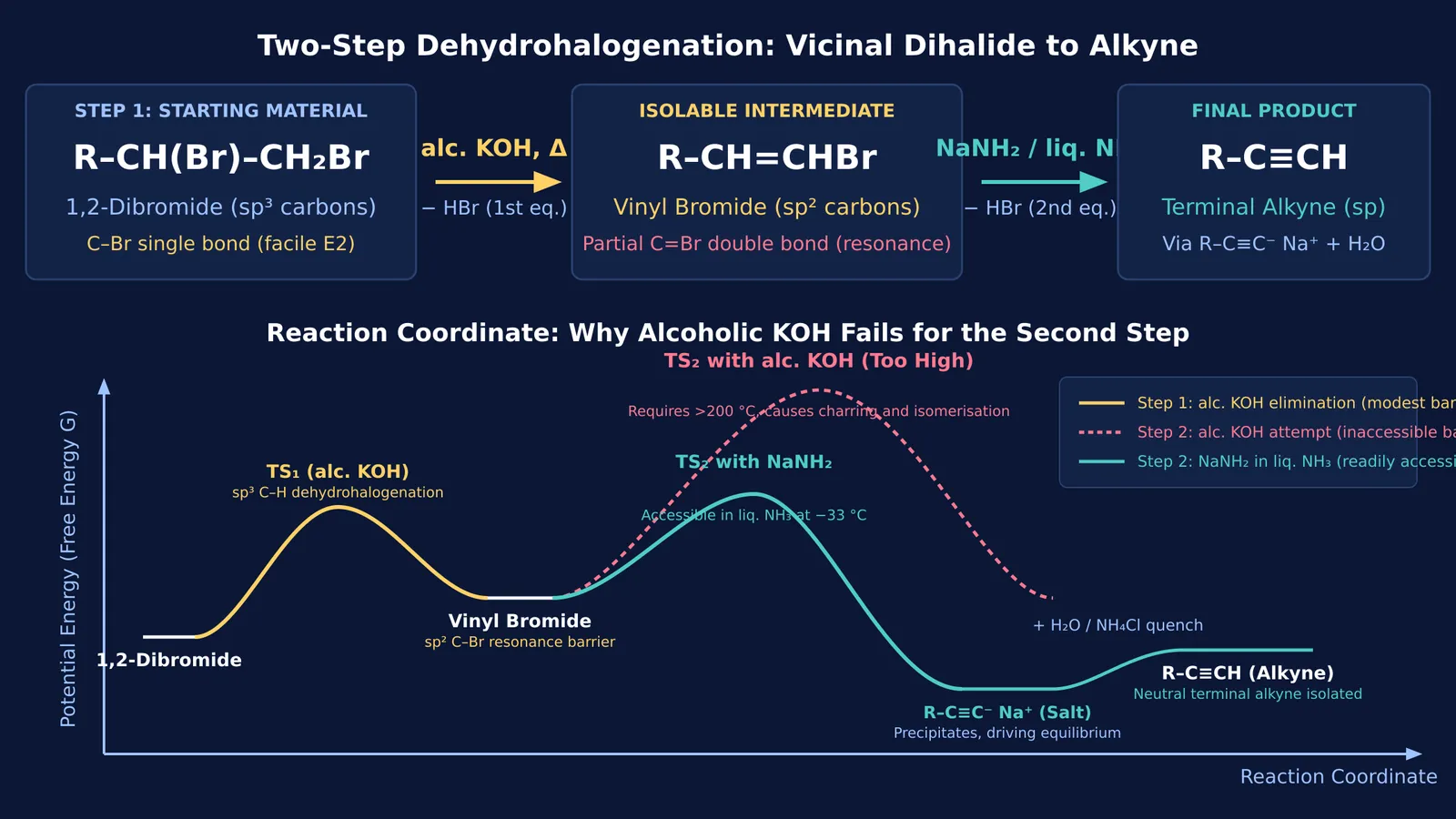
The first stage dehydrohalogenates the vicinal dibromide with alcoholic potassium hydroxide (alc. KOH). In ethanol, hydroxide forms ethoxide ions (C₂H₅O⁻). As explored in our review of aqueous versus alcoholic potassium hydroxide, poorly solvated ethoxide acts as a strong base. When heated, ethoxide abstracts a proton while bromide departs from the adjacent carbon in an anti-periplanar transition state:
R–CH(Br)–CH₂Br + alc. KOH → R–CH=CHBr + KBr + H₂O
Because the leaving group departs from an sp³ carbon, the activation barrier is modest. The reaction halts cleanly at this mono-elimination, producing a stable vinyl halide intermediate.
Why does the second elimination require a stronger base like NaNH2?
Attempting the second elimination with alcoholic potassium hydroxide under standard conditions fails, requiring a much stronger base such as sodium amide (Schuda & Heimann, 1982). The obstacle stems from the hybridisation and electronic structure of the vinyl halide intermediate.
First, the vinylic carbons are sp²-hybridised, containing one-third s-character compared to one-fourth in the sp³ starting alkane. Greater s-character holds electron density closer to the nucleus, making both the vinylic C–H and C–Br bonds shorter, stronger, and more resistant to cleavage.
Second, the bromine lone pairs conjugate with the alkene through resonance:
CH₂=CH–Br ↔ ⁻CH₂–CH=Br⁺
This pi-overlap gives partial double-bond character to the carbon-bromine bond, sharply reducing its leaving ability. Furthermore, vinylic protons are poor acids. Frederick G. Bordwell's non-aqueous measurements showed that while ethanol has a pKa of 15.9 and water 15.7, ammonia has a pKa near 38 (Bordwell, 1988). The amide ion (NH₂⁻) in sodium amide is therefore over 10²² times more basic than ethoxide or hydroxide.
While molten potassium hydroxide requires destructive temperatures above 200 °C that cause charring and isomerisation, sodium amide in liquid ammonia (boiling point −33 °C) provides the basicity to cleanly eliminate the second hydrogen halide under mild conditions (Schuda & Heimann, 1982):
R–CH=CHBr + NaNH₂ → R–C≡CH + NaBr + NH₃
How does terminal alkyne synthesis change base stoichiometry?
Calculating molar equivalents of sodium amide is a frequent exam pitfall. As established in classical synthetic work (Campbell & Campbell, 1950), base stoichiometry depends strictly on whether the product is an internal or terminal alkyne.
For an internal alkyne (such as converting 2,3-dibromobutane into but-2-yne), exactly two equivalents of base are consumed across the sequence—either one equivalent of alc. KOH followed by one of NaNH₂, or two equivalents of NaNH₂ directly. The resulting internal alkyne lacks acidic hydrogens and remains unchanged in basic medium.
For a terminal alkyne, the newly formed triple bond ends in an acetylenic hydrogen (R–C≡C–H). Because an sp carbon has one-half s-character, this proton is unusually acidic, with a pKa of approximately 25 (Bordwell, 1988). As detailed in our guide on the acidity of terminal alkynes, the basic amide ion deprotonates this alkyne to form a sodium acetylide salt:
R–C≡CH + NaNH₂ → R–C≡C⁻ Na⁺ + NH₃
As established by Kenneth N. Campbell and Barbara K. Campbell (Campbell & Campbell, 1950), preparing a terminal alkyne directly from a vicinal dihalide strictly requires three equivalents of sodium amide. The third equivalent shifts equilibrium to completion by precipitating the acetylide salt. An aqueous quench is then required to liberate the neutral alkyne:
R–C≡C⁻ Na⁺ + H₂O → R–C≡CH + NaOH
How do you synthesise propyne from propene step by step?
To see these principles in action, consider the laboratory synthesis of propyne from propene:
Electrophilic bromination: Adding bromine in carbon tetrachloride to propene forms 1,2-dibromopropane:
CH₃–CH=CH₂ + Br₂ → CH₃–CH(Br)–CH₂Br
First elimination: Heating 1,2-dibromopropane with alcoholic potassium hydroxide yields isomeric vinyl bromides:
CH₃–CH(Br)–CH₂Br + alc. KOH → CH₃–CH=CHBr + KBr + H₂O
Second elimination: Treating the vinyl halide with sodium amide in liquid ammonia consumes two equivalents of NaNH₂ (Schuda & Heimann, 1982):
CH₃–CH=CHBr + 2 NaNH₂ → CH₃–C≡C⁻ Na⁺ + NaBr + 2 NH₃
Hydrolytic workup: Quenching with water or ammonium chloride liberates neutral propyne:
CH₃–C≡C⁻ Na⁺ + H₂O → CH₃–C≡CH + NaOH
When preparing for multi-step reaction problems, the Fermi Problem Library provides worked problems with a step-by-step solver that explains the reasoning rather than printing an answer. If you are reviewing reaction conditions, the Fermi Concept Library covers every concept in physics, chemistry, biology, mathematics and computing, each with its own lesson and its place in the map.
How do you avoid common elimination errors in exams?
When solving organic synthesis schemes, keep these four operational rules in mind:
Base stoichiometry: Allocate three equivalents of NaNH₂ for terminal alkynes and two equivalents for internal alkynes when starting from vicinal or geminal dihalides.
Solvent choice: Aqueous potassium hydroxide causes substitution rather than elimination, producing a vicinal diol (glycol).
Quench step: Without an aqueous quench, the terminal alkyne remains trapped as a sodium acetylide salt.
Geminal dihalides: Geminal dihalides (such as 1,1-dibromopropane) follow the same two-step elimination with sodium amide via a vinyl halide to yield alkynes.


