On this page
On 29 December 1868, a Widnes alkali maker named Henry Deacon was granted a US patent for "the continuous production of chlorine" by passing hydrogen chloride gas and atmospheric air over heated metal compounds, preferably of copper (US patent 85,370, Manufacture of Chlorine). For JEE or board chemistry, it is a clean real example of equilibrium, Le Chatelier's principle and catalysis working together.
Who was Henry Deacon?
Henry Deacon was born in London on 30 July 1822 into a Sandemanian family; Michael Faraday, a member of the same church, was a family friend (Henry Deacon biography)). Apprenticed to a London engineering firm, he moved to Widnes in 1851 to make alkali, founded Gaskell, Deacon and Co in 1855, and filed at least 29 patents between 1854 and 1876. In 1867 he hired the chemist Ferdinand Hurter, who worked with him on chlorine. He died of typhoid on 23 July 1876.
The Leblanc soda works around him released hydrogen chloride gas. Britain's Alkali Act 1863, in force from 1 January 1864, was passed "for the more effectual condensation of Muriatic Acid Gas in Alkali Works" (Alkali Act 1863). Deacon wanted to turn the captured acid into chlorine for bleaching powder.
What is the Deacon process?
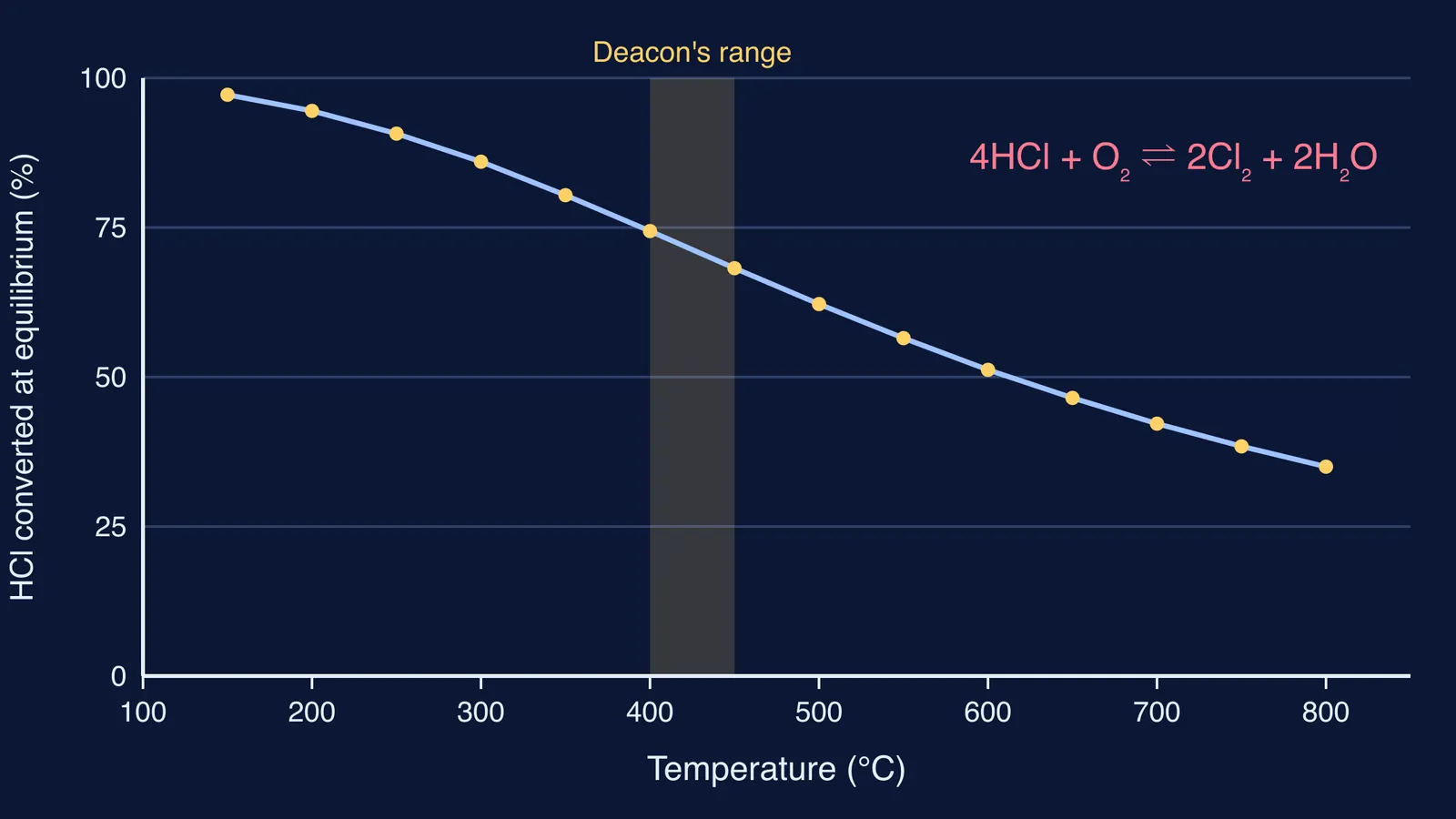
The Deacon process is the oxidation of hydrogen chloride by oxygen over a heated catalyst, giving chlorine and water: 4HCl + O₂ ⇌ 2Cl₂ + 2H₂O (Deacon process overview). The same overview gives the operating temperature as 400 to 450 °C.
Deacon's patent calls atmospheric air "the cheapest source" of the oxygen and prefers copper: clay or fire-clay bricks soaked in a strong copper sulphate solution, placed in heated retorts or flues (US85370A). It estimates that one furnace of the size described could make enough chlorine for about three tons of bleaching powder every 24 hours. With Hurter, Deacon arrived at a better process using cupric chloride as the catalyst in 1870 (Deacon biography)).
Why did the Deacon process fade, and why is it back?
Copper was the weak point. A 2012 review from ETH Zurich and Bayer MaterialScience says the original CuCl₂-on-pumice catalyst "suffered from fast deactivation due to volatilization of copper in form of chlorides" (Mondelli et al., Chimia 2012). His patent had warned that if the temperature is too high, "certain compounds of copper are volatilized". Electrolysis of salt solutions became the main route, and most chlorine is still made that way (Deacon process overview).
The comeback came from industries that make HCl as a by-product: about 50% of the chlorine used ends up as HCl or chloride salts, and making one mole of toluene diisocyanate generates 4 moles of HCl (Chimia 2012). The review notes that Sumitomo reported its ruthenium dioxide on rutile titanium dioxide catalyst to be 50 times more active than copper, chromium, iron, manganese and nickel catalysts. Kohei Seki described its development in Catalysis Surveys from Asia (2010).
How do you solve a Deacon process equilibrium question?
Here is a calculation an examiner could build, using NIST standard values for HCl, water vapour, chlorine and oxygen.
Enthalpy: ΔH° = 2(−241.83) − 4(−92.31) = −114.4 kJ, so the reaction is exothermic.
Entropy: ΔS° = 2(223.08) + 2(188.84) − 4(186.90) − 205.15 = −128.9 J/K. Five moles of gas become four, so entropy falls.
Crossover: treating ΔH° and ΔS° as constant, ΔG° = 0 when T = 114 400 ÷ 128.9 ≈ 887 K, about 614 °C. Hotter than that, K drops below 1.
At Deacon's 450 °C (723 K): ΔG° ≈ −114.4 + 723 × 0.1289 ≈ −21.2 kJ, so K = e^(21 200 ÷ (8.314 × 723)) ≈ e^3.53 ≈ 34.
Le Chatelier check: exothermic, so cooler is better for yield; fewer gas moles on the right, so higher pressure and extra oxygen help. The Chimia review agrees: conversion is favoured below about 700 K, at a high O₂-to-HCl ratio and at high pressure.
Carried further, with air at 1 bar and just enough oxygen, our calculation from the NIST values gives about 74% of the HCl converted at equilibrium at 400 °C and about 51% at 600 °C.
If you can follow these steps but slip when setting up your own, the Fermi Problem Library has worked problems with a step-by-step solver that explains the reasoning rather than printing an answer. For ideas that are easier to see than to read, try the Fermi Simulation Lab.
How can you read any industrial process like Deacon did?
The same checklist works for the Haber, Contact and Deacon processes:
Balance the equation and count gas moles on each side.
Use the sign of ΔH to see which way temperature pushes K.
Find the compromise between yield and rate.
Ask what the catalyst does, and how it fails.
Ask where the raw material comes from and where the waste goes.
Try it on the next process in your syllabus.