On this page
Chapter 4 of the NCERT Class 12 Biology textbook (2026-27 reprint) introduces many new words, and several come in pairs that sound alike. The terms below come from that chapter and are grouped by the topics in the CBSE Class 12 Biology syllabus for 2026-27. Learn the pairs together, because they are easy to confuse. For answer-writing and a revision plan, use our Principles of inheritance board exam guide.
What do gene, allele, genotype and phenotype mean?
Inheritance: how traits travel from one generation to the next, which is what makes heredity possible. Don't confuse with: variation, the differences you see between offspring and their parents.
Gene: the unit of inheritance that carries the information for one trait. Mendel called it a "factor".
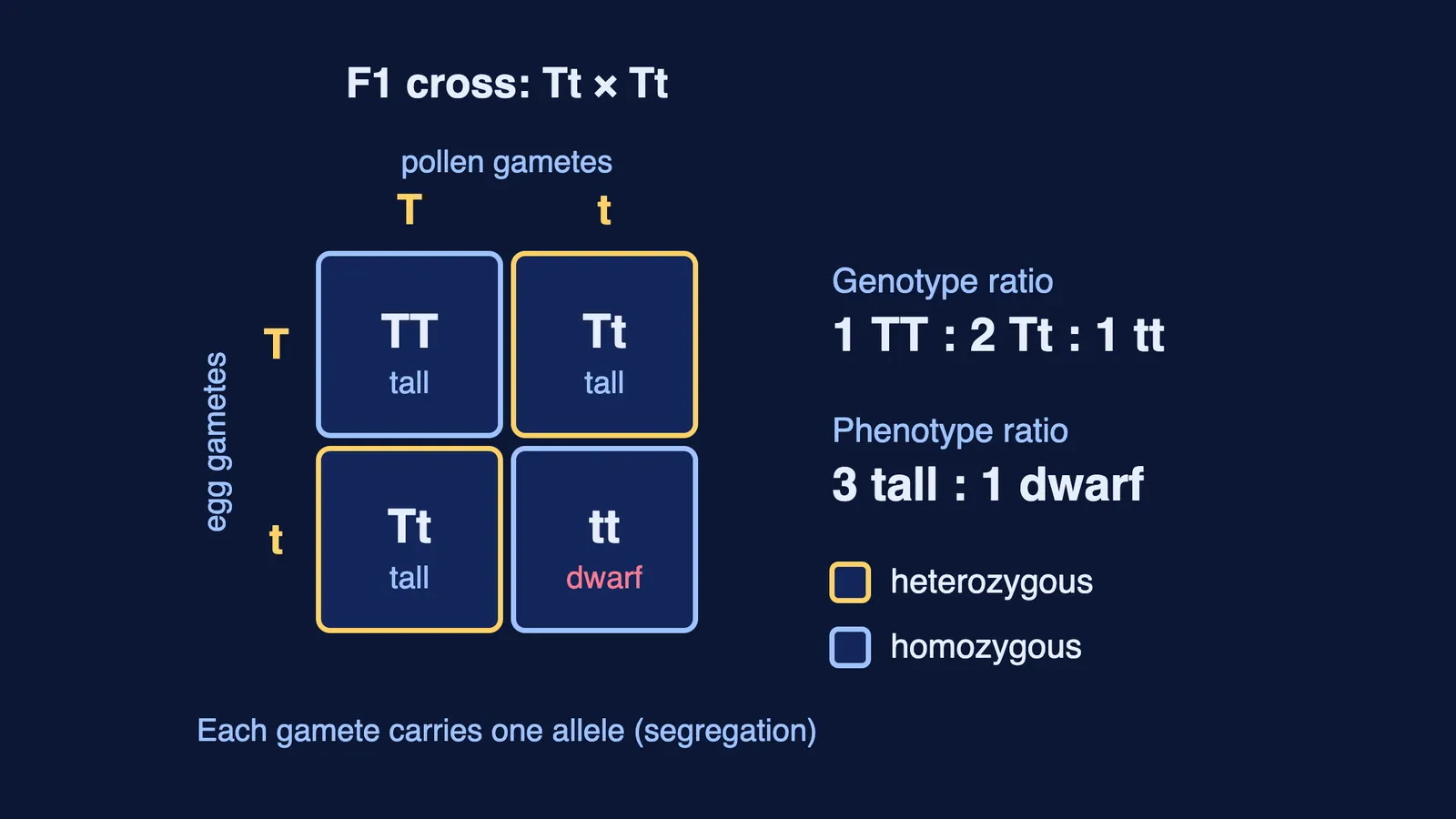
Allele: an alternative version of a gene; the two alleles of a pair control contrasting forms of one trait. Example: T (tall) and t (dwarf) are alleles for pea plant height.
Homozygous: both alleles of a pair are the same (TT or tt). Don't confuse with: heterozygous, where they differ (Tt).
Genotype: the allele combination an organism carries, such as Tt. Don't confuse with: phenotype, the trait you can see or measure, such as "tall".
Dominant and recessive: in a heterozygote, the dominant allele is the one whose trait shows; the recessive trait shows only when both alleles are recessive.
True-breeding line: a line that keeps showing the same trait over many generations of self-pollination.
F1 and F2: the first and second filial (offspring) generations of a cross.
Which crosses and laws did Mendel describe?
Mendel's pea crosses gave a 3:1 phenotypic ratio and a 1:2:1 genotypic ratio in the F2 of a monohybrid cross, and 9:3:3:1 in a dihybrid cross (NCERT chapter 4).
Monohybrid cross: a cross between parents that differ in one character. Example: TT × tt. Don't confuse with: dihybrid cross, where parents differ in two characters, such as RRYY × rryy.
Punnett square: a grid that lists gametes on two sides and shows every possible zygote in the boxes, so you can read off ratios.
Test cross: crossing an organism with the dominant phenotype to a recessive homozygote to find its genotype. Example: Tt × tt gives tall and dwarf in 1:1.
Law of Dominance: characters are controlled by paired factors, and in an unlike pair only one is expressed.
Law of Segregation: the two alleles separate during gamete formation, so each gamete carries only one of them.
Law of Independent Assortment: in a dihybrid, the segregation of one gene pair does not depend on the other pair.
What are the exceptions to Mendel's dominance?
Incomplete dominance: the heterozygote is in between the two parents. Example: red × white snapdragon gives pink F1, and the F2 is 1 red : 2 pink : 1 white. Don't confuse with: co-dominance.
Co-dominance: both alleles are fully expressed together in the heterozygote. Example: IAIB gives blood group AB, with both A and B sugars on red blood cells.
Multiple alleles: more than two alleles of one gene exist in a population, though each person carries only two. Example: IA, IB and i give six genotypes in the ABO system.
Pleiotropy: one gene affects several traits. Example: in phenylketonuria, one mutant gene affects mental development and hair and skin pigmentation. Don't confuse with: polygenic inheritance, where several genes add up to shape one trait, such as human height or skin colour. Our post on polygenic inheritance and pleiotropy works through both.
How do chromosomes explain linkage and sex determination?
Chromosomal theory of inheritance: genes sit on chromosomes, and chromosome behaviour in meiosis explains Mendel's laws (Sutton and Boveri).
Linkage: genes on the same chromosome tend to be inherited together. Don't confuse with: recombination, the appearance of non-parental gene combinations. In Morgan's Drosophila crosses, white and yellow showed 1.3 per cent recombination while white and miniature wing showed 37.2 per cent (NCERT).
Autosomes and sex chromosomes: humans have 22 pairs of autosomes, the same in both sexes, and one pair of sex chromosomes (XX or XY).
Male heterogamety: males make two kinds of gametes for sex chromosomes. Example: XY in humans, XO in grasshoppers. Don't confuse with: female heterogamety, as in birds (female ZW, male ZZ).
Haplodiploidy: sex set by the number of chromosome sets. Example: honey bee females are diploid (32 chromosomes) and drones are haploid (16), growing from unfertilised eggs.
How are genetic disorders classified?
Mutation: a change in the DNA sequence that can change genotype and phenotype. A point mutation changes one base pair. Example: sickle-cell anaemia.
Pedigree analysis: tracing a trait through a family tree over generations, used because controlled crosses are not possible in humans.
Mendelian disorder: caused by a change in a single gene. Examples: haemophilia, thalassemia. Don't confuse with: chromosomal disorder, caused by missing, extra or rearranged chromosomes.
Sex-linked recessive disorder: the gene is on the X chromosome, so it usually passes from a carrier mother to sons. Examples: haemophilia, colour blindness.
Carrier: a heterozygote who looks unaffected but can pass the allele on.
Sickle-cell anaemia vs thalassemia: sickle-cell is a qualitative fault (a wrongly working globin, from Glu replaced by Val at position six of the beta chain); thalassemia is quantitative (too little of one globin chain is made).
Aneuploidy: gain or loss of one or a few chromosomes, from failed chromatid separation. Examples: Down's syndrome (trisomy 21), Klinefelter's syndrome (47, XXY), Turner's syndrome (45, X0), as described in NCERT. Don't confuse with: polyploidy, a gain of a whole set of chromosomes, often seen in plants.
How to learn these terms
Learn them in pairs: genotype and phenotype, homozygous and heterozygous, linkage and recombination, pleiotropy and polygenic, aneuploidy and polyploidy.
Draw a Punnett square for every ratio term. If you can produce 3:1, 1:2:1, 1:1 and 9:3:3:1 from memory, the definitions follow. Our guide to Punnett squares and genetics ratios has practice crosses.
Tie each disorder to three tags: Mendelian or chromosomal, autosomal or sex-linked, and the example.
If one idea keeps slipping, such as why co-dominance is not incomplete dominance, the Fermi Concept Library gives each biology concept its own lesson and shows where it sits in the map.