

On this page
NCERT teaches two things about this reaction that are worth putting side by side. First, rate rises with temperature, typically doubling or so for a 10 K rise, as in our post on the temperature coefficient of a reaction. Second, 2NO + O₂ → 2NO₂ is its standard example of a termolecular reaction, the one our post on order vs molecularity also uses. Both statements serve you well for almost every reaction you will meet. But this example happens to be the classic exception to the first: its rate constant gets smaller when you heat it.
Does every reaction speed up when you heat it?
Almost every one you will see in JEE or NEET does, because almost every reaction has a positive activation energy. The oxidation of nitric oxide is the classic exception.
The IUPAC Subcommittee on Gas Kinetic Data Evaluation reviews the measured rate data for atmospheric reactions and publishes preferred values. For 2NO + O₂ → 2NO₂ its data sheet gives (Atkinson et al., Atmos. Chem. Phys. 4, 1461, 2004, data sheet I.A3.53):
k = 2.0 × 10⁻³⁸ cm⁶ molecule⁻² s⁻¹ at 298 K
k = 3.3 × 10⁻³⁹ e^(530/T) cm⁶ molecule⁻² s⁻¹ from 270 to 600 K
ΔH° = −114.1 kJ/mol for the reaction as written
Look at the exponent. In a normal Arrhenius expression it is −Ea/RT, a negative number, so k grows as T rises. Here it is +530/T, so k shrinks as T rises.
To use these numbers in the mol L⁻¹ units of your textbook, multiply by Avogadro's number squared and by 10⁻⁶ L² per cm⁶. The pre-exponential factor becomes 3.3 × 10⁻³⁹ × (6.022 × 10²³)² × 10⁻⁶ ≈ 1.2 × 10³ L² mol⁻² s⁻¹, and k at 298 K comes out at about 7 × 10³ L² mol⁻² s⁻¹.
The same data sheet records two details worth knowing. The uncertainty in the temperature term is ±400 K, so the activation energy is small and not known precisely, but it is negative across the whole range. And one detailed study (Olbregts, 1985) found that k keeps falling up to about 600 K and then starts to rise again at higher temperatures.
How do you find Ea from k = A e^(530/T)? A worked example
(a) Read off the activation energy.
Arrhenius form: k = A e^(−Ea/RT).
Match exponents: −Ea/R = +530 K.
Ea = −530 × 8.314 = −4,406 J/mol ≈ −4.4 kJ/mol.
With the ±400 K uncertainty, Ea lies between about −7.7 and −1.1 kJ/mol. The same matching trick is in our post on reading Ea and A straight off a printed Arrhenius equation.
(b) Compare two temperatures.
k(300 K) / k(600 K) = e^(530 × (1/300 − 1/600)).
1/300 − 1/600 = 1/600 = 0.001667 K⁻¹, and 530 × 0.001667 = 0.883.
e^0.883 ≈ 2.4.
At the same concentrations, the reaction runs about 2.4 times faster at room temperature than at 600 K.
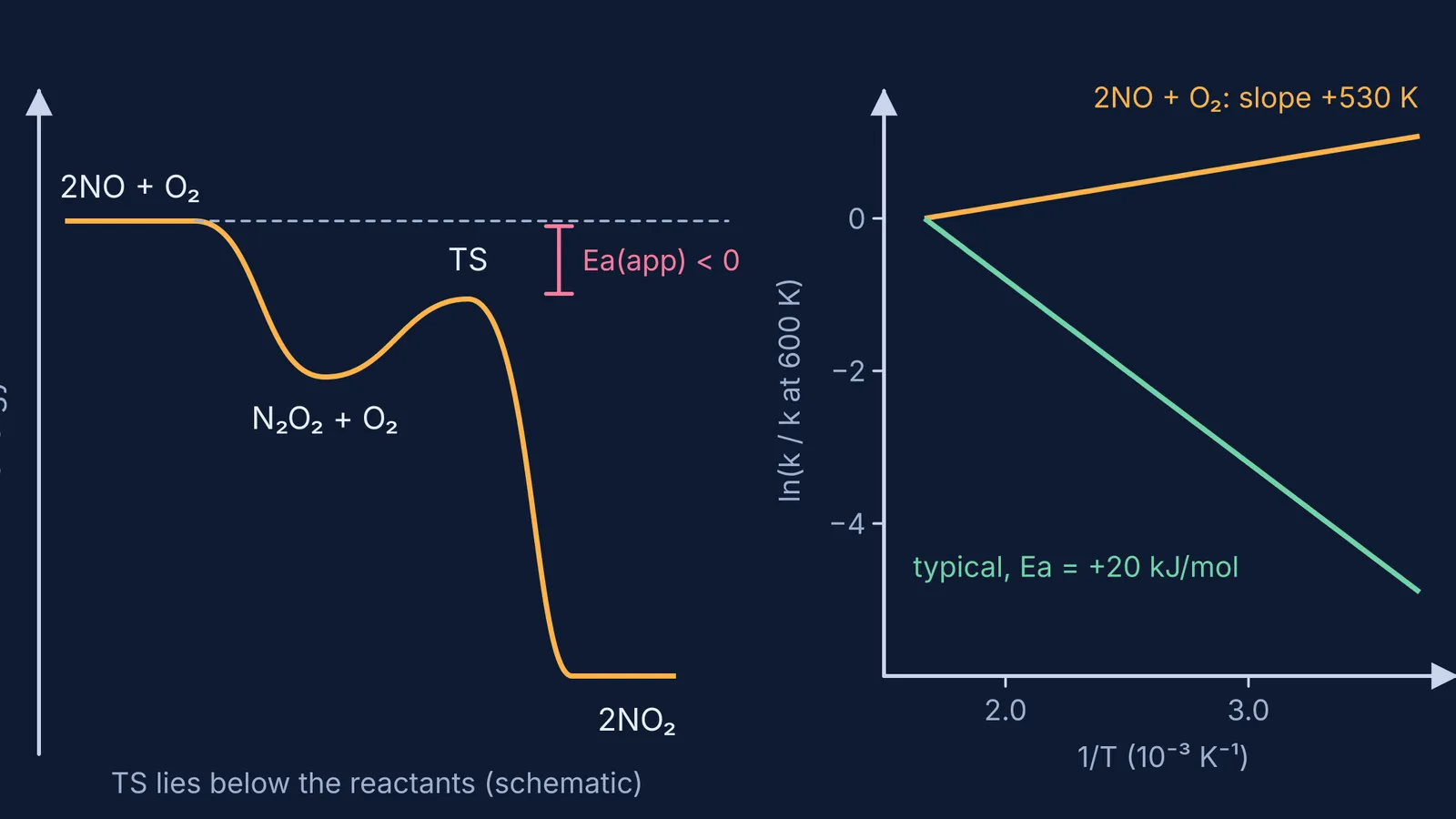
(c) Draw the Arrhenius plot. Plot ln k against 1/T. The slope is −Ea/R = +530 K, so the line rises to the right, the opposite of the usual picture. Arrhenius plot guides often warn that a negative Ea means you dropped a minus sign. That is good advice for ordinary data, so do check your arithmetic. But if k really falls as T rises, a negative Ea is the correct answer. The Arrhenius equation still fits; it just fits with a negative Ea.
Why does 2NO + O₂ get slower when heated?
The usual explanation is that the reaction is not one three-body collision but two steps, with a fast pre-equilibrium first:
Step 1, fast and reversible: 2NO ⇌ N₂O₂. Two NO molecules pair up weakly. This step is exothermic, with enthalpy change ΔH₁ < 0.
Step 2, slow: N₂O₂ + O₂ → 2NO₂, with rate constant k₂ and activation energy Ea₂.
Add the steps and N₂O₂ cancels, leaving 2NO + O₂ → 2NO₂. Now derive the rate law the way our post on finding a rate law from a reaction mechanism does:
Rate = k₂[N₂O₂][O₂], from the slow step.
Step 1 is at equilibrium: k₁[NO]² = k₋₁[N₂O₂], so [N₂O₂] = K₁[NO]², where K₁ = k₁/k₋₁.
Substitute: rate = k₂K₁[NO]²[O₂].
That is exactly the rate law NCERT gets from its Table 3.2 data, rate = k[NO]²[O₂], with k = K₁k₂.
Now the temperature dependence. Taking logs, ln k = ln K₁ + ln k₂. K₁ changes with temperature according to ΔH₁, and k₂ according to Ea₂, so, to a good approximation:
Ea(apparent) = Ea₁ − Ea₋₁ + Ea₂ = ΔH₁ + Ea₂
If the pre-equilibrium is more exothermic than the slow step's barrier is high, the sum is negative. With illustrative values only, ΔH₁ = −15 kJ/mol and Ea₂ = +10 kJ/mol, Ea(apparent) = −5 kJ/mol, close to the measured −4.4. In words: heating speeds up step 2, but it also breaks up more N₂O₂ (Le Chatelier's principle for an exothermic step), and the second effect wins.
Some books write the pre-equilibrium through NO₃ instead: NO + O₂ ⇌ NO₃, then NO₃ + NO → 2NO₂. That gives the same rate law and the same sign argument. The IUPAC sheet notes that Olbregts interpreted his data with either NO₃ or the dimer (NO)₂, and research papers still discuss which intermediate matters more.
Is 2NO + O₂ termolecular, then?
NCERT uses it as a termolecular example because a single step with three molecules would also give rate = k[NO]²[O₂]. The rate law alone cannot tell the two pictures apart, and the rate-law post shows the same problem for 2NO + Cl₂. The negative temperature dependence is the extra clue that chemists usually read as a short-lived complex forming first. The textbook example still illustrates what molecularity means.
Why does the Ostwald process cool NO before oxidising it?
In the Ostwald process, NO leaves the platinum gauze at around 900 °C and is cooled before it meets more oxygen. Our post on Haber and Ostwald process conditions explains the equilibrium reason: 2NO + O₂ → 2NO₂ is exothermic (−114.1 kJ/mol), so a lower temperature favours NO₂. The rate points the same way. Within the IUPAC range, cooling from 600 K to 300 K makes k about 2.4 times larger. Do not extrapolate the formula to 900 °C, though; it is only evaluated up to 600 K, and above that k rises again.
What should you write in a board, JEE or NEET exam?
Molecularity of 2NO + O₂ → 2NO₂: termolecular. That is the NCERT answer.
Order: 2 in NO, 1 in O₂, 3 overall.
"Effect of temperature on rate" in general: rate increases with temperature. Do not bring in this exception unless the question does.
If data show k falling as T rises: calculate Ea as usual and keep the negative sign.
If a question gives a fast exothermic pre-equilibrium: write k = K₁k₂ and Ea(apparent) = ΔH₁ + Ea₂.
To see how the slope of an Arrhenius plot follows Ea, try the Fermi Simulation Lab, which has interactive simulations for ideas that are easier to see than read.
Quick checklist
IUPAC: k = 3.3 × 10⁻³⁹ e^(530/T) cm⁶ molecule⁻² s⁻¹, 270–600 K.
Ea(apparent) ≈ −4.4 kJ/mol; k(300 K) is about 2.4 times k(600 K).
Pre-equilibrium: k = K₁k₂, so Ea(apparent) = ΔH₁ + Ea₂.
Exam answer for molecularity: still termolecular.


