

On this page
Most Arrhenius questions give you rate constants at two temperatures and ask for the activation energy. A few problems in the NCERT Class 12 Chemical Kinetics exercises do something different. They print the equation already filled in, such as k = (4.5 × 10¹¹ s⁻¹) e^(−28000 K/T), and ask for Ea. If the only tool you know is the two-temperature formula, there is nothing to plug in, and many students get stuck. The skill you need is matching: lay the given equation over the standard form and read Ea and A straight off it. This post works three problems of this type: a hydrocarbon decomposition, the decomposition of H₂O₂, and a reverse case where you find A. Exercise numbers shift between reprints, so look for them by their wording.
What are the three forms of the Arrhenius equation?
NCERT writes the equation as k = A e^(−Ea/RT). Taking logs gives two more forms. Learn to see all three as the same thing:
Exponential form: k = A e^(−Ea/RT). The number that multiplies 1/T inside the exponent is Ea/R.
Natural log form: ln k = ln A − Ea/RT. The coefficient of 1/T is Ea/R.
Base-10 log form: log k = log A − Ea/(2.303RT). The coefficient of 1/T is Ea/(2.303R).
In every form, the term that does not contain T gives A (or its log), and the term with 1/T carries Ea. Two unit facts help you check yourself. First, Ea/RT has no units, so the number standing in for Ea/R must have units of kelvin. That is why the problem writes "28000 K/T": kelvin over kelvin cancels. Second, A always has the units of k, so a first-order reaction has A in s⁻¹. Our post on what the pre-exponential factor A means explains why.
How do you find Ea from k = (4.5 × 10¹¹ s⁻¹) e^(−28000 K/T)?
This is the hydrocarbon decomposition problem. Work it in three steps.
Match the exponent. Put e^(−28000 K/T) beside e^(−Ea/RT). The two match only if Ea/R = 28 000 K.
Multiply by R. Ea = 28 000 K × 8.314 J K⁻¹ mol⁻¹ = 232 792 J mol⁻¹, which is about 232.8 kJ mol⁻¹.
Read A. The factor in front is A = 4.5 × 10¹¹ s⁻¹. The unit s⁻¹ tells you the reaction is first order.
The trap is to write Ea = 28 000. A number in kelvin cannot be an energy. If you ever want this equation in base-10 form, divide the exponent by 2.303: log k = 11.65 − 12 158 K/T.
How do you find Ea and the temperature from log k = 14.34 − 1.25 × 10⁴ K/T?
This is the H₂O₂ problem. The first-order rate constant for the decomposition of H₂O₂ is given by log k = 14.34 − 1.25 × 10⁴ K/T. Find Ea, and the temperature at which the half-period is 256 min.
Match the form. This is the base-10 form, log k = log A − Ea/(2.303RT). So Ea/(2.303R) = 1.25 × 10⁴ K.
Find Ea. Ea = 1.25 × 10⁴ × 2.303 × 8.314 = 239 339 J mol⁻¹, which is about 239.3 kJ mol⁻¹. The 2.303 is already inside the slope, so you multiply by it once and only once.
Read A. log A = 14.34, so A = 10^14.34, which is about 2.2 × 10¹⁴ s⁻¹.
Turn the half-life into k. First convert to seconds: 256 min = 15 360 s. For a first-order reaction, k = 0.693/t½ = 0.693/15 360 = 4.51 × 10⁻⁵ s⁻¹.
Take the log. log k = −4.346. Keep three decimals here.
Solve for T. 1.25 × 10⁴/T = 14.34 − log k = 14.34 + 4.346 = 18.686. So T = 12 500/18.686 = 669 K.
Two slips give a wrong temperature. If you round log k to −4.3, you get T = 671 K, which is about 2 K off, because T depends on the small difference in the denominator. If you leave the half-life in minutes, k = 2.71 × 10⁻³ min⁻¹ and you get T = 739 K. That is wrong because the 14.34 in the equation is log A with A in s⁻¹, so k must be in s⁻¹ as well.
How do you find A when you know k and Ea?
This problem runs the other way. The rate constant for the decomposition of a hydrocarbon is 2.418 × 10⁻⁵ s⁻¹ at 546 K, and Ea = 179.9 kJ mol⁻¹. Find the pre-exponential factor.
Rearrange the log form. log A = log k + Ea/(2.303RT).
Log of k. log(2.418 × 10⁻⁵) = −4.617.
Energy term, in joules. Ea/(2.303RT) = 179 900/(2.303 × 8.314 × 546) = 17.208.
Add. log A = −4.617 + 17.208 = 12.591.
Antilog. A = 10^12.591, which is about 3.9 × 10¹² s⁻¹.
Check the answer against what A means. The ratio k/A equals e^(−Ea/RT), the fraction of molecules with energy of at least Ea. Here k/A is about 6 × 10⁻¹⁸, a tiny fraction, which fits a high activation energy. If you forget to convert kJ to J, the energy term becomes 0.0172 and you get A ≈ 2.5 × 10⁻⁵ s⁻¹. That is barely larger than k itself, which would mean almost every molecule clears the barrier despite a 180 kJ barrier. A should come out far larger than k for any real Ea, so treat this as an alarm.
What does a printed Arrhenius equation look like as a graph?
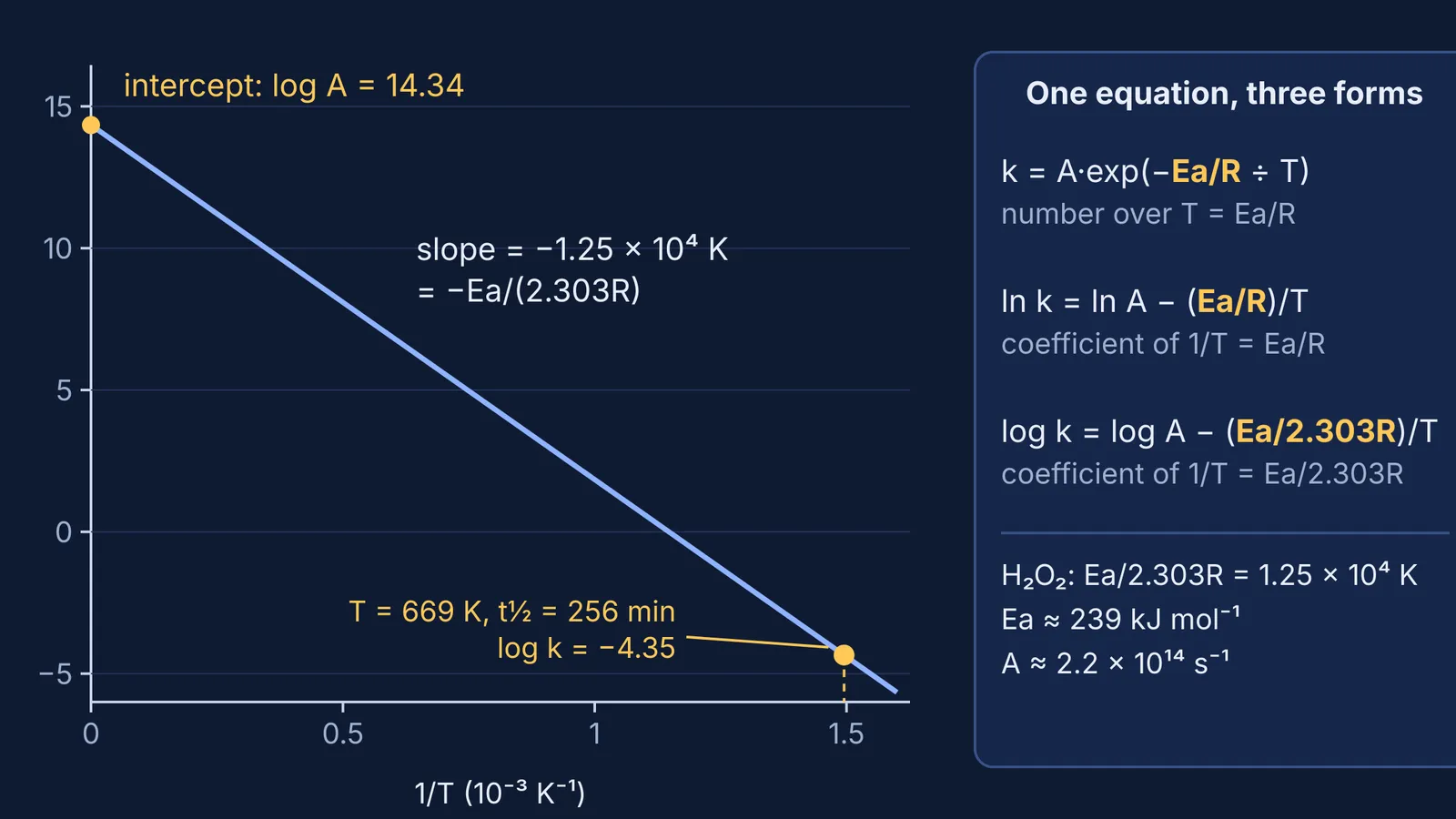
A printed equation is just the straight line from an Arrhenius plot, already fitted. For the H₂O₂ equation, plot log k against 1/T. The line meets the y-axis (where 1/T = 0) at log A = 14.34 and falls with slope −1.25 × 10⁴ K. The point for 669 K sits at 1/T = 1.495 × 10⁻³ K⁻¹ and log k = −4.35. The hero diagram above draws this to scale.
So the three kinds of question are one skill seen from different sides:
Given a table of k and T, you fit the line yourself. That method is in our post on finding activation energy from rate data.
Given two half-lives, you can use their ratio directly, as shown in activation energy from half-lives at two temperatures.
Given the equation, the line is already drawn, and you only read its slope and intercept.
If you match the form correctly but your number still does not agree with the answer key, the Fermi Problem Library has a step-by-step solver that explains the reasoning, so you can see which step went wrong.
What should you check before writing the answer?
Name the form first: exponential, ln or log.
The number multiplying 1/T is Ea/R in the e and ln forms, and Ea/(2.303R) in the log form.
That number is in kelvin. It is never Ea itself.
A has the same units as k, and it should be much larger than k.
Convert half-lives to seconds when A or k is in s⁻¹.
Keep Ea in J mol⁻¹ inside the calculation and convert to kJ only at the end.
Keep at least three decimals in log k before you solve for T.


