On this page
The "chlorine tablets" used to disinfect drinking water in emergencies and at home are usually not bleaching powder. Most contain sodium dichloroisocyanurate, NaDCC for short. Its label often promises an amount of "available chlorine" that looks too large: about two-thirds of the tablet's mass, even though only one-third of the mass is chlorine atoms. Working out why uses redox, mole concept and equilibrium.
What is inside a chlorine tablet?
NaDCC is the sodium salt of dichloroisocyanuric acid. Its formula is C₃N₃O₃Cl₂Na. It is a six-membered ring of alternating C and N atoms. Each carbon carries a C=O, two nitrogens carry a chlorine, and the third nitrogen site carries the negative charge (spread onto the neighbouring C=O oxygens), balanced by Na⁺. So both chlorines sit on N–Cl bonds, not on carbon.
The WHO background document on sodium dichloroisocyanurate in drinking-water (February 2008) describes it as a source of free available chlorine, in the form of hypochlorous acid, HOCl. It is used mainly for emergency and household water treatment, and for swimming pools, because it is more stable in sunlight than most chlorine sources.
In water it hydrolyses. WHO writes the overall reaction as:
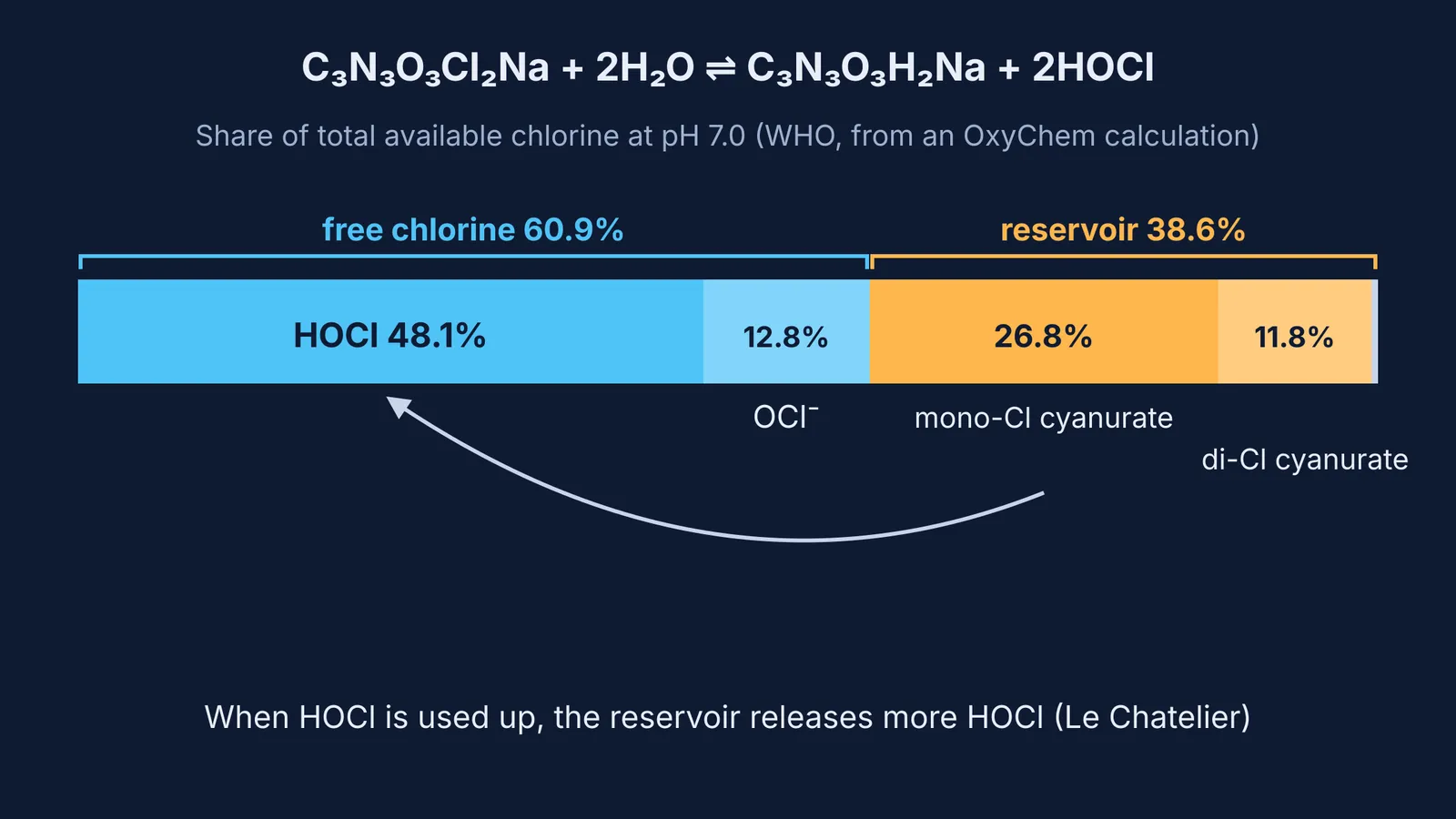
C₃N₃O₃Cl₂Na + 2H₂O ⇌ C₃N₃O₃H₂Na + 2HOCl
Check it: C 3, N 3, Na 1, Cl 2, O 5 and H 4 on each side, charge zero. The other product is sodium cyanurate, with N–H where the N–Cl bonds were.
What is the oxidation state of chlorine in NaDCC?
By the electronegativity rule, Cl (Pauling about 3.16) is slightly above N (about 3.04), which would make chlorine −1. That does not match the chemistry.
Use the hydrolysis instead. Hydrolysis is not redox: no electrons move, only bonds swap partners. The chlorine comes out as HOCl, where it is +1. So in NaDCC it behaves as +1, a "positive chlorine" that is handed over to water as Cl⁺. The same reasoning explains a familiar exam reaction, NCl₃ + 3H₂O → NH₃ + 3HOCl, where nitrogen ends up at −3 and chlorine at +1.
When the tablet disinfects, each HOCl is reduced to chloride:
HOCl + H⁺ + 2e⁻ → Cl⁻ + H₂O
Check: H 2, O 1, Cl 1 on each side; charge +1 − 2 = −1 on the left and −1 on the right. Chlorine goes from +1 to −1, two electrons.
Why is available chlorine 64.5% when chlorine is only 32% by mass?
"Available chlorine" is a convention. It expresses any oxidant as the mass of Cl₂ that would accept the same number of electrons. One Cl₂ accepts 2 electrons (Cl₂ + 2e⁻ → 2Cl⁻). One HOCl also accepts 2 electrons. So each HOCl counts as one Cl₂, worth 70.90 g per mole.
NaDCC releases 2 HOCl, so one mole of it does the work of 2 mol of Cl₂. WHO's footnote says it: in Cl₂ + H₂O ⇌ HOCl + HCl only one chlorine atom ends up as HOCl, while with NaDCC both do. The same electron counting gives chlorine dioxide its 263% figure, as worked in why chlorine dioxide counts as 263% available chlorine.
Worked example: from formula to a bucket of water
Molar masses used: Na 22.990, C 12.011, N 14.007, O 15.999, Cl 35.45, H 1.008 g mol⁻¹.
Molar mass of NaDCC. 22.990 + 3(12.011) + 3(14.007) + 3(15.999) + 2(35.45) = 219.94 g mol⁻¹.
Chlorine by mass. 70.90/219.94 = 32.2%, the number often wrongly quoted as available chlorine.
Available chlorine. 2 mol HOCl count as 2 × 70.90 = 141.80 g of Cl₂. So 141.80/219.94 = 0.6447, or 64.5%. WHO gives exactly 64.5% for pure NaDCC, and 62–64% for the commercial anhydrous product.
The dihydrate. NaDCC·2H₂O has M = 219.94 + 2(18.015) = 255.97 g mol⁻¹. Then 141.80/255.97 = 55.4%. WHO quotes 55.5% (and 55–56% for the commercial product).
Dose per litre. To get 1 mg of available chlorine you need 1/0.6447 = 1.55 mg of NaDCC, the same 100/64.5 = 1.55 that WHO gives.
A tablet in a bucket. Suppose a tablet contains 67 mg of pure NaDCC. It gives 67 × 0.6447 = 43.2 mg of available chlorine. Dissolved in 20 L, that is 43.2/20 = 2.16 mg L⁻¹. Real tablets contain binders, and brands differ.
What is left behind. For a chlorine dose of 10 mg L⁻¹: 10/141.80 = 0.0705 mmol of NaDCC per litre, which leaves 0.0705 × 151.06 = 10.7 mg L⁻¹ of sodium cyanurate. That matches WHO's statement that even at 10 mg L⁻¹ of chlorine, sodium cyanurate stays below 11 mg L⁻¹.
This is a chemistry calculation, not a dosing guide. Always follow the tablet's label and your local health authority's instructions. For reference, WHO's guideline value for free chlorine in drinking water is 5 mg/L, its guideline value for NaDCC is 50 mg/L and for cyanuric acid 40 mg/L. WHO also says "topping-up" a container with extra tablets should be discouraged, because cyanurate then builds up.
What is "reservoir chlorine", and how does Le Chatelier explain it?
The single equation is a simplification. WHO says NaDCC sets up equilibria among six chlorinated and four non-chlorinated isocyanurates within seconds. Chlorine still on nitrogen is reservoir chlorine.
WHO quotes a calculated distribution (from a 1997 OxyChem report, not a measurement) for 1.0 mg L⁻¹ of total available chlorine at pH 7.0:
HOCl: 48.1%
OCl⁻: 12.8%
monochlorocyanurate: 26.8%
dichlorocyanurate: 11.8%
others: under 1%
So free chlorine (HOCl + OCl⁻) is 60.9%, and the reservoir is 38.6%. Now apply Le Chatelier. When HOCl oxidises microbes or organic matter, it is removed, the equilibrium shifts right, and the chlorocyanurates release more. In WHO's words, they "will rapidly dissociate to release more hypochlorous acid". The free chlorine level is buffered.
A bonus check: the HOCl to OCl⁻ split at pH 7 is 48.1 : 12.8. Using pH = pKa + log([OCl⁻]/[HOCl]): pKa = 7 − log(12.8/48.1) = 7.57. That is close to the textbook pKa of HOCl, about 7.5. Why HOCl, not OCl⁻, does most of the killing is explained in why HOCl is the weakest chlorine oxoacid but the strongest oxidiser.
How water labs measure the chlorine actually left in treated water, and what "free" and "combined" mean there, is covered in the DPD chlorine test.
If equilibrium still feels abstract, the Concept Library covers Le Chatelier's principle and acid–base equilibria.
What should you write in the exam?
The hydrolysis: C₃N₃O₃Cl₂Na + 2H₂O ⇌ C₃N₃O₃H₂Na + 2HOCl, with the balance shown.
Chlorine on nitrogen is taken as +1 because hydrolysis gives HOCl without any redox step.
Available chlorine = mass of Cl₂ with the same oxidising power ÷ mass of sample × 100. Each HOCl counts as one Cl₂.
For iodometric questions: HOCl + 2I⁻ + H⁺ → I₂ + Cl⁻ + H₂O, so 1 mol NaDCC gives 2 mol I₂ and needs 4 mol thiosulphate.
To practise numericals like these for the exam, Fermi Test Prep offers JEE Main and Advanced preparation with an AI tutor.
Quick checklist
NaDCC has two N–Cl chlorines (+1), giving 2 HOCl; Cl₂ gives only 1 HOCl.
Available chlorine: 64.5% (anhydrous), about 55.4% (dihydrate); chlorine by mass is only 32.2%.
At pH 7, WHO's calculated split is 60.9% free chlorine and 38.6% reservoir, which releases HOCl as it is used up.
For real water: follow the label and health-authority advice; WHO's free chlorine guideline value is 5 mg/L.