

On this page
Ask which chlorine oxoacid is the strongest acid and the answer is HClO₄. Ask which one oxidises things fastest and the answer is HOCl, the weakest acid of the four. The two orders run in opposite directions, and JEE and NEET questions like to set them side by side. The acid half is the familiar one. The oxidising half is where most books give a reason that does not quite hold up, so this post looks at the data and gives the better explanation: the order of oxidising power comes mostly from how fast each species reacts, not from its standard electrode potential alone.
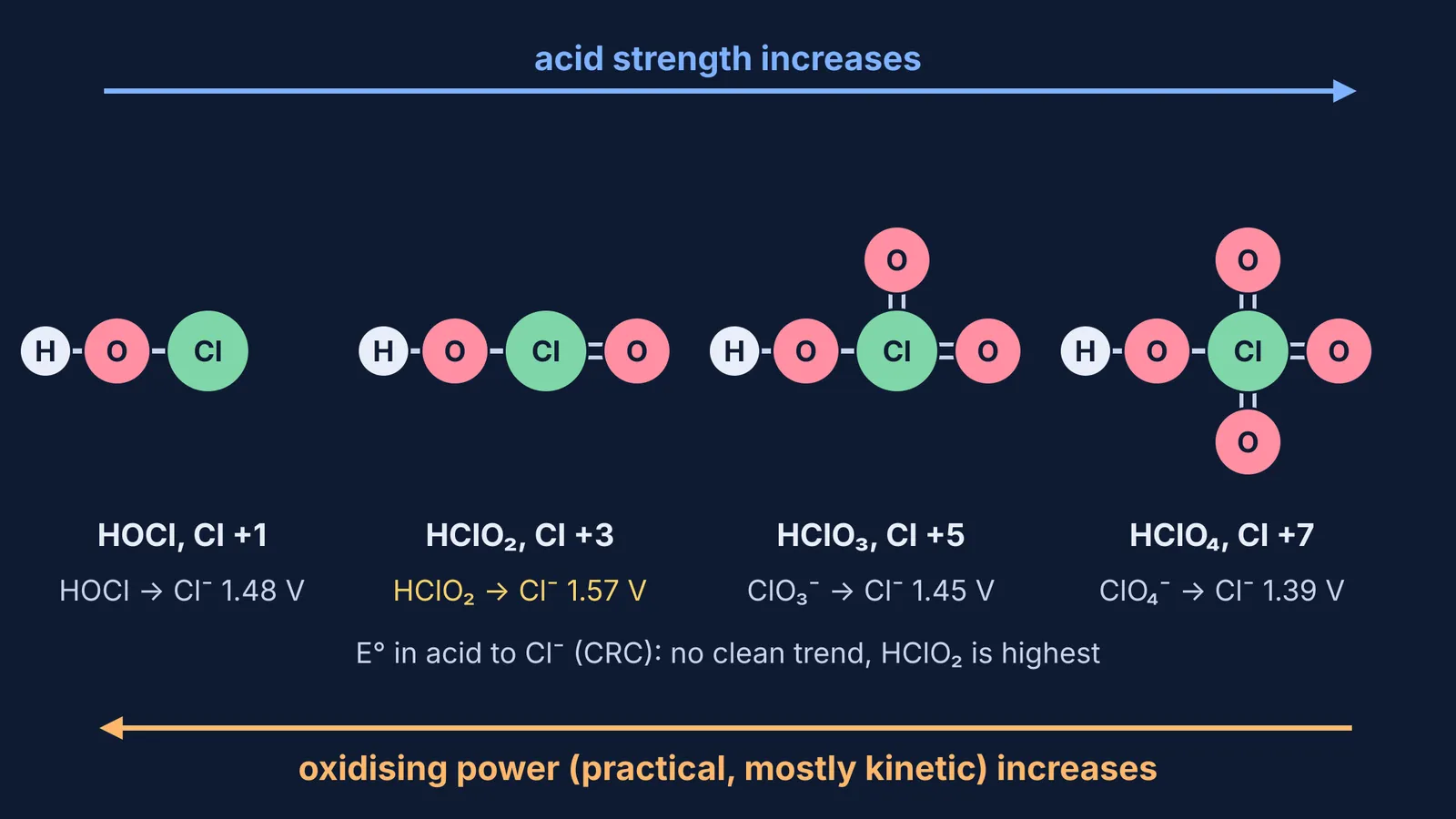
What are the two orders for chlorine oxoacids?
Acid strength: HOCl < HClO₂ < HClO₃ < HClO₄.
Oxidising power (textbook order): HOCl > HClO₂ > HClO₃ > HClO₄.
The oxidation state of chlorine rises along the series: +1, +3, +5, +7. So the species with chlorine in its highest oxidation state is the slowest oxidant. That surprises students, because "higher oxidation state means stronger oxidant" works for many other series.
Why HClO₄ is the strongest acid, with more oxygens spreading the negative charge of the anion, is explained in why HClO₄ beats HOCl in acidity. That argument is not repeated here, but keep it in mind. The same stable, charge-spread anion turns up again below.
Do standard electrode potentials explain the oxidising order?
Only roughly. Here are the standard reduction potentials in acid, each to Cl⁻, from one table (CRC Handbook of Chemistry and Physics, rounded):
HOCl + H⁺ + 2e⁻ → Cl⁻ + H₂O, E° ≈ 1.48 V
HClO₂ + 3H⁺ + 4e⁻ → Cl⁻ + 2H₂O, E° ≈ 1.57 V
ClO₃⁻ + 6H⁺ + 6e⁻ → Cl⁻ + 3H₂O, E° ≈ 1.45 V
ClO₄⁻ + 8H⁺ + 8e⁻ → Cl⁻ + 4H₂O, E° ≈ 1.39 V
Two things stand out.
There is no clean order. HClO₂ has the highest E°, above HOCl. The values fall overall from HClO₂ to ClO₄⁻, but HOCl does not sit at the top.
All four are strong oxidants on paper. Every value is above E°(Cl₂/Cl⁻) ≈ 1.36 V. Perchlorate, the "weak" oxidant, is thermodynamically a slightly stronger oxidant than chlorine gas. Per mole it also takes 8 electrons, so its ΔG° of reduction (−nFE°) is far larger than that of HOCl.
So E° cannot be the main reason for the textbook order. The order HOCl > HClO₂ > HClO₃ > HClO₄ rests largely on kinetics: how quickly each species actually reacts at room temperature in dilute solution.
Why does perchlorate react so slowly?
To be reduced, an oxoanion has to let a reducing agent get at chlorine and then break a Cl–O bond. Perchlorate makes both steps hard.
Chlorine is buried. In ClO₄⁻ the chlorine sits at the centre of a tetrahedron of four oxygens, with no lone pair and no open side for an attacking species to approach.
The charge is spread evenly. All four Cl–O bonds are equivalent, and the −1 charge is shared over four oxygens. There is no especially electron-poor or reactive spot. This is the same delocalisation that makes HClO₄ such a strong acid.
The Cl–O bonds are short and strong. They are about 145 pm long, against about 170 pm for the single Cl–O bond in HOCl. Breaking one costs a lot of energy, so the activation energy is high.
HOCl is the opposite case. It has a single, weak, polar Cl–O bond. Its chlorine carries a partial positive charge and is open to attack, so a nucleophile such as I⁻ can bond directly to chlorine and push out OH⁻. That is a low-energy path, so the reaction is fast. HClO₂ and ClO₃⁻ sit in between: more oxygens, more shielding, slower reactions.
So the factor that makes an oxoacid strong (a stable, symmetric, charge-spread anion) is also the factor that makes the anion slow to accept electrons. That is the real link between the two opposite orders.
Worked example: HOCl and perchlorate with iodide
Take E°(I₂/I⁻) ≈ 0.54 V from the same table and compare the two reactions.
HOCl with iodide. HOCl + 2I⁻ + H⁺ → I₂ + Cl⁻ + H₂O. Check charge: −2 + 1 = −1 on the left, −1 on the right.
E°cell and K. E°cell = 1.48 − 0.54 = 0.95 V, with n = 2. log K = nE°/0.0591 = 2 × 0.946/0.0591 ≈ 32.
Perchlorate with iodide. ClO₄⁻ + 8I⁻ + 8H⁺ → Cl⁻ + 4I₂ + 4H₂O. Check charge: −1 − 8 + 8 = −1 on the left, −1 on the right. Atoms: 8 I, 8 H and 4 O on each side.
E°cell and K. E°cell = 1.39 − 0.54 = 0.85 V, with n = 8. log K = 8 × 0.853/0.0591 ≈ 115.
What thermodynamics says. Both reactions should go to completion. Perchlorate has the larger K by a huge margin.
What you see. HOCl turns iodide solution brown with iodine at once, and starch turns blue-black. Cold, dilute perchlorate with iodide shows no noticeable reaction at room temperature.
Conclusion. The reaction with the far larger K is the one that does not happen on any useful time scale. The difference is rate, not E°.
Zinc gives the same lesson. Zinc dissolves in dilute HClO₄ just as it does in dilute HCl: Zn + 2HClO₄ → Zn(ClO₄)₂ + H₂. Hydrogen ions do the oxidising and the perchlorate ions are spectators. Compare dilute nitric acid, where the nitrate ion itself is reduced. The way bleach uses HOCl and OCl⁻ in practice is covered in how bleach removes stains through oxidation.
If you want to practise more questions that mix E° with what actually happens, the Fermi Problem Library has a step-by-step solver that explains the reasoning at each stage.
When is perchloric acid a strong oxidiser?
"Weak oxidiser" applies to cold, dilute perchloric acid only. Hot, concentrated HClO₄ is a violent oxidiser. It reacts explosively with organic matter, and anhydrous HClO₄ is dangerously unstable. This fits the kinetic picture: heat and high concentration supply the energy and the collisions needed to get over the barrier that keeps dilute perchlorate inert. Chlorates behave similarly. Solid KClO₃ mixed with sulphur or sugar is a well-known explosive hazard. How hypochlorite and chlorate are made from chlorine in the first place is in chlorine with cold dilute and hot concentrated NaOH.
Quick checklist
Acid strength: HOCl < HClO₂ < HClO₃ < HClO₄.
Practical oxidising power: HOCl > HClO₂ > HClO₃ > HClO₄.
E° to Cl⁻ in acid: about 1.48, 1.57, 1.45 and 1.39 V. No clean order, and all are strong oxidants on paper.
Perchlorate is slow because chlorine is shielded, the charge is spread and the Cl–O bonds are strong.
HOCl reacts fast through its weak, exposed Cl–O bond.
Hot, concentrated HClO₄ is a dangerous oxidiser; the "weak" label is for cold, dilute acid.


