On this page
Music and Us is Chapter 6 of NCERT's Madhurima, the new Class 9 Art Education textbook (First Edition, April 2026). It opens the book's Music section. This guide covers its three big ideas, with our own practice questions.
What does Music and Us cover in Class 9?
The chapter has three strands: genres and active listening, music and navarasa, and folk songs as community knowledge. In the CBSE Art Education curriculum for Class IX (2026-27), this matches the unit "Music, Me and Us", planned for 5.8 hours (7 periods).
Your school assesses Art Education entirely internally, out of 100 marks, split into 40 for theory and 60 for practical, according to the same curriculum. In the theory paper, Music carries 4 marks. Those 4 marks are shared by all four Music chapters (6 to 9); the curriculum does not split them by chapter, and there is no board exam in this subject. For the wider picture, read do Class 9 marks matter.
What is a genre (vidhā) in music?
Madhurima treats a genre, also called a form or vidhā, as a category of music with its own typical features and sound. Śhailī is the style of presentation inside that category. Instruments, singing style, rhythm and region all identify a genre.
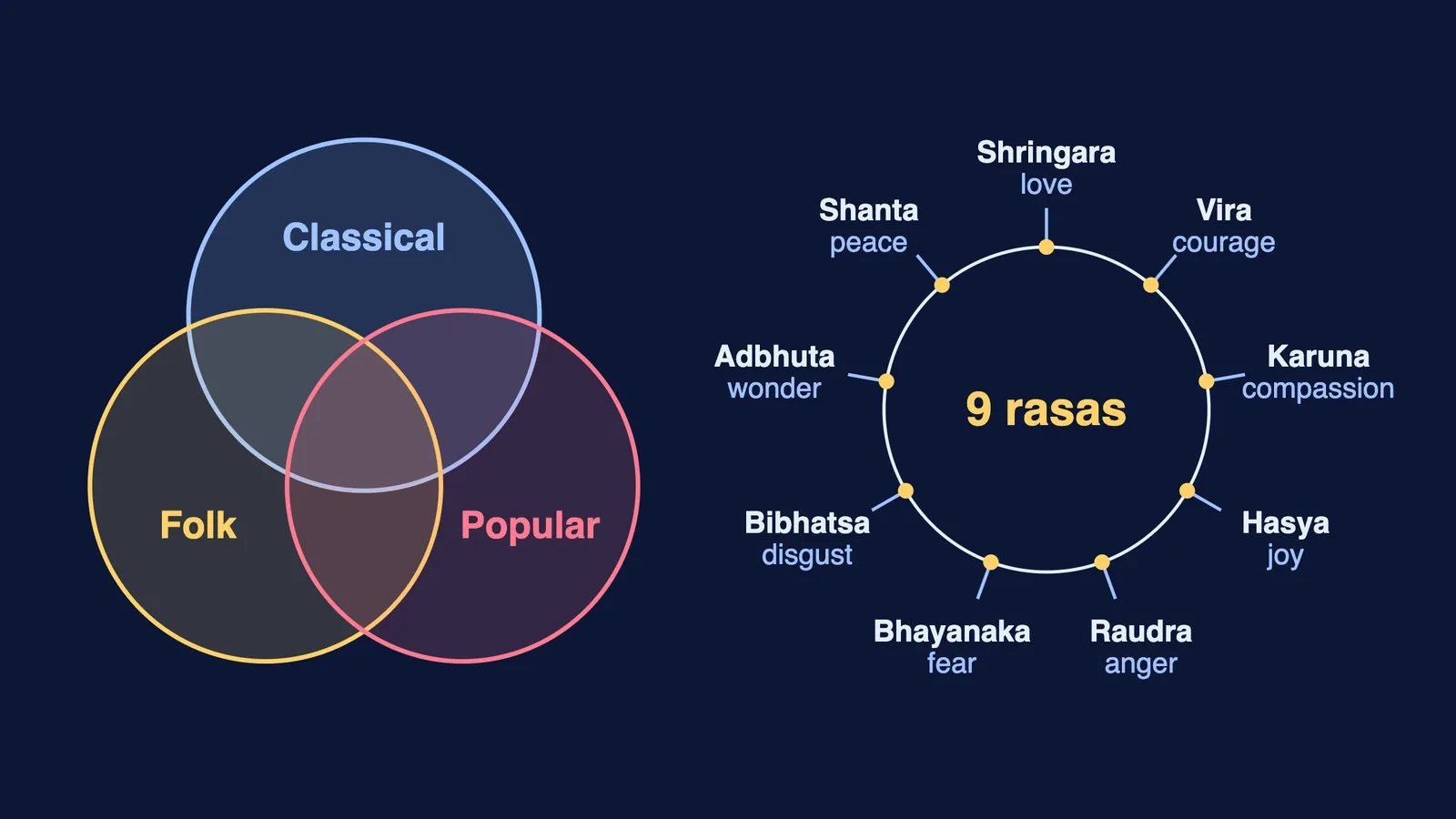
The book sorts most Indian music into three broad areas:
Classical and semi-classical: melody built on rāgas, many tālas (rhythm cycles), and plenty of improvisation.
Folk, indigenous and regional: rooted in a community's language and customs, handed down orally, and tied to work, rituals and festivals.
Popular and film: a hybrid that borrows from Indian and global sources and follows current trends.
These boxes overlap. The chapter's own examples include rāgas that grew out of folk tunes and film songs set in rāgas, and it places devotional music and fusion where all three meet.
Songs also have a shape. A devotional song usually opens with a chorus, called the sthāyī or pallavī, and then moves through two or more verses, called antarās or charaṇas.
How do you practise active listening?
The curriculum asks for 10 minutes of active listening in every music class. The chapter adds a music journal that you keep through Grades 9 and 10, logging songs you hear, learn and write.
Its example is Kumar Gandharva, who lost his voice to tuberculosis at 23, spent years in bed listening to folk songs, bells and birds, and came back with deeper music.
Worked example (made up for practice): your teacher plays a slow song with harmonium, tabla and a group of voices repeating one line. Genre: devotional (chorus then verses, the chapter's devotional shape). Structure: the repeated line is the sthāyī; solo lines between are antarās. Rasa: śhānta. Change: softer tabla in verse one.
How is navarasa linked to music?
Indian treatises name nine rasas, or emotions, and Madhurima lists them: love (śhṛiṅgāra), courage (vīra), compassion (karuṇa), joy (hāsya), anger (raudra), fear (bhayānaka), disgust (bībhatsa), wonder (adbhuta) and peace (śhānta). A calm piece leans towards śhānta; a strong beat can raise vīra.
The matching activity is a playlist of about five songs. For each, note the genre, rāga and tāla if classical, composer, lyricist, performers, and the mood you play it in. If one of your playlists is for homework, see what experiments found about studying with music.
How do folk songs carry traditional knowledge?
The chapter argues that folk songs often act as a storehouse of a community's know-how. Its example is a seed-sowing song from Nagaland, sung by women of the Phom community. Read as a farming calendar, it moves from preparing forest land in December (the month Ketnyiü), through clearing shrubs for new jhum land, praying for a good harvest and building a farm house, to readying seeds of paddy, yam, maize, cucumber and pumpkin.
Then you compare a song from your own region, and write and sing lyrics about a family tradition, with a chorus and at least one verse.
Practice questions for Music and Us
These are our own questions; the marks are our suggestion, not a CBSE format.
(1 mark) Which term means a style of presentation within a genre: vidhā, śhailī, tāla or rāga?
(2 marks) A film song is set in a rāga. Name the two broad areas it draws on and one feature of each.
(2 marks) Place each in one of the three broad areas: a Hindustani vocal recital, an Indian pop single, a harvest song sung in a village.
(3 marks) Imagine a boat song from a fishing village that mentions the tide, the moon and the season's first catch. Name three things it could help people remember, and say why passing it on orally matters.
(4 marks) Build a three-song playlist for one rasa and justify each choice by genre, instruments and rhythm.
Answers to 1 and 2: śhailī; classical (rāga-based melody) and popular or film (borrows from many Indian and global influences).
Juggling Art Education with maths and science this term? Fermi's AI tutor works out what you already know and builds a plan for the session.