On this page
Many students study with earphones in, and many parents worry about it. Researchers have tested this for decades. Their answer is not “music is bad”. It is that what helps or hurts depends on two things: whether the music has words, and what your brain is doing at the time.
Is it good to study with music?
On average, background music neither helps nor hurts. A 2011 meta-analysis of studies on adult listeners found a null effect overall (Kämpfe, Sedlmeier and Renkewitz, Psychology of Music). The authors say this zero is most probably good and bad effects averaging out.
Look closer and a pattern appears. The same meta-analysis found that background music disturbs reading and has small harmful effects on memory, while it has a positive effect on emotional reactions and sports performance. Studying is mostly reading and memorising, so it falls on the wrong side of that line.
Do lyrics make studying harder?
Usually, yes, and this is one of the clearest patterns in the research.
In a classic memory experiment, people recalled lists of nine digits while music played in the background (Salamé and Baddeley, 1989). In the first experiment, vocal and instrumental music both disrupted recall compared with quiet, and vocal music disrupted it more. A repeat found only vocal music significantly worse than silence. Noise that pulsed with the rhythm of speech did not differ from silence.
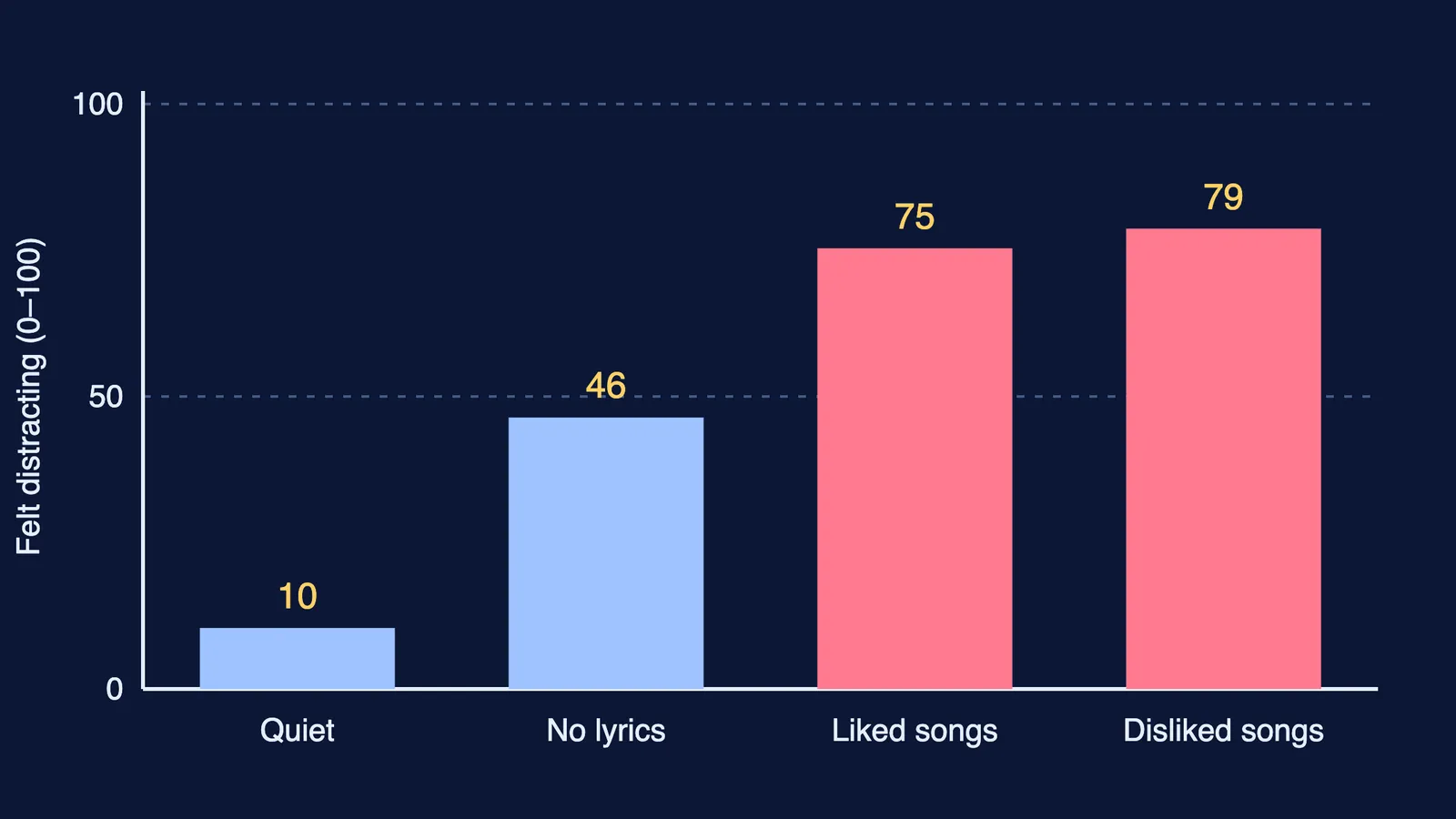
Reading shows the same pattern. In a 2014 experiment, 30 university students answered questions on passages under four conditions: quiet, songs with lyrics from their own music collection, disliked songs with lyrics (thrash metal chosen by the researchers), and an instrumental thrash metal track (Perham and Currie, Applied Cognitive Psychology; accepted manuscript). Scores were best in quiet and with the instrumental track, which did not differ significantly from each other. Both lyrical conditions were significantly worse than quiet.
The students noticed, too. On a 0 to 100 scale in the same study, they rated their own lyrical songs about 75 for distraction, the instrumental track about 46 and quiet about 10.
That earlier study found serial recall poorer with liked and disliked music alike than in quiet (Perham and Vizard, 2011).
Is instrumental music fine for studying?
Often, if it is slow and soft. One study had 25 participants read passages with instrumental music at two speeds and two volumes (Thompson, Schellenberg and Letnic, 2012). Comprehension fell significantly below a silent baseline when the music was fast and loud, the combination the authors found most disruptive.
Music without words did less damage than songs in these experiments, though it still hurt digit recall.
Does music before studying help?
It may, through mood rather than magic. The famous “Mozart effect” was tested by comparing a lively Mozart sonata, a slow, sad Albinoni adagio and silence before a spatial task (Thompson, Schellenberg and Husain, 2001). Only the Mozart listeners did better than silence, and when the researchers statistically held arousal and mood constant, the effect disappeared.
The practical reading: a song you enjoy may lift your energy before you sit down. Then switch it off.
A sound plan for your study session
Match the sound to the task:
Memorising formulas, reactions, definitions or dates: silence.
Reading a new NCERT chapter or long passages: silence, or soft instrumental at most. No lyrics.
Routine practice you already know how to do, such as redrawing diagrams: slow, quiet instrumental is less likely to get in the way.
Warm-up: one or two songs you enjoy, then off.
Breaks: lyrics welcome.
If you are not sure your playlist hurts, test it instead of arguing about it:
Pick two problem sets or two passages of equal difficulty.
Do one in silence and one with your usual music, for the same length of time, on the same day.
Mark both. Note your score and how many times you checked your phone or skipped a track.
Repeat the next day with the order swapped, so tiredness does not decide the result.
Parents, a script that tends to land better than a ban: “Try the two-day test with me. If music really doesn't change your score, keep it for practice. If it does, keep it for breaks.”
Keep the volume low whatever you choose; our guide for families of a teen who wears earphones all day covers that. If music is filling the silence because you get stuck and bored, the problem is the stuck part. The Fermi Problem Library has worked problems with a step-by-step solver that explains the reasoning rather than printing an answer.
If you do not know where to start a session, Fermi's AI tutor can work out what you already know and build a plan for the session. To see where your study time actually goes, try a one-week study time audit, and if your phone is the bigger pull than music, use a 3-step plan to stop scrolling reels before you study.
If music is mainly how you cope with stress that feels heavy, talk to someone you trust, or call Tele MANAS on 14416.