
On this page
If your teenager has earphones in from the moment they get home until they fall asleep, you are dealing with two separate questions. One is about their ears: how loud, and for how long. The other is about your home: when do you actually talk? Both have fixable answers, and neither needs a fight.
According to the World Health Organization, nearly 50% of people aged 12 to 35, or 1.1 billion young people, are at risk of hearing loss from prolonged and excessive exposure to loud sounds.
A 2022 systematic review of 33 studies in BMJ Global Health gave a pooled estimate that 23.81% of young people aged 12 to 34 are exposed to unsafe listening from personal listening devices.
How loud is too loud for earphones?
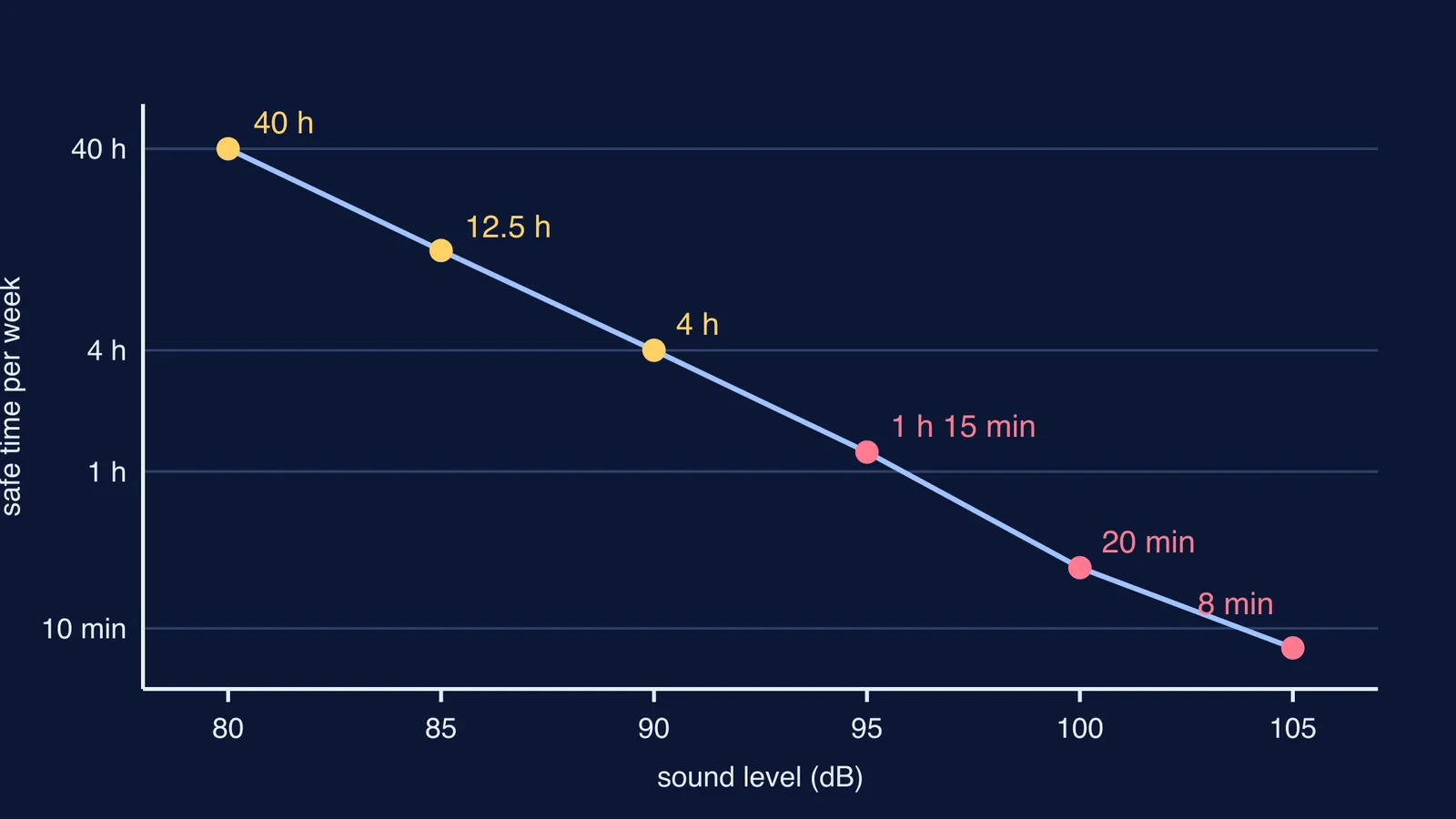
WHO's guidance works like a weekly sound budget: the louder the sound, the less time you can safely spend with it. Its safe listening Q&A gives these limits:
80 dB: up to 40 hours a week
85 dB: 12 hours 30 minutes a week
90 dB: four hours a week
95 dB: 1 hour 15 minutes a week
100 dB: 20 minutes a week
105 dB: 8 minutes a week
Each 5-decibel step cuts the safe time to roughly a third. Phones do not usually show decibels on the volume bar, so WHO's practical rule is simpler: set the device to no more than 60% of maximum volume, use well-fitted, noise-cancelling headphones so you do not turn up the sound to drown out a noisy room, and use an app or phone setting that tracks your exposure.
How many hours of earphones a day is safe?
There is no single daily number, because time and volume trade off against each other. Here is a worked example using the WHO limits above.
Say your child listens for 3 hours on each school day and 5 hours on each weekend day. That is 15 + 10 = 25 hours a week.
At around 80 dB, 25 hours is inside the 40-hour weekly budget.
At around 85 dB, the budget is 12.5 hours, so 25 hours is double the safe amount.
At around 90 dB, the 4-hour budget runs out on the second school day.
So the same habit can be fine or risky depending on the volume. If you want one change that protects their ears, turn the volume down rather than banning earphones. WHO also advises giving your ears frequent breaks from loud sound so the sensory cells inside can recover.
WHO notes that regular loud or prolonged exposure can cause noise-induced hearing loss that cannot be reversed. Our explainer on how the cochlea turns sound into nerve signals covers the hair cells that loud sound can damage.
Why does my teenager wear earphones all the time at home?
Usually for ordinary reasons: music, podcasts, lecture videos, gaming with friends, or blocking out a noisy flat. In a small home, earphones are also a way to get some private space.
The risk is quieter. When earphones are always in, the small conversations that happen in passing, in the kitchen, at the door, during a chore, stop happening, and nobody notices until weeks have gone by. If the earphones go in mainly for long study videos, our guide to music while studying covers when sound helps focus and when it hurts. A shorter session with Fermi's AI tutor, which works out what you already know and builds a plan for the session, is one alternative to hours of passive lecture videos.
If the earphones seem to be about shutting everyone out, along with low mood, poor sleep or dropping friends, talk to a doctor or counsellor, or call India's free Tele MANAS mental health helpline on 14416.
What family rules work for earphone-free hours?
Aim for a few protected windows rather than a blanket ban.
Meals: both ears free, and adults put phones away too. Our guide to a phone-free family dinner has more on making this stick.
The first 10 minutes after anyone comes home: earphones out, a quick hello and how the day went.
Shared rooms: one earbud out, or a shoulder tap means "pause, I'm talking to you".
One fixed earphone-free hour on the weekend, such as a walk, a chore together, or a drive.
A weekly volume check: check the phone's sound settings together to see whether listening stays under the 60% of maximum that WHO suggests.
Let your teen add one rule for the adults, such as not interrupting when one earbud is out for a call. Rules both sides keep last longer.
Start with one window this week and add the next once it feels normal.