
On this page
Your 16-year-old has asked for a dating app, or you have found one on their phone. Before you answer, it helps to know what the apps and Indian law say, what the real risks are, and how to talk so your teen keeps coming to you.
Can a 16-year-old use a dating app in India?
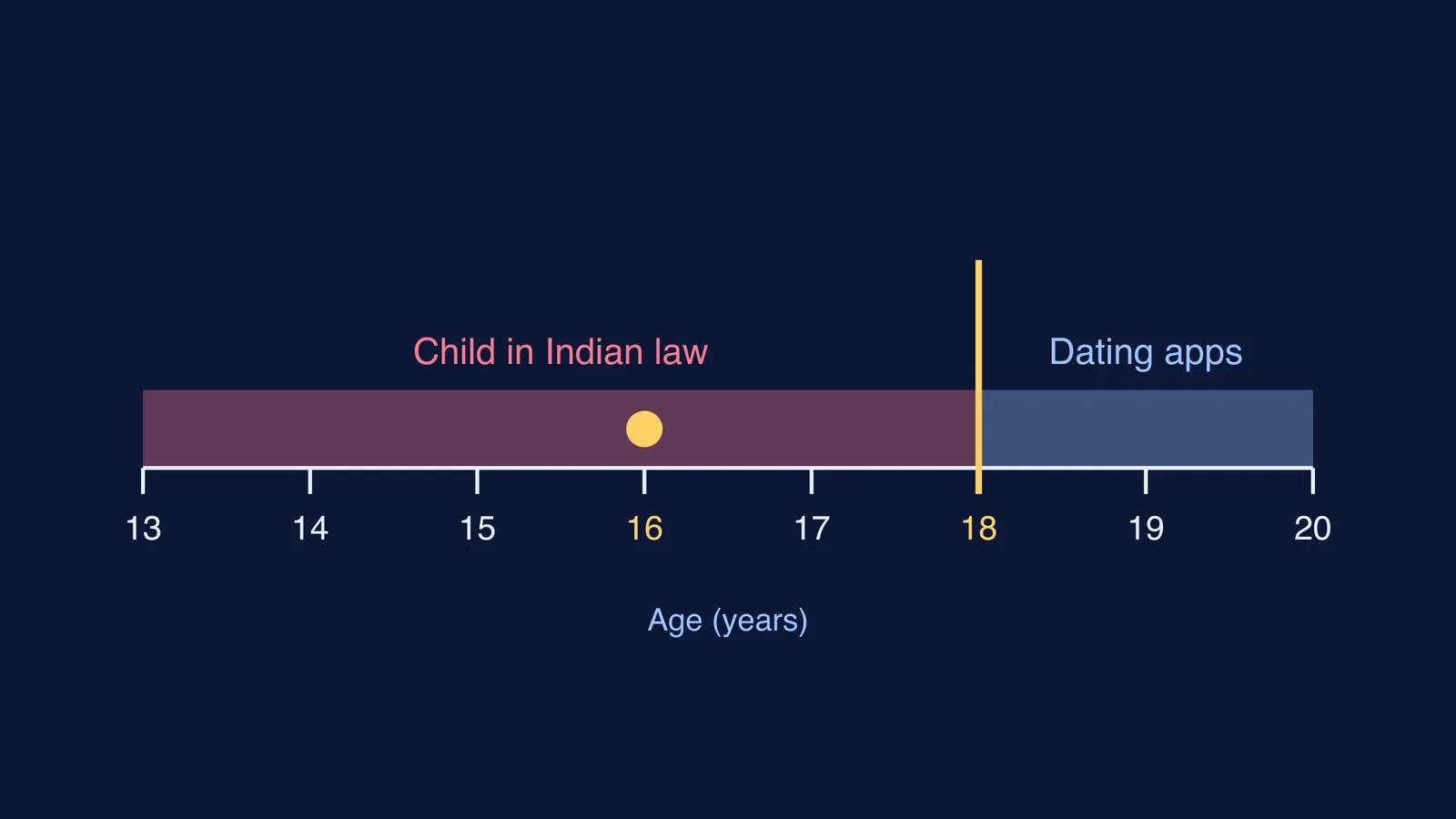
Not under the apps' own rules. Tinder's terms of use say a user must be "at least 18 years old". Bumble's terms also set the minimum at 18, or the local age of majority if that is higher. A 16-year-old can only sign up by giving a false date of birth, which breaks the terms they agreed to.
Indian law points the same way. The Digital Personal Data Protection Act, 2023 defines a child as "an individual who has not completed the age of eighteen years" (DPDP Act, Section 9 and definitions). Section 9 says apps must get verifiable consent from a parent before processing a child's personal data, and must not track, monitor the behaviour of, or target ads at children, subject to exemptions the government can set (same source). The government notified the DPDP Rules in November 2025 with an 18-month phased timeline (PIB, 14 November 2025), and the duties on children's data apply from May 2027 (AZB & Partners).
The POCSO Act, 2012 also treats anyone below 18 as a child and protects children from sexual assault, sexual harassment and pornography (NCPCR guide to the JJ and POCSO Acts). On an 18+ app, everyone your teen meets has said they are an adult.
What are the real risks of meeting strangers from an app?
The biggest risk is not a bad date. It is a stranger who is not who they say they are. The US National Center for Missing & Exploited Children (NCMEC on sextortion) says offenders may pretend to be younger, use social media to learn a child's interests and school, and move the chat from one platform to another. NCMEC's CyberTipline received more than 186,800 reports of online enticement in 2023 (same source).
One US study passively tracked phone use for six months in 149 adolescents and found that 35 of them (23.5%) used dating apps (McGregor et al., 2025, Journal of Psychopathology and Clinical Science). Users reported more risky behaviour at the start, but the authors say the findings are cross-sectional, so the causal direction is unclear. The teens covered a wide range of internalizing symptoms such as anxiety and depression, so the sample is not a picture of all teenagers.
So the risk is real but specific: adults posing as peers, requests for photos or money, and a first meeting with no one else knowing where your teen is.
How do I talk to my teen about it without a fight?
A flat "no" with no reason can push the app out of sight. Try this five-step conversation instead.
Ask before you answer. "What made you want it? Is it someone specific, or are your friends on it?" Listen to the full answer.
Name the rule, not a verdict on them. "These apps are 18+ by their own rules, and Indian law treats you as a child until 18. So the answer is not yet, and it is not because I think you did something wrong."
Respect the need underneath. Wanting to meet people and feel liked is normal at 16. Talk about where that can happen safely: friends of friends, clubs, events, school activities.
Agree on a no-trouble rule. "If anyone online asks for photos, money, or to move to another app, tell me. You will not be punished for telling me."
Plan for 18 together. Tinder's own safety tips say to meet in a populated public place, tell a friend or family member your plans, control how you get there and back, and never send money. Agree on these now so they are habits later.
If the conversation turns to a real person they like, our guide to handling a relationship in Class 11 covers the next step.
What if my teen is already on one?
Stay calm and sit with them, not over them. Look through the app together. If anyone asked for photos, money or a private meeting, take screenshots first, then block them and delete the account. Go through what your child should never share online, such as school name, address and live location.
If someone is threatening them, follow what to do when someone threatens to leak photos. Report on the National Cyber Crime Reporting Portal or the 24x7 helpline 1930, which guides victims, particularly women and children, on reporting (PIB). If your teen seems anxious or low afterwards, Tele MANAS offers 24x7 tele-mental health counselling on the toll-free number 14416 (PIB).
If schoolwork is part of what feels stuck, Fermi's AI tutor can work out what your teen already knows and build a plan for the session, so study time starts with a clear next step.