
On this page
You pay for tuition, your child goes every week, and the test marks haven't moved. India's Comprehensive Modular Survey: Education 2025 found that 27.0% of students were taking or had taken private coaching during the current academic year, rising to 30.7% in urban areas. Tuition is common, but it doesn't always lift marks, and in four weeks you can tell whether your child's tuition does.
Why are marks not improving even with tuition?
Sitting in tuition is not practising. Three patterns are common:
The tutor does the thinking. Your child copies clear solutions but rarely starts a problem alone.
No practice between sessions. The topic isn't touched again until the test.
The same mistakes repeat. Nobody sorts the lost marks, so one kind of error keeps costing marks.
Research supports the first two. In a 2001 study of one-to-one tutoring, Michelene Chi and colleagues found that students learned just as effectively when tutors were stopped from giving explanations and feedback and used prompts instead. A 2013 review of ten study techniques led by John Dunlosky rated practice testing and spaced-out practice as high utility, and rereading and highlighting as low utility.
In Roediger and Karpicke's 2006 experiments, students who took recall tests remembered more on tests two days or a week later than students who restudied, even though restudying made them more confident. So your child can leave tuition feeling ready and still struggle in the test.
Tutoring can work: a 2020 meta-analysis of tutoring experiments by Andre Nickow, Philip Oreopoulos and Vincent Quan estimated an overall effect of 0.37 standard deviations. Those were structured programmes, so the question is whether your child's tuition looks like one.
How do you check if tuition is working?
Give this about 20 minutes a week for four weeks.
Week 1: see what the tutor actually does. Sit in for 15 minutes, or look at that day's notebook: how many problems did your child start without help? Then ask the tutor: "Which topic is my child weakest in, and what are you doing about it?" A specific answer is a good sign.
Week 2: check practice on their own. Ask your child to solve two problems from last week's tuition topic in front of you, book closed, no help. Just watch whether they can start. If they can't begin a problem they "did" four days ago, the missing piece is practice, not more teaching.
Weeks 3 and 4: sort every lost mark. After each test, sit with your child and put every lost mark in a bucket:
Concept: didn't know or misunderstood the idea.
Method: knew the idea but picked the wrong approach or got stuck.
Slip: arithmetic, sign, units or copying error.
Time: didn't reach the question.
Older students can go deeper with our guide on how to analyse a mock test.
What does an error pattern look like?
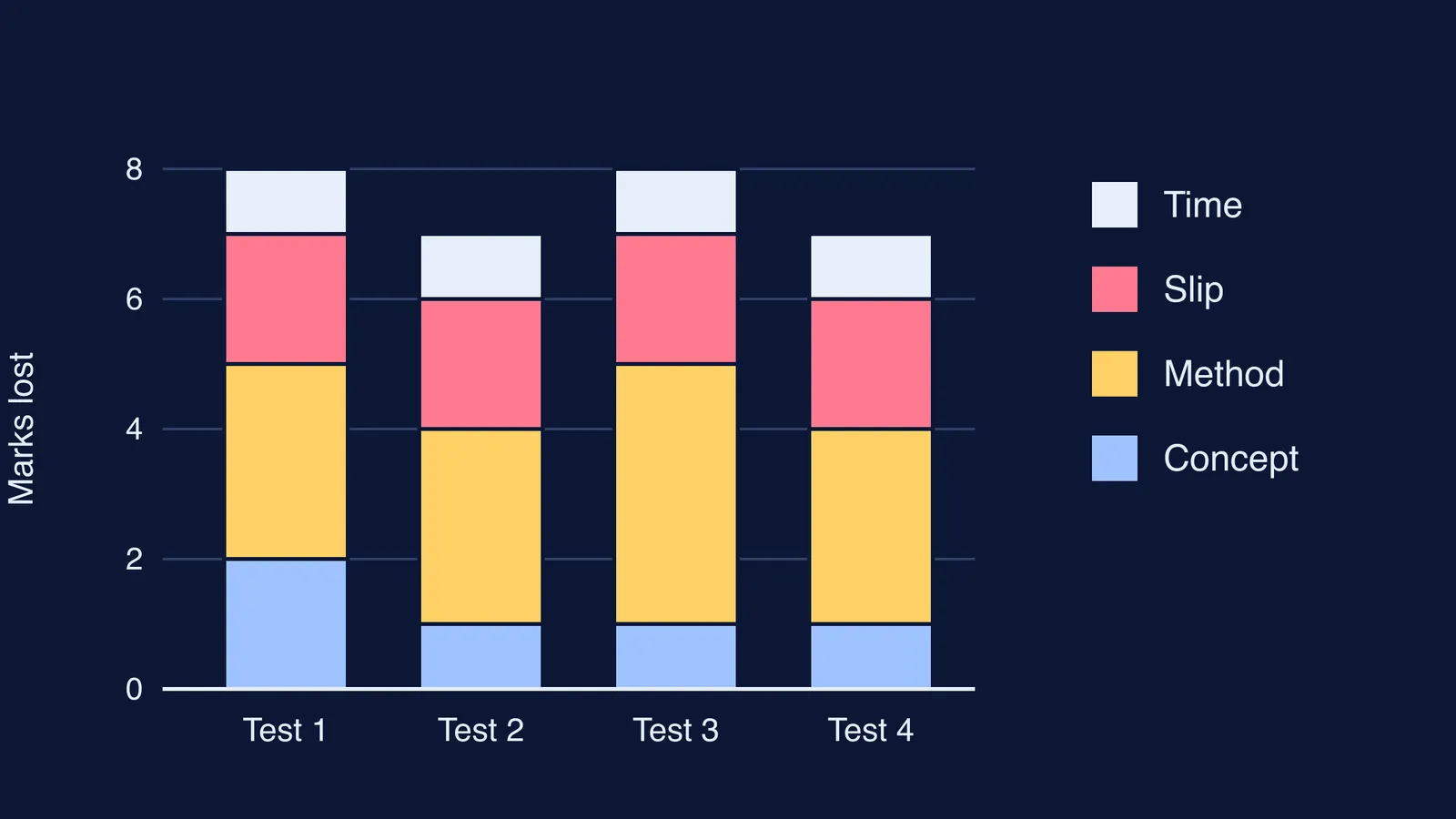
Take a Class 10 student with weekly tuition tests out of 20. Scores of 12, 13, 12, 13 look like no progress. The buckets say more:
Test 1: concept 2, method 3, slip 2, time 1
Test 2: concept 1, method 3, slip 2, time 1
Test 3: concept 1, method 4, slip 2, time 1
Test 4: concept 1, method 3, slip 2, time 1
Concept errors halved, so the explanations are landing. Method errors stayed at 3 or 4: the student follows examples but can't choose an approach alone. The fix is mixed problems attempted before any help, not more explanation. The steady 2 marks lost to slips need a quick habit: re-read the question, check signs and units.
For method mistakes, the Fermi Problem Library has worked problems with a step-by-step solver that explains the reasoning rather than printing an answer, so your child can try a step first and then check their reasoning, not just the final number.
When should you change tutor or stop tuition?
Decide on four weeks of evidence, not one bad test:
Keep the tutor, change the routine if concept errors are falling but method errors or slips stay flat.
Talk to the tutor first if your child does almost no independent work in sessions. Try: "For the next four weeks, could she try each problem for five minutes before you step in, and finish each session with two questions she solves alone? We're tracking which mistakes repeat, and method errors are the stubborn ones."
Change tutor if four more weeks show the same pattern, the tutor can't name specific weaknesses, or sessions are mostly school homework. Our checklist for choosing a tuition teacher helps with the next pick.
Pause or stop if concepts are secure and only slips and time remain, which timed practice at home can fix, or if tuition is eating into practice and sleep. If your child is the one asking, read what to do when your child wants to quit tuition.
Start this week with the two-problem check from Week 2. It takes ten minutes and tells you more than the next report card.