
On this page
Textbooks drill a tunnel through the Earth's centre and show that a dropped ball oscillates with a period of about 84 minutes. Then the exam tilts the tunnel along a chord that misses the centre. The period does not change, and the proof takes four lines. (New to the diameter case? Start with SHM through a tunnel across the Earth.)
What is the time period of a body in a tunnel along a chord of Earth?
For a smooth tunnel along any chord, the period is T = 2π√(R/g), the same as for a diameter. This assumes a uniform Earth, no friction or air resistance, and no rotation.
Inside a uniform Earth, gravity is proportional to distance from the centre, which gives the same form as Hooke's law for a spring; HyperPhysics works this out to a round-trip time of 84.5 minutes, with the traveller reaching the far side in a little more than 42 minutes. The gravity train article puts it in one sentence: all straight-line gravity trains on a given planet take exactly the same amount of time to complete a journey.
Why does a tunnel along a chord give SHM with the same period?
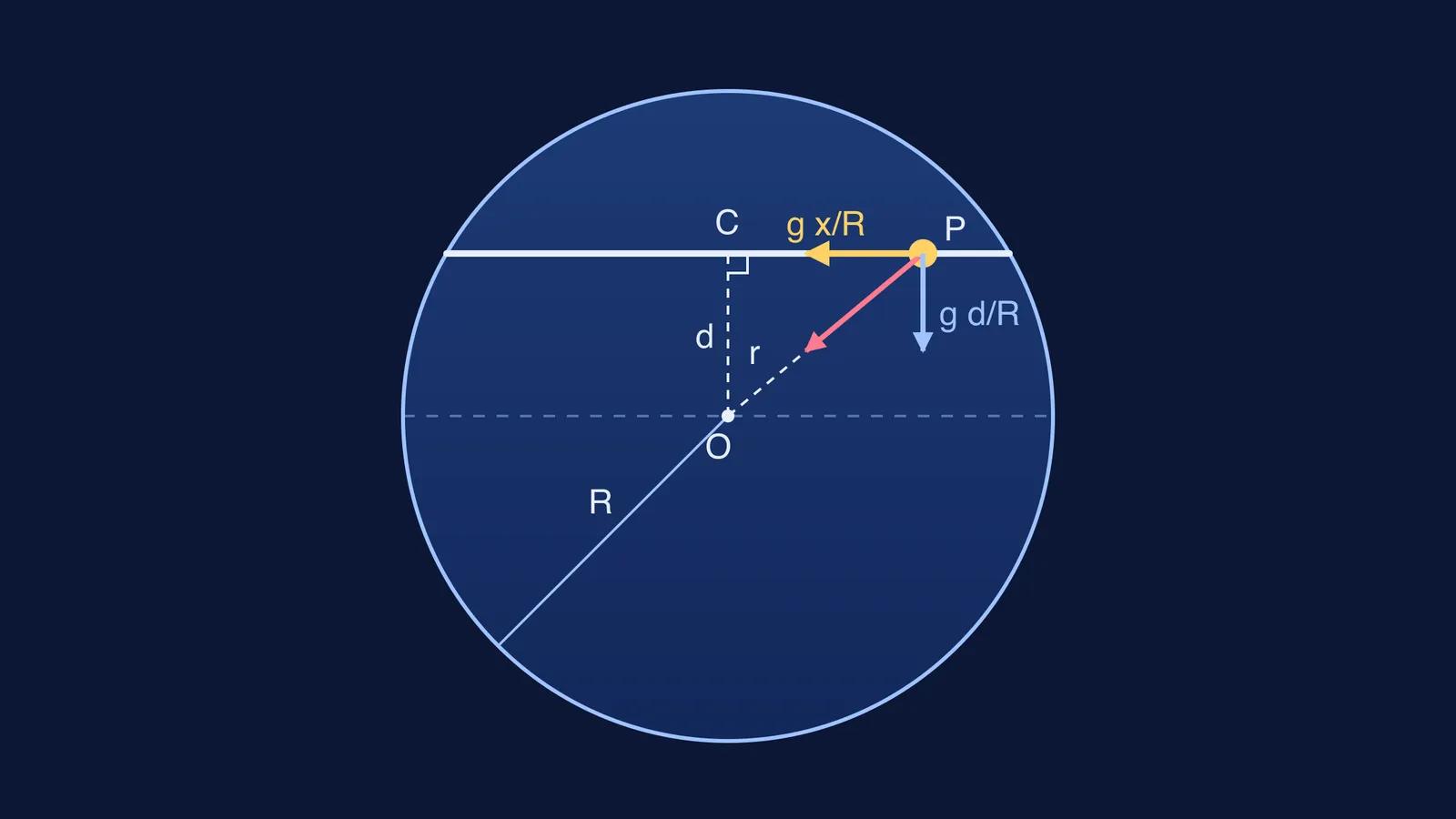
Put the centre of the Earth at O. Drop a perpendicular from O to the tunnel; it meets the tunnel at its midpoint C, at a distance d from O. Let the body be at P, a distance x from C along the tunnel and a distance r from O.
Inside a uniform Earth, the gravitational field at distance r from the centre is g(r) = g r/R, pointing towards O. (Our graph of how gravity changes inside Earth shows this straight-line rise.)
The angle between OP and the tunnel has cosine x/r, so the component of gravity along the tunnel is (g r/R) × (x/r) = g x/R, pointing back towards C.
The r cancels. The acceleration along the tunnel is a = −(g/R) x.
That is the SHM condition a = −ω²x with ω² = g/R, so T = 2π/ω = 2π√(R/g). The distance d never appears.
The other component, g d/R, points into the wall; the smooth wall's normal force balances it and does no work. If step 4 feels too quick, see how to check if motion is SHM from its acceleration equation.
Worked example: a tunnel whose midpoint is 3,200 km below the surface
Take the textbook values g = 9.8 m/s² and R = 6,400 km. NASA's Earth fact sheet lists a mean radius of 6,371 km and surface gravity of 9.82 m/s², so these are close. A straight tunnel's midpoint C is d = R/2 = 3,200 km from the centre. A ball is released from rest at one end.
Half-length (amplitude): A = √(R² − d²) = R√3/2 ≈ 5,543 km.
Angular frequency: ω = √(g/R) = √(9.8 / 6.4 × 10⁶) ≈ 1.237 × 10⁻³ rad/s.
Period: T = 2π/ω ≈ 5,078 s ≈ 84.6 minutes. One-way trip: T/2 ≈ 42.3 minutes.
Maximum speed, at C: v = Aω ≈ 6.86 km/s. Through a diameter it would be Rω ≈ 7.92 km/s, so the chord is slower but shorter, and the time comes out equal.
Acceleration along the tunnel at the entrance: g A/R = g √3/2 ≈ 8.49 m/s². The wall supplies a normal force per kilogram of g d/R = 4.9 N.
Time to reach the point halfway between the entrance and C (x = A/2): solve x = A cos ωt, so cos ωt = 1/2 and ωt = π/3. That is T/6 ≈ 14.1 minutes.
With NASA's 6,371 km and 9.82 m/s² you get about 84.3 minutes instead; state your values either way.
Does the answer hold for the real Earth?
Not exactly, because the real Earth is denser towards the core. Alexander Klotz used Earth's internal structure from seismic data in a 2015 paper in the American Journal of Physics: the fall along the diameter takes 38 minutes, compared with 42 minutes for a uniform Earth, and straight-line trips between other points are no longer all equal, ranging from about 42 minutes for short trips to 38 minutes for long ones. For exams, assume uniform density unless the question says otherwise.
Common mistakes to check before you write the answer
Using the full g r/R along the tunnel. Only the component g x/R acts along it.
Measuring x from the centre of the Earth instead of from the midpoint of the tunnel.
Writing a different period for a short chord. Only amplitude and top speed change.
Forgetting to say the tunnel is smooth. With friction, the motion is not SHM.
For more tunnel, spring and pendulum questions, the Fermi Problem Library has worked problems with a step-by-step solver that explains the reasoning rather than printing an answer. If the result for gravity inside a sphere is still shaky, the Fermi Concept Library gives each physics concept its own lesson and its place in the map.
Next time a question tilts the tunnel, resolve gravity along it first; d drops out on its own.