
On this page
Two circular coils share a centre, and their planes are at right angles. What is the magnetic field at the centre? The physics is one formula and one vector sum, and the sum is where it is easiest to slip.
What is the field at the centre of one circular coil?
For a coil of N turns and radius R carrying current I, the field at its centre is B = μ₀NI/2R, as derived in OpenStax University Physics Volume 2, section 12.4. Here μ₀ = 4π × 10⁻⁷ T·m/A, the value used in OpenStax section 12.1. NIST's 2022 CODATA value, 1.256 637 061 27 × 10⁻⁶ N/A², matches it to far more places than any exam needs.
At the centre, the field points along the coil's axis, perpendicular to the plane of the coil. Curl the fingers of your right hand along the current and your thumb points along the field. Our post on the magnetic field on the axis of a circular loop builds it from Biot-Savart and sets the distance to zero.
Why is the resultant B√2 and not 2B?
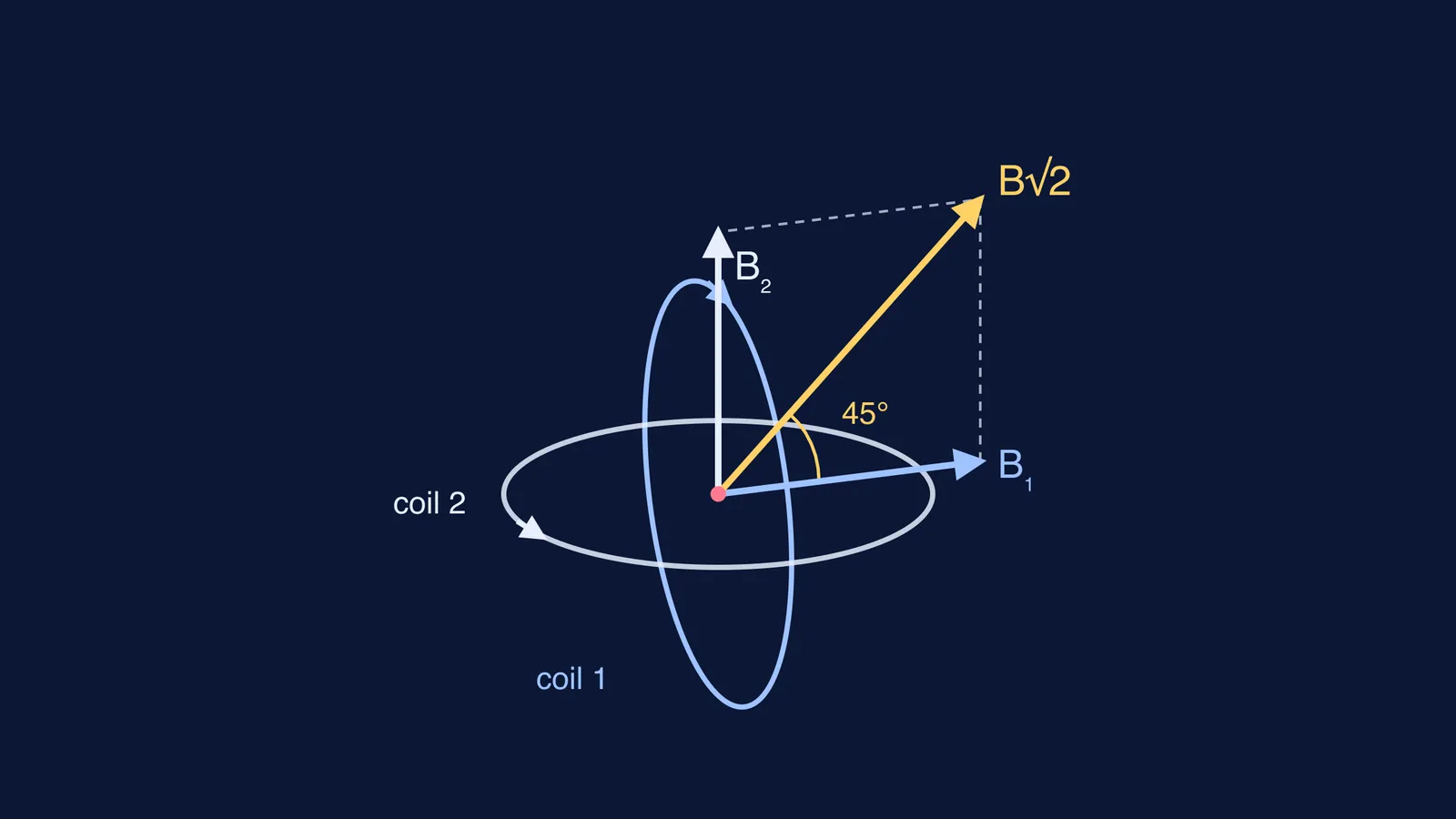
The two coils' planes are perpendicular, so their axes are perpendicular too. That means B₁ and B₂ are perpendicular vectors. Magnetic fields from separate sources add as vectors: OpenStax advises finding each contribution and adding the results by superposition of vectors.
Two perpendicular vectors add like the sides of a right triangle:
Magnitude: B = √(B₁² + B₂²)
Direction: tan θ = B₂/B₁, where θ is measured from the axis of coil 1
For identical coils with equal currents, B₁ = B₂ = B, so the resultant is B√2, at θ = 45° to each axis. Writing 2B treats the fields as parallel, which they are not. If vector addition feels shaky, our post on parallelogram diagonals as a + b and a − b works through the parallelogram picture.
How do you solve it step by step? A worked example
Take two coils, each with N = 10 turns and radius R = 0.10 m, placed with their planes perpendicular and a common centre.
Case 1, equal currents: both carry I = 1 A.
Field from one coil: B₁ = μ₀NI/2R = (4π × 10⁻⁷ × 10 × 1)/(2 × 0.10) = 2π × 10⁻⁵ T ≈ 6.28 × 10⁻⁵ T.
B₂ is the same size, along the other axis.
Resultant: B = B₁√2 ≈ 8.89 × 10⁻⁵ T.
Direction: tan θ = 1, so θ = 45° from each coil's axis.
Case 2, unequal currents: coil 1 carries 1 A and coil 2 carries √3 A.
B₁ ≈ 6.28 × 10⁻⁵ T as before.
B₂ = √3 × B₁ ≈ 10.88 × 10⁻⁵ T, because B is proportional to I.
Resultant: √(B₁² + 3B₁²) = 2B₁ ≈ 12.57 × 10⁻⁵ T.
Direction: tan θ = √3, so θ = 60° from the axis of coil 1, which is 30° from the axis of coil 2.
When N and R are the same for both coils, the shortcut is tan θ = I₂/I₁ and B = (μ₀N/2R)√(I₁² + I₂²).
Case 3, different radii: same current and turns, but coil 2 has radius 2R. Since B is proportional to 1/R, B₂ = B₁/2. The resultant is B₁√(1 + 1/4) = (√5/2)B₁ ≈ 1.12B₁, at tan θ = 1/2, about 26.6° from coil 1's axis.
Which mistakes cost marks on this question?
Adding magnitudes. 2B is right only when the two fields point the same way, not for perpendicular coils.
Forgetting N. A coil of N turns gives N times the field of a single turn.
Using diameter for R. 20 cm across means R = 0.10 m.
Angle from the wrong reference. The angle from coil 1's axis is θ; the angle from coil 1's plane is 90° − θ.
Ignoring current direction. Reversing the current in one coil flips that coil's field. The magnitude stays the same, but the resultant is mirrored to the other side of the other coil's axis.
Where can you practise this next?
Try the same question with the coils' axes at 60° to each other. You will need the full parallelogram formula, B² = B₁² + B₂² + 2B₁B₂ cos 60°, where 60° is the angle between the two fields. For more field-at-a-point problems, our guide to Biot-Savart and Ampère's law covers wires, loops and solenoids.
If you keep getting the direction wrong, work a few in the Fermi Problem Library, where the step-by-step solver explains the reasoning rather than printing an answer. If the right-hand rule itself is the gap, the Fermi Concept Library has a lesson for each concept in physics, with its place in the map.