

On this page
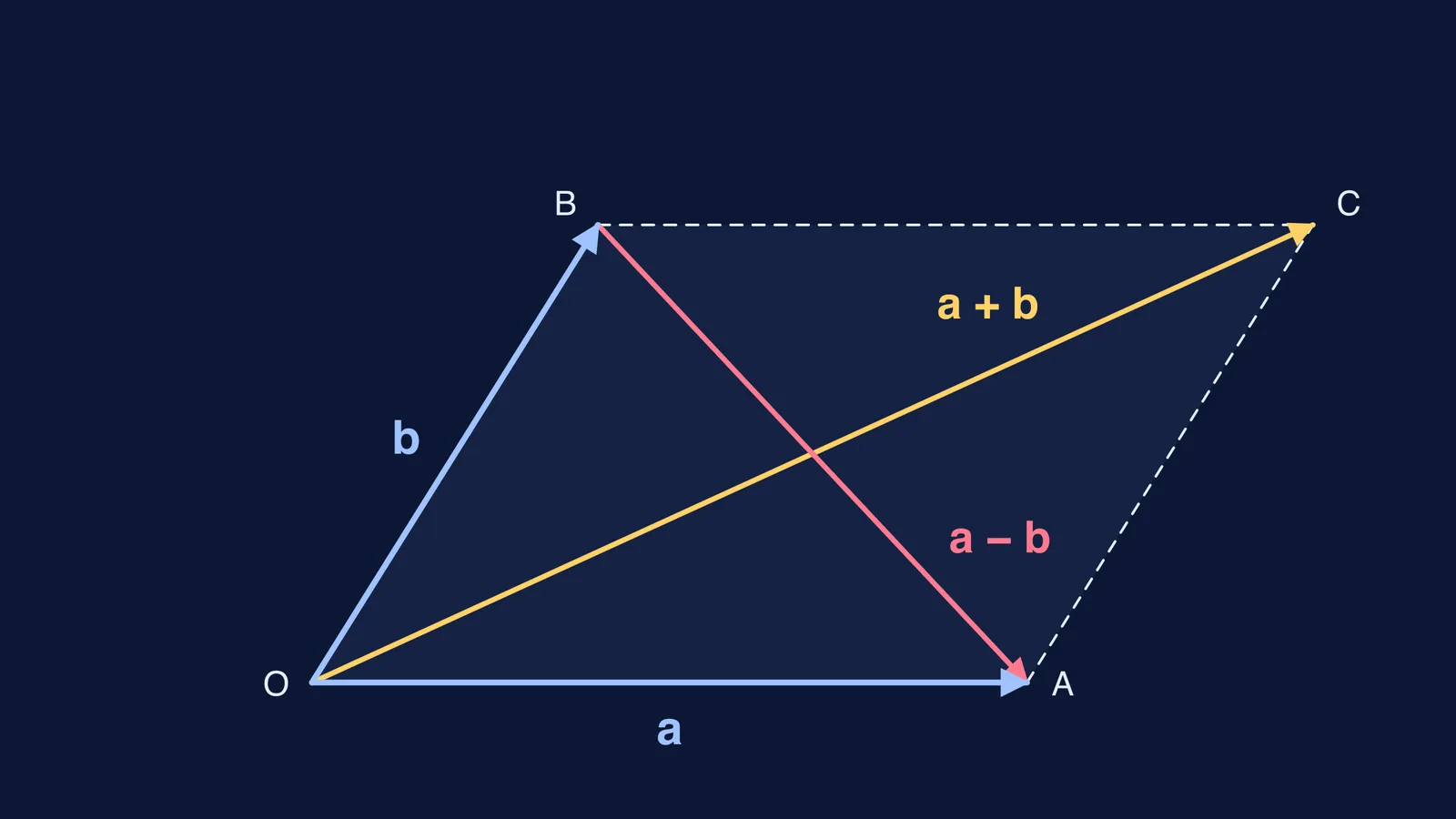
Draw a parallelogram and name two sides from one corner as vectors a and b. Now you can write both diagonals without measuring anything: one is a + b and the other is a − b. With those, results like "equal diagonals mean a rectangle" take a few lines of algebra.
Why is one diagonal a + b and the other a − b?
Label the parallelogram OACB, going round in order, with OA = a and OB = b. Opposite sides of a parallelogram are equal and parallel, so AC = b and BC = a.
For the first diagonal, walk from O to A and then on to C. The triangle law says OC = OA + AC = a + b. OpenStax's University Physics on adding vectors puts the same idea as the parallelogram rule: start both vectors at the same point, and the diagonal from that point is the resultant.
For the second diagonal, walk O to B to A. Then OB + BA = OA, which gives BA = a − b. The same OpenStax chapter states it outright: the other diagonal of the parallelogram is the vector difference.
Direction matters: AB = b − a is the same diagonal pointing the other way. Our post on why vector AB equals the position vector of B minus A explains why.
How do you prove equal diagonals mean a rectangle?
You need four facts about the dot product, all listed in OpenStax's section on products of vectors: a·b = |a||b| cos θ, a·a = |a|², the dot product is commutative and distributive, and the dot product of two perpendicular vectors is zero.
|a + b|² = (a + b)·(a + b) = |a|² + 2a·b + |b|²
|a − b|² = (a − b)·(a − b) = |a|² − 2a·b + |b|²
Subtract line 2 from line 1: |a + b|² − |a − b|² = 4a·b
If the diagonals are equal, the left side is zero, so a·b = 0.
a and b are non-zero sides, so cos θ = 0 and θ = 90°.
Co-interior angles of a parallelogram add to 180°, so one right angle makes all four right angles. The parallelogram is a rectangle.
Every step can be reversed, so the converse holds too: the diagonals of a rectangle are equal.
Add lines 1 and 2 instead and you get the parallelogram law: the squares of the two diagonals add up to the squares of all four sides. For a rectangle it reduces to Pythagoras' theorem.
What else follows from a + b and a − b?
Perpendicular diagonals mean a rhombus. (a + b)·(a − b) = |a|² − |b|², so the diagonals are perpendicular exactly when |a| = |b|.
The diagonals bisect each other. The midpoint of each diagonal works out to (a + b)/2. Our post on why the diagonals of a parallelogram bisect each other proves it step by step.
You can get a dot product from lengths alone. Line 3 rearranged is the polarization identity, a·b = ¼(|a + b|² − |a − b|²).
A worked example you can check by hand
Take a = 4i + j and b = −i + 4j.
a + b = 3i + 5j, so |a + b|² = 9 + 25 = 34.
a − b = 5i − 3j, so |a − b|² = 25 + 9 = 34.
Equal diagonals, so it should be a rectangle. Check: a·b = −4 + 4 = 0.
Now take a = 4i and b = i + 3j.
a + b = 5i + 3j, so |a + b|² = 34.
a − b = 3i − 3j, so |a − b|² = 18.
The difference is 16. Since a·b = 4, that matches 4a·b, and the shape is not a rectangle.
The sum is 52 = 2(16) + 2(10), so the parallelogram law holds too.
Which mistakes cost marks in these proofs?
Writing |a + b| = |a| + |b|. That is only true when a and b point the same way.
Expanding (a + b)² as a² + b² and losing the 2a·b term.
Using a − b where the question asks for the directed diagonal AB, which is b − a.
Stopping at a·b = 0 without saying the sides are non-zero and that one right angle gives all four.
Starting from what you were asked to prove instead of from what is given.
The same method works for midpoints and centroids, as our guide to geometry proofs using vectors shows. For practice, the Fermi Problem Library has worked problems with a step-by-step solver that explains the reasoning rather than printing an answer, so you can compare it with your proof line by line. If the dot product itself still feels shaky, start with its lesson in the Fermi Concept Library.
Next time a parallelogram turns up in a vectors question, write a + b and a − b first.


