

On this page
Classical geometry proofs ask you to spot the right congruent triangles. Vector proofs are more predictable: label every point, write what you are told as equations, and simplify. It is the algebra of NCERT Class 12 Mathematics, Chapter 10, Vector Algebra, turned towards proofs.
How do you prove geometry results using vectors?
Use the same four steps every time.
Fix an origin and name the points. Pick any point O and call the position vectors of A, B, C (the vectors OA, OB, OC) a, b and c. It need not be a vertex.
Translate what you are given. Each geometric fact becomes a vector equation (list below).
Do the algebra. Add, subtract and collect terms.
Translate back. Say in words what the final equation means for the figure.
The translations you will use most:
The vector from P to Q equals q − p (head minus tail).
The midpoint of PQ has position vector (p + q)/2.
The point dividing PQ internally in the ratio m : n has position vector (mq + np)/(m + n). This is the section formula in NCERT Class 12, section 10.5.3, and the midpoint is its m = n case.
“PQ is parallel to RS” means q − p = k(s − r) for some number k. “Half as long” means k = 1/2 or −1/2.
“Two points coincide” means their position vectors are equal.
How do you prove the midpoint theorem with vectors?
The midpoint theorem says that the segment joining the midpoints of two sides of a triangle is parallel to the third side and half as long. Our post on quadrilaterals and the mid-point theorem in Class 9 puts the theorem alongside the parallelogram properties it is used with.
Take triangle ABC with position vectors a, b, c. Let F be the midpoint of AB and E the midpoint of AC.
f = (a + b)/2 and e = (a + c)/2.
The vector from F to E is e − f = (a + c)/2 − (a + b)/2 = (c − b)/2.
But c − b is the vector from B to C.
So the vector FE is 1/2 times the vector BC: parallel to BC and half as long. Three lines, no congruent triangles.
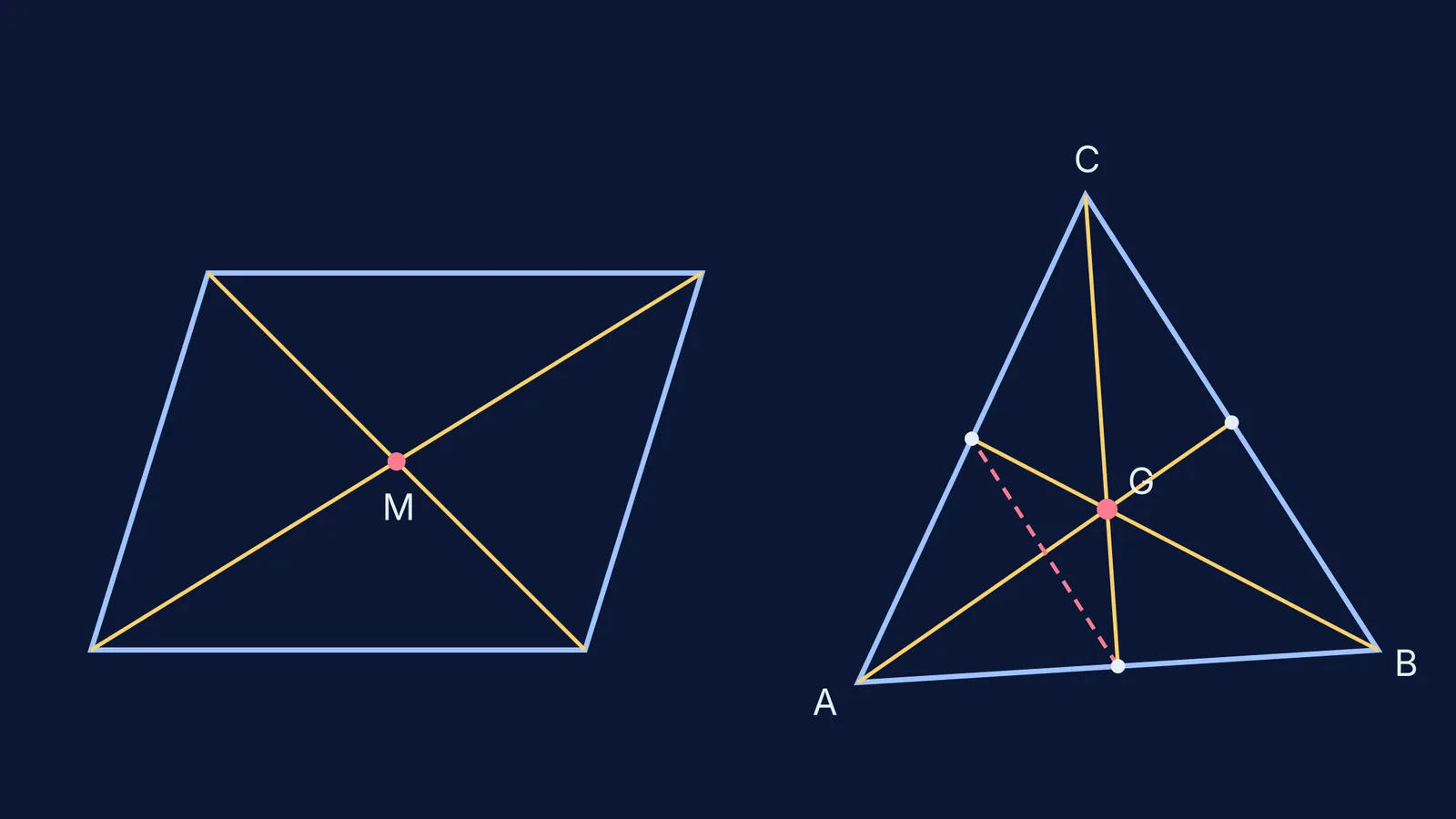
Why do the diagonals of a parallelogram bisect each other?
Let ABCD be a parallelogram with position vectors a, b, c, d. Being a parallelogram means the vector from A to B equals the vector from D to C (same length, same direction).
Write it as an equation: b − a = c − d.
Rearrange: a + c = b + d.
Divide by 2: (a + c)/2 = (b + d)/2.
The left side is the midpoint of diagonal AC; the right side is the midpoint of diagonal BD. They are equal, so the diagonals share a midpoint and each cuts the other in half. Run the steps backwards for the converse.
How do you show the medians of a triangle meet at the centroid?
A median joins a vertex to the midpoint of the opposite side. Take the median from A to D, the midpoint of BC, so d = (b + c)/2.
Find the point G that divides AD in the ratio 2 : 1, measured from A. By the section formula with m = 2 and n = 1:
g = (2d + a)/3 = (2 × (b + c)/2 + a)/3 = (a + b + c)/3.
The answer (a + b + c)/3 does not change if you swap the letters. Repeat the calculation for the median from B or from C and you get the same vector. So one point lies on all three medians and divides each in the ratio 2 : 1: the centroid. Our post on centroid, incentre and circumcentre in coordinate geometry does the same in coordinates.
What mistakes cost marks in vector proofs?
Writing the vector backwards. The vector from P to Q is q − p, never p − q.
Claiming “parallel” without a scalar. Show the k. Without it, the examiner sees an assertion, not a proof.
Skipping the final sentence. End in words: “hence FE is parallel to BC and FE = BC/2.”
Then try one yourself: the midpoints of the sides of any quadrilateral form a parallelogram. Hint: compare the vectors joining consecutive midpoints. Next, use the position vector test for collinear points to show that B, G and E (the midpoint of AC) lie on one line.
If you get stuck on a step, the Fermi Problem Library has worked problems with a step-by-step solver that explains the reasoning rather than printing an answer. If a vector idea feels shaky, start with its lesson in the Fermi Concept Library.


