
On this page
If you are in or just past Class 12 and want to be a lawyer, you have two routes. The Bar Council of India (BCI) decides which law degrees count for enrolment as an advocate, and its Rules of Legal Education, 2008 set out two: a five-year integrated degree after Class 12, and a three-year LLB after a bachelor's degree.
What do Bar Council rules say about the 3-year and 5-year LLB?
Rule 4 of the BCI Rules of Legal Education sets out both courses. The three-year LLB is taken "after obtaining a Bachelors' Degree in any discipline". The integrated degree (BA LLB, BBA LLB, BSc LLB and so on) is a double degree "of not less than five years' duration".
Rule 5 sets the entry point. For the three-year LLB, you must have graduated in any subject. For the integrated course, you need Class 12 or an equivalent such as A levels.
Rule 7 sets the floor on marks. A 2017 BCI clarification puts the minimum at 45% for general-category applicants, 42% for OBC and 40% for SC/ST, in Class 12 for the five-year course or in your degree for the three-year course.
Meeting that floor only lets you apply. Each university and test still sets its own cut-off.
Is the 5-year LLB faster than a degree plus the 3-year LLB?
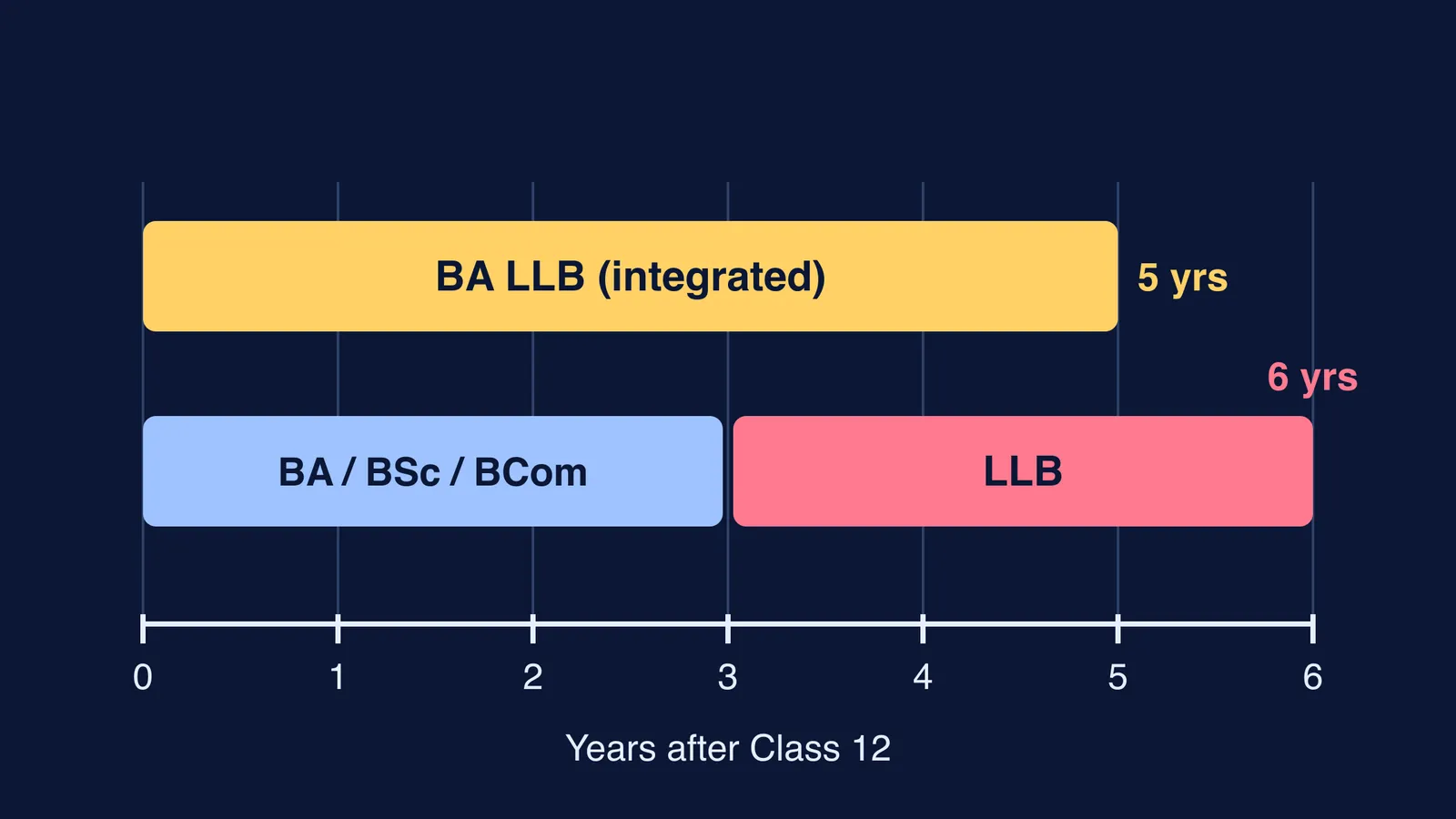
Yes, by one year if your first degree takes three years. The BCI rules spell out the arithmetic: an integrated BA LLB can be completed in "(3+3 –1) i.e. 5 years", while a BTech LLB "can be done in (4+3-1) i.e., 6 years". A three-year degree followed by the three-year LLB takes six years; a four-year degree followed by it takes seven.
Which route costs less?
There is no single answer, because fees differ widely between national law universities, state universities and private colleges.
As a worked example, at the National Law School of India University in Bengaluru, which admits students to its five-year BA LLB (Hons) through CLAT, the course costs Rs 4,51,000 a year for 2026-27 (tuition and facilities Rs 3,18,200, housing with meals Rs 1,32,800), plus a one-time admission fee of Rs 13,900. Five years at this year's rate comes to about Rs 22.7 lakh including the admission fee, before any fee rises.
To price a three-year route for the colleges you are considering, add up:
Three years of your first degree: fees plus living costs.
Three years of LLB fees plus living costs.
One extra year before you start earning.
If your first degree is at a low-fee government college near home, the six-year route can cost less in total even though it takes longer. If both stages are at private colleges away from home, it can cost more.
How do you get in: CLAT or a test after graduation?
For the five-year course, the main national test is the Common Law Admission Test (CLAT), run by the Consortium of National Law Universities. Its CLAT 2027 press release sets the test for Sunday, 6 December 2026, from 2 pm to 4 pm, with 31 October 2026 as the last date for applications.
For the three-year LLB, admission is run by individual universities and states, after you graduate. Maharashtra's State CET Cell, for example, runs separate admission rounds for the three-year LLB and the five-year integrated LLB.
On either route, to practise as an advocate you also need to pass the BCI's All India Bar Examination, which is open to graduates of both three-year and five-year LLB courses, and to final-semester students with no backlogs.
Which route fits you?
Choose the five-year course if most of these are true:
You are fairly sure you want law now, at 17 or 18.
You want to start working a year earlier.
You can prepare for CLAT or a state law test alongside Class 12.
Choose a degree first, then the three-year LLB, if most of these are true:
You are not yet sure about law and want a degree that stands on its own.
You love a subject, such as economics, engineering or a science, and want to study it in depth first.
Your family's budget works better with a low-fee local college first.
If you take the second route with a science degree, the Fermi Concept Library covers every concept in physics, chemistry, biology, mathematics and computing, each with its own lesson, so you can keep your first degree strong while law waits.
For the next decisions, read our guides on choosing between BA LLB and BBA LLB, preparing for CLAT after the science stream and the judiciary route after a law degree.