

On this page
Hearing "I want to stop tuition" often triggers immediate parental panic. You think of the syllabus, upcoming board exams, competitive entrance tests, and the tuition fees already paid. In India, supplemental classes have become the default. According to the National Statistical Office's 75th round survey published in NSS Report No. 585, 29.7% of students in secondary school attend private coaching, accounting for approximately 18% of total household education expenditure.
Yet when a student asks to leave, their request is rarely an impulse to avoid work entirely. More often, it reflects one of four underlying friction points:
Exhaustion from a double school day: Moving straight from six hours of school into three hours of coaching leaves little cognitive energy for actual learning.
Redundant teaching: The tuition batch may be moving too slowly, reteaching chapters your child already mastered in school.
Lost self-study time: Problem solving requires quiet concentration. If every evening is booked with lectures, homework piles up untouched.
Mismatch in pacing: In large coaching batches, tutors race to complete the syllabus, leaving students who stumble on prerequisites stranded.
Before making a permanent decision between coaching, online classes or self-study, unpack which friction point your teenager is experiencing.
What does research say about student autonomy and tuition fatigue?
Educational research shows that more teaching hours do not automatically yield higher marks. In a landmark UNESCO-IIEP monograph, comparative education researcher Mark Bray analysed private tutoring across multiple school systems in Confronting the Shadow Education System. Bray found that intensive tutoring frequently creates a dependency trap: students become passive recipients waiting for pre-digested steps, while the sheer volume of classes crowds out independent practice and causes severe fatigue.
Compelling a reluctant child to stay in tuition rarely repairs the problem. In a foundational study published in the *Journal of Educational Psychology*, psychologists Wendy S. Grolnick and Richard M. Ryan investigated parent styles associated with children's self-regulation and competence. The authors found that children whose parents supported autonomy—acknowledging their perspective and encouraging initiative—developed significantly higher self-regulation and academic competence than children whose parents used controlling, coercive tactics.
Practicing autonomy-supportive parenting does not mean stepping away or letting academic habits drift. It means offering choice within a clear structure.
What should you say when your child asks to quit?
The first conversation sets the tone for whether your child opens up or shuts down. Replace immediate warnings with open diagnosis.
Phrases that close the conversation:
"Do you know how much money we paid for this batch?"
"Everyone else in your class goes to tuition; how will you clear the exam?"
"You will waste all your time on your phone if you sit at home."
Phrases that open the diagnosis:
"Tell me what is happening during those two hours that feels unhelpful."
"What would your daily routine look like if you did not have that commute?"
"Let us look at your recent test papers together to see where you are getting stuck."
Listen for whether your child wants to quit tuition because they want more time to solve problems, or because they feel overwhelmed by the subject itself.
How can you structure a four-week trial period?
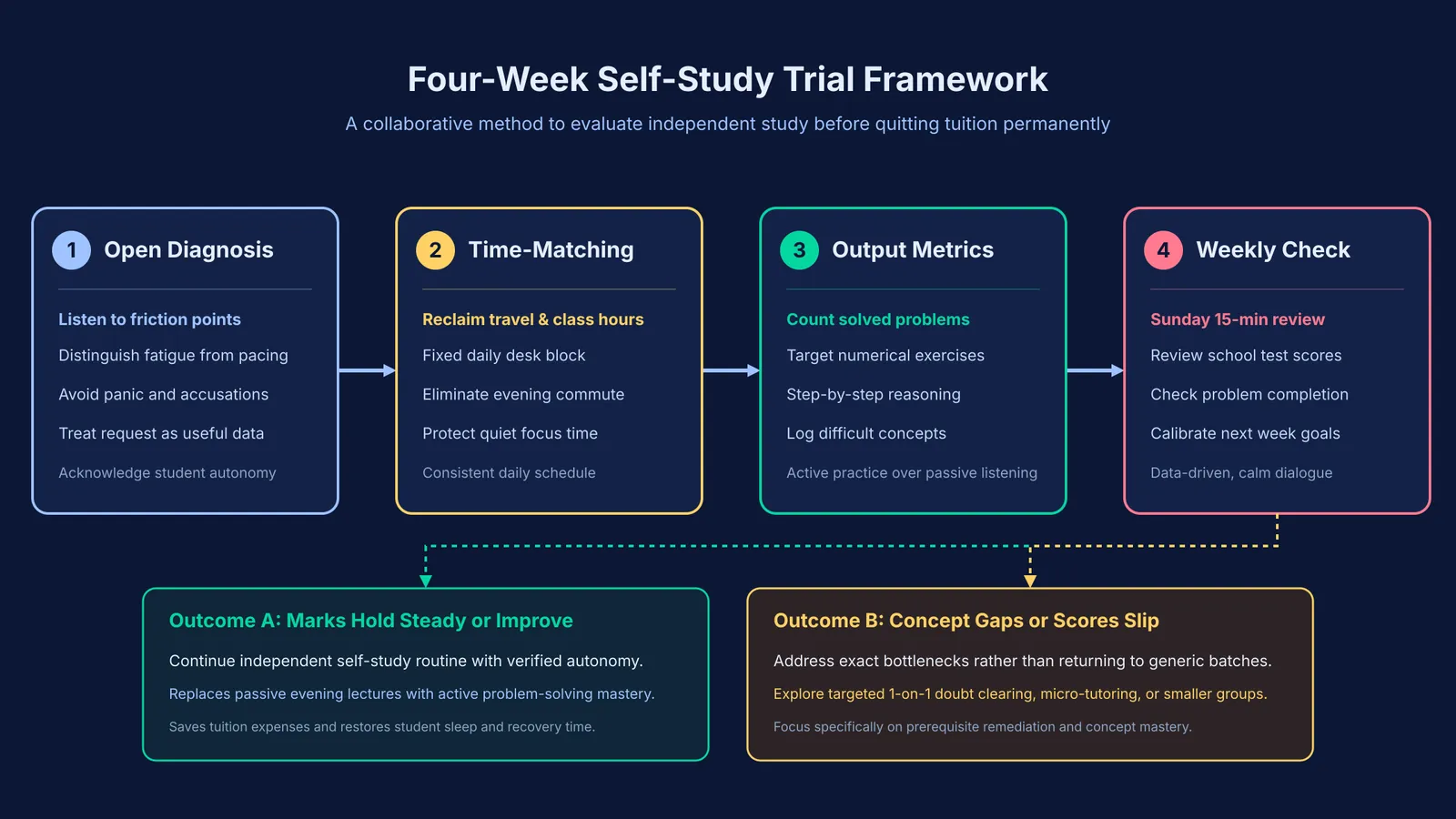
Rather than an irreversible withdrawal, propose a four-week self-study trial. This honours your child's autonomy while maintaining accountability.
Set up the trial around four clear rules:
Time-matching: Convert the tuition and travel hours directly into focused home study sessions. If tuition took two hours from 5:30 pm to 7:30 pm, that exact block becomes dedicated desk time.
Measurable outputs: Track solved problems rather than elapsed hours. A goal of completing 15 physics numericals or one complete NCERT exercise gives an unambiguous record of effort.
Targeted tools: When your child encounters difficulties without an instructor, use deliberate self-study resources. The Fermi Problem Library offers worked problems with a step-by-step solver that explains the reasoning rather than printing an answer, while the Fermi Concept Library helps students rebuild missed prerequisites.
Weekly checkpoint meetings: Sit down every Sunday evening for 15 minutes. Review the week's school quizzes, chapter exercises, and routine without anger. If school marks hold steady or improve, continue the trial; if your child falls behind, discuss whether to try a different tutor, a smaller batch, or one-to-one doubt clearing.
What official protections exist if you leave a coaching centre?
Parents often hesitate to withdraw because of financial anxiety. In January 2024, the Ministry of Education released model Guidelines for Registration and Regulation of Coaching Center. The guidelines explicitly require registered centres to cap daily coaching at 5 hours, prohibit classes during regular school hours, and mandate a pro-rata refund of remaining course and hostel fees within 10 days if a student exits midway.
Before making payments or signing contracts, check how centres handle exits by evaluating a coaching institute beforehand. Knowing your legal protections lets you make pedagogical decisions based on what your child needs, rather than feeling trapped by sunken fees.


