
On this page
In 1950 Alan Turing swapped the question “Can machines think?” for a game you could actually run. Seventy-five years later, researchers ran it with modern chatbots, and one chatbot was picked as the human more often than the real people were. Winning, though, tells you less than the headlines suggest.
What is the Turing test?
Turing's paper “Computing Machinery and Intelligence” opens with the line “I propose to consider the question, ‘Can machines think?’” (Turing, Mind, 1950). He then proposed the imitation game. An interrogator in a separate room sends written questions to two hidden players and must work out which is which. Turing then asks what happens when a machine takes one player's place.
He also made a prediction in the same paper: that in about fifty years computers would play so well that “an average interrogator will not have more than 70 per cent. chance of making the right identification after five minutes of questioning.” Read as a pass mark, that forecast means judges pick the machine as the human in at least 30% of five-minute chats.
For the work Turing did before this, read our post on Alan Turing's 1936 paper on what a computer can and cannot do.
Has AI passed the Turing test?
Yes, in published, controlled experiments, and by a wider margin than Turing predicted.
The first sign came in a 2024 preprint by Cameron Jones and Benjamin Bergen. Each participant chatted with either a human or an AI, and GPT-4 was judged human 54% of the time, against 22% for ELIZA and 67% for real humans (Jones and Bergen, arXiv, 2024).
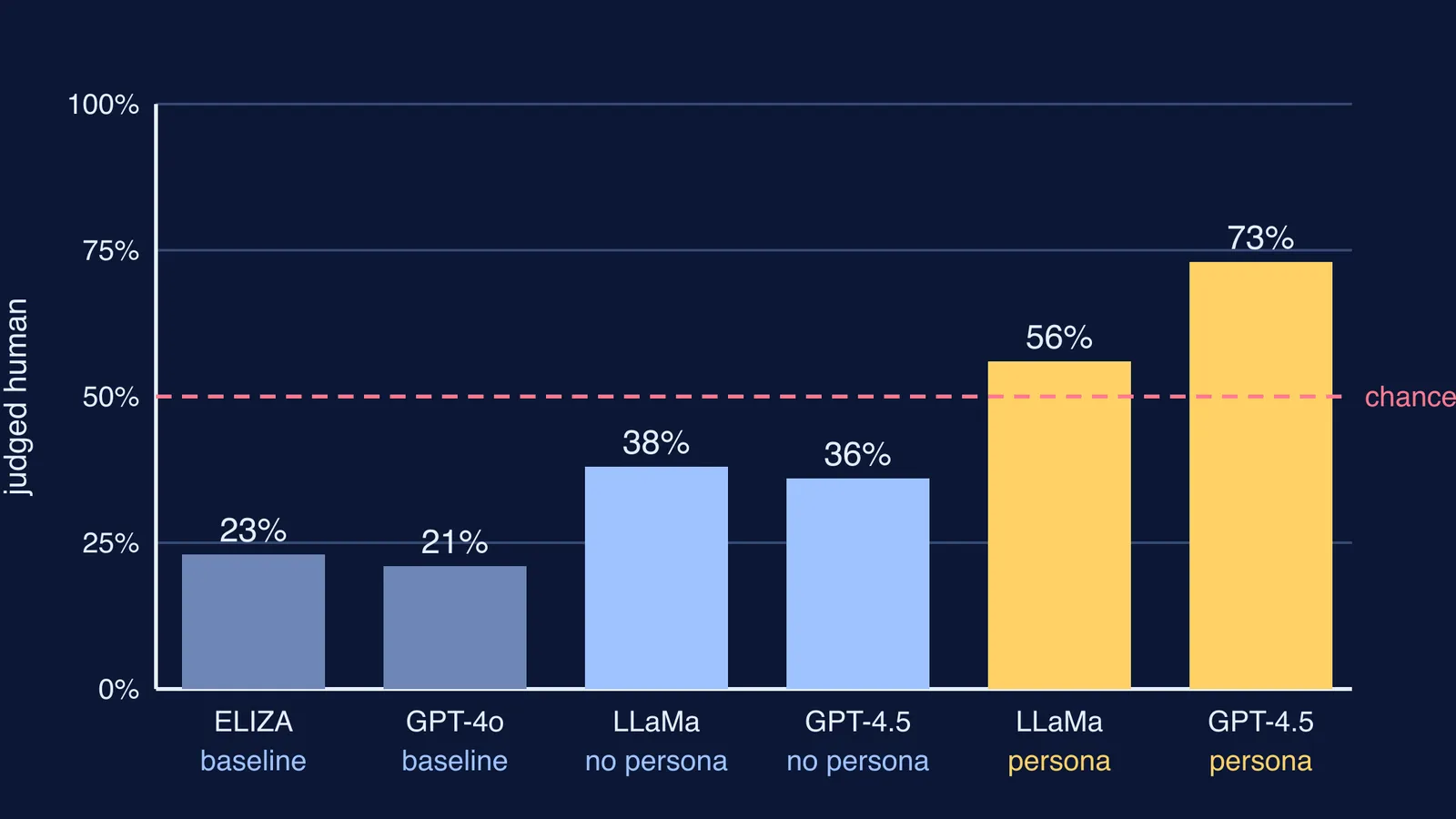
The stronger result used the three-player version Turing described. In a study published in PNAS in May 2026, each participant chatted for five minutes with a human and an AI at the same time, then chose which one was the human (Jones and Bergen, PNAS, 2026). Their results:
GPT-4.5, prompted to adopt a humanlike persona, was chosen as the human 73% of the time, significantly more often than the real human.
LLaMa-3.1-405B with the same prompt was chosen 56% of the time, not significantly different from the humans.
Without the persona prompt, GPT-4.5 scored 36% and LLaMa-3.1-405B scored 38%.
The baselines, ELIZA and GPT-4o, scored 23% and 21%.
In a third study with 15-minute games, persona-prompted GPT-5 scored 59% and LLaMa-3.1 56%.
Why doesn't fooling people prove a chatbot understands?
Same model, same knowledge: GPT-4.5 went from 36% to 73% just by being told to play a character. The PNAS authors report that interrogators' reasoning “focused more on stylistic and socio-emotional aspects of human behavior rather than more traditional notions of intelligence” (Jones and Bergen, PNAS, 2026).
ELIZA makes the same point from the other side. Joseph Weizenbaum's 1966 program found key words in your sentence and reassembled them into a reply using fixed rules (Weizenbaum, Communications of the ACM, 1966). It had no grasp of what the words meant, yet judges in the 2026 study still picked it as human almost a quarter of the time. To see how far rules alone can go, try our paper-and-Python activity for building a rule-based chatbot.
The philosopher John Searle argued in 1980 that running a program is never, by itself, enough for real understanding: a person could follow the same program step by step and still lack what he called intentionality, the quality of thoughts being about something (Searle, Behavioral and Brain Sciences, 1980). Not everyone accepts his argument, but the Turing test checks imitation, not what is going on underneath. For the understanding question itself, see Does AI really understand, or just predict words?
The same gap shows up in studying: you can recite a definition fluently and still get stuck when a question twists it. That is why Fermi's AI tutor checks understanding as it goes, rather than taking a fluent answer at face value.
How can you run the imitation game in class?
The teacher runs the chatbot on one device; students only see paper slips.
Pick an interrogator who sits facing away, a hidden human, and a scribe who copies both players' answers onto slips marked A and B, so handwriting gives nothing away.
Give the chatbot a persona, as the PNAS team did: “You are a 16-year-old student in Pune. Reply in one or two casual sentences.”
The interrogator asks five questions, then names the human and gives one reason.
Run five rounds, then a second set where interrogators may only ask questions that need understanding. Try “If I double a pendulum's length, does its period double? Explain without a formula.” (It doesn't: the period grows by about 1.4 times, the square root of 2.)
Discuss. Were round-one reasons mostly about style, as the PNAS team found? If the chatbot got the physics right, does that prove it understands?
Worked example: if your interrogators pick the human correctly in 3 of 5 rounds, that is 60%, under the 70 per cent figure from Turing's 1950 paper. That looks like a pass by his forecast, but five rounds are far too few to rule out luck.