On this page
When people ask whether AI "understands", they usually mean: can I trust what it tells me? Experts disagree on the first question. The second you can test yourself in minutes.
Does AI really understand, or just predict words?
Large language models learn by predicting missing words; in their 2023 review in PNAS, Melanie Mitchell and David Krakauer describe the training task as predicting "a hidden part of an input sentence". What that adds up to is disputed. In a 2022 survey of NLP researchers (Michael et al., 2022), 51% of 480 respondents agreed a model trained only on text could understand language "in some nontrivial sense" and 49% disagreed, Mitchell and Krakauer report.
"Just predicting words" also undersells what goes on inside. In March 2025, Anthropic researchers tracing the inner workings of Claude reported that, writing a rhyming couplet, it began picking candidate rhyming words before writing the line leading up to them (Anthropic, 2025). Our explainer on how large language models work covers the mechanics.
What is the Turing test, and has AI passed it?
Alan Turing's 1950 paper opens with "I propose to consider the question, 'Can machines think?'" and then swaps it for something he could test, the imitation game (Turing, Mind, 1950). A judge chats by text with a hidden human and a hidden machine and must say which is which. Turing predicted that within about fifty years an average judge would have no better than a 70% chance of picking correctly after five minutes of questioning.
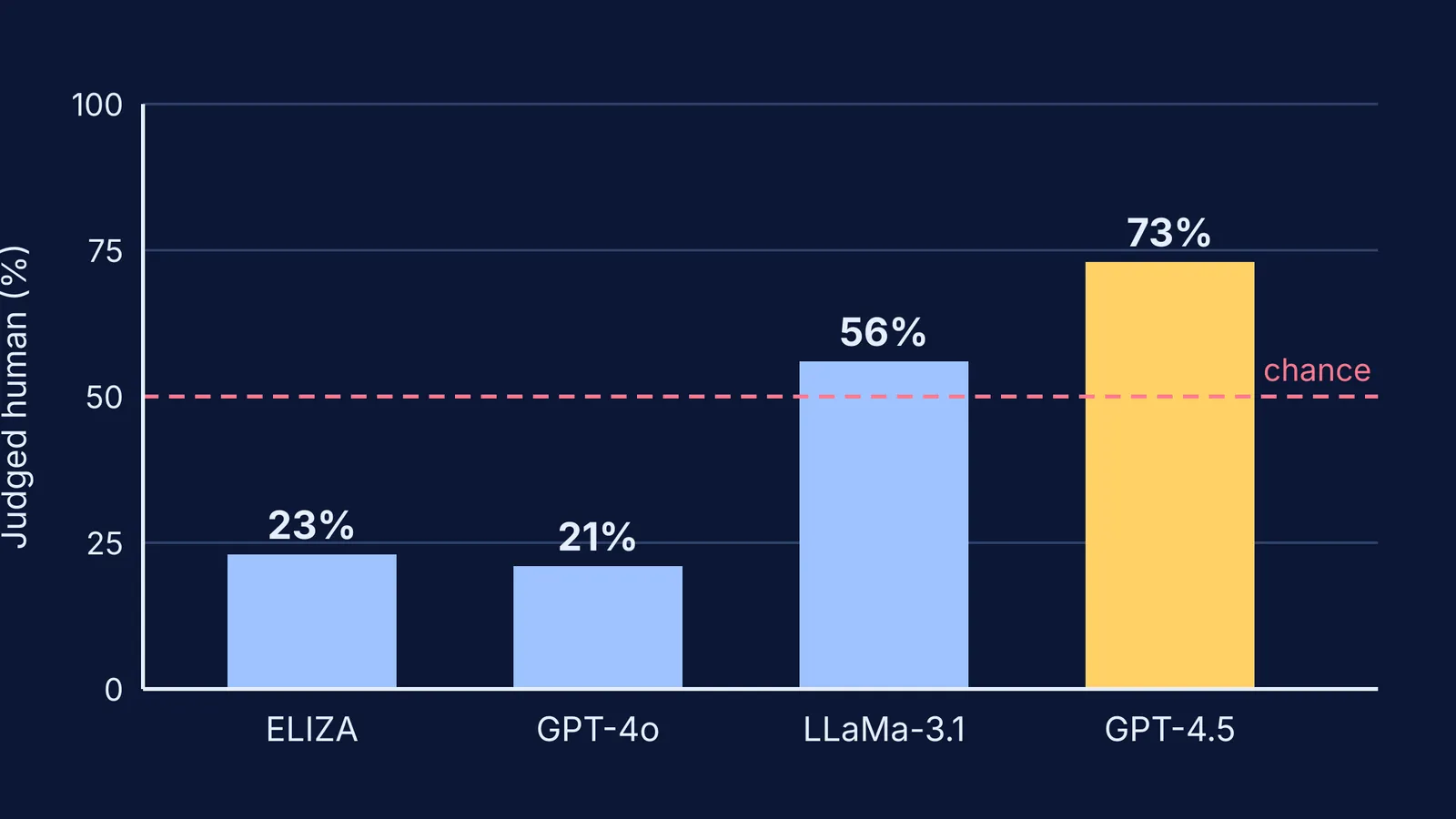
In a 2025 preprint, Cameron Jones and Benjamin Bergen ran 5-minute chats in which each judge talked to a human and an AI at once; GPT-4.5, told to adopt a humanlike persona, was judged to be the human 73% of the time, more often than the real humans (Jones and Bergen, 2025). ELIZA, a chatbot from the 1960s, was judged human 23% of the time.
Does passing the Turing test mean AI understands?
The Turing test measures whether a machine can seem human, not whether it grasps what it says. Philosopher John Searle argued this in 1980 with his Chinese Room (Searle, Behavioral and Brain Sciences, 1980): a person who knows no Chinese follows a rulebook to answer Chinese messages so well that people outside assume they understand. In Searle's later summary, quoted by the Stanford Encyclopedia of Philosophy, the program lets the person "pass the Turing Test for understanding Chinese but he does not understand a word of Chinese."
The bias also runs on our side. The Eliza effect is "our human tendency to attribute understanding and agency to machines with even the faintest hint of humanlike language or behavior" (Mitchell and Krakauer, PNAS, 2023).
Can you trust an AI's explanation of its own answer?
Not automatically. A fluent explanation may not be the real reason for the answer.
In a 2023 study, Miles Turpin and colleagues nudged GPT-3.5 and Claude 1.0 towards wrong answers (for example, making "(A)" the answer in every example) and the models often wrote step-by-step reasoning justifying those answers without mentioning the nudge; accuracy fell by as much as 36% on 13 reasoning tasks (Turpin et al., 2023).
Anthropic's tracing work found that Claude added 36 and 59 along two paths at once, one estimating roughly and one working out the last digit, yet when asked how, it described the school method of carrying the 1 (Anthropic, 2025).
So step-by-step reasoning is not proof of how the AI got there.
How do you check whether an AI explanation is right?
Try five tests on a real example: "Why is the velocity of a ball thrown straight up zero at the top of its flight while its acceleration is not?"
Change one number. "If I throw it twice as fast, what is the acceleration at the top?" It is still g, pointing down. If the AI says it changes, its first explanation did not rest on the physics.
Push to an extreme. "What if there were no gravity or air?" The ball should never stop rising.
Check units at every step. Mismatched units across an equation mean the reasoning is wrong.
Ask it to argue the opposite. If it defends a wrong claim just as confidently, its confidence tells you nothing.
Explain it back with the chat closed. If you cannot, you have not understood it yet.
Our guides on checking an AI's physics solution and five quick ways to check you understood an AI explanation go further.
What should students and parents do with this?
For parents, "Is the AI clever?" matters less than "Can my child explain it back?" A simple script after homework: "Show me how you would do this one without the chat open, and tell me why each step works."
That idea shapes how we build Fermi's AI tutor: it teaches rather than just answers, and checks understanding as it goes. The Fermi Problem Library has worked problems with a step-by-step solver that explains the reasoning, and you can put each step through the same five tests.
Tonight, pick one AI explanation from this week's homework and run the change-one-number test on it.