
On this page
When you type a homework question into a free chatbot, the conversation is saved on the company's servers, and it can become training material for future models unless you change a setting. Here is where to find those settings in ChatGPT, Gemini and Claude, and what is kept even after you opt out.
Can AI companies use my chats for training?
For personal accounts, usually yes. An Engadget guide published in September 2026 says ChatGPT personal accounts are opted in by default and Gemini training is on by default. Claude asks you to choose. Training means using real conversations to shape how future versions answer; our explainer on how AI chatbots are trained with human feedback shows what that process looks like.
People can read some chats too. Google's Gemini Apps privacy hub says human reviewers read a subset of chats, and asks: "Please don't enter confidential information that you wouldn't want a reviewer to see or Google to use to improve our services, including machine-learning technologies."
The rules can differ by account type. When Anthropic updated its consumer terms on 28 August 2025, it asked Claude Free, Pro and Max users whether their chats could be used for training. The change did not cover Claude for Work, Education or API use.
Where is the setting to stop AI training on my chats?
ChatGPT: go to Settings, then Data Controls, and switch off "Improve the model for everyone". Engadget notes this covers web and mobile, and your chats stay in your history.
Gemini: open Gemini Apps Activity at myactivity.google.com/product/gemini and turn off Keep Activity. If you leave it on, Google's privacy hub says chats auto-delete after 18 months by default, and you can change that to 3 or 36 months.
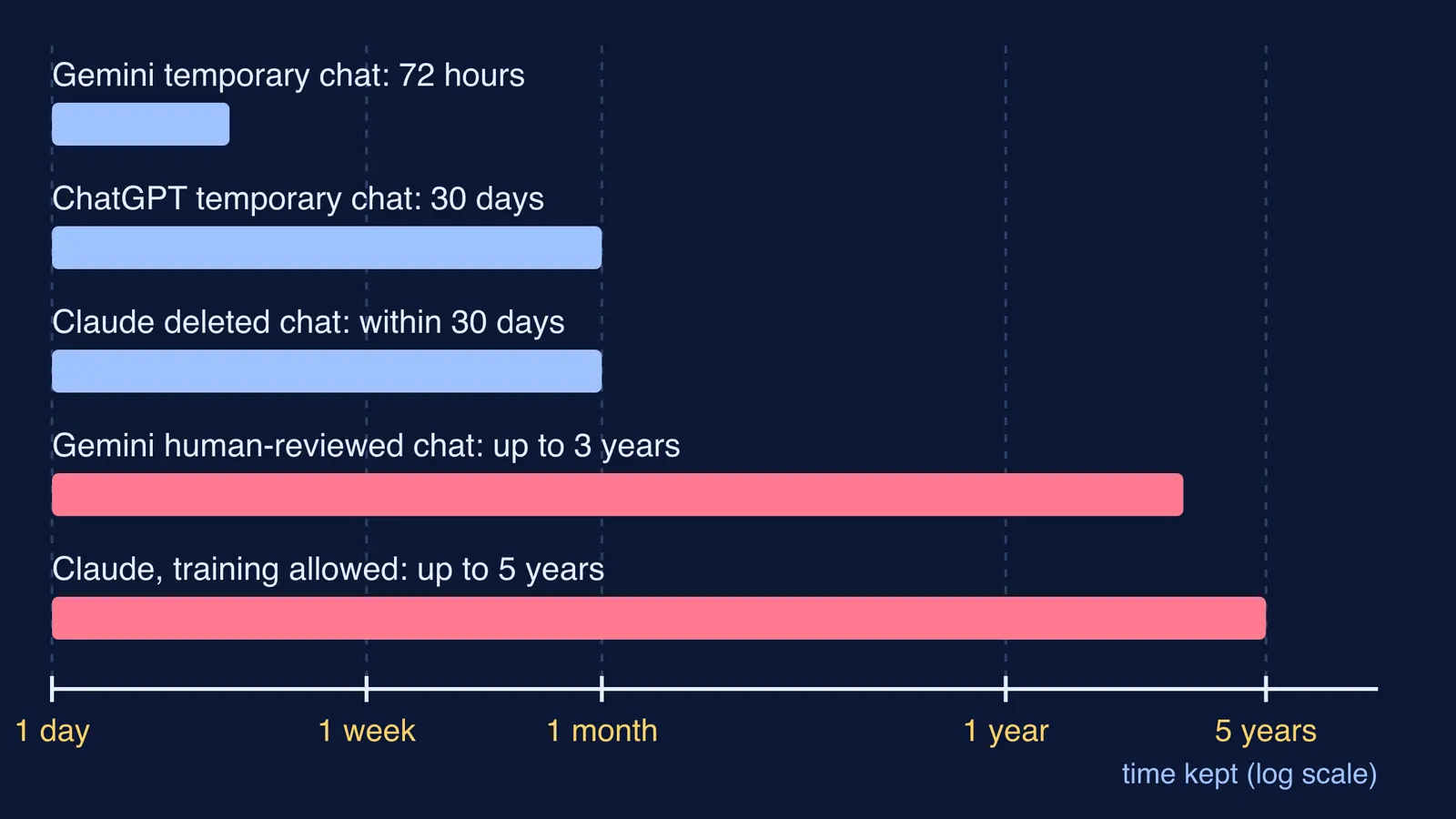
Claude: turn off Model Improvement in your Privacy Settings, Anthropic says. Its terms update says chats are kept for five years if you allow training, against 30 days if you don't.
Opting out does not apply to conversations already used, Engadget notes.
Do temporary chats and deleting history actually help?
Yes, within limits.
ChatGPT's Temporary Chats are never used for training and are purged after 30 days, according to Engadget.
"Temporary chats are not used to train Google's AI models", and they are kept with your account for 72 hours, Google says.
"Your Incognito chats are not used to improve Claude, even if you have enabled Model Improvement", Anthropic says.
Deleting old chats helps too, with limits. Anthropic says a deleted Claude chat is removed from your history immediately and from its back-end storage within 30 days, and that it will not be used for future training. Google says Gemini chats that human reviewers have already seen are not deleted when you delete your activity and are kept for up to three years.
What still gets stored after you opt out?
A short safety window. Google keeps chats for 72 hours even with Keep Activity off, per its privacy hub. Claude chats are kept for 30 days when training is off, per Anthropic.
Flagged chats. If Anthropic's automated safety systems flag a chat, it may keep the inputs and outputs for up to 2 years, and safety classification scores for up to 7 years.
Feedback. A thumbs up or down on Claude is kept for 5 years and may be used to train models once it is separated from your user ID, Anthropic says. Google says Gemini feedback is reviewed by people and kept for up to three years, disconnected from your account.
A quick privacy check to do together
Open each chatbot you use and switch off the training setting listed above.
In Gemini, if you keep history on, set auto-delete to 3 months, the shortest option Google lists.
Use a temporary or incognito chat for anything about health, family or money.
Don't press thumbs up or down on a chat that has personal details in it.
Delete old chats that name you, your school or your phone number.
Remove your name and roll number before pasting, and check our list of what personal information not to share with an AI chatbot.
Worked example: Aarav, 16, uploads a photo of his physics worksheet to ask about a pulley question. The top of the photo shows his name, school and roll number. The fix: crop the photo down to the question and ask in a temporary chat. He gets the same help, and his name never enters the chat.
A script for parents: "I'm not checking what you ask. Can we spend a few minutes turning off training and setting auto-delete on the apps you use?" If your child is under 18, our guide to what India's data protection law says about children's data explains the consent rules apps must follow.
Most homework help needs only the question itself. The Fermi Problem Library has worked problems with a step-by-step solver that explains the reasoning rather than printing an answer, and a pulley question never needs your name in it.