
On this page
If someone has your private photos or videos and says they will send them to your family, friends or followers unless you pay or send more, you are being targeted by sextortion. It is a crime, it is not your fault, and there is a clear way through it.
What is sextortion?
Sextortion is blackmail with intimate images: someone threatens to share a nude or sexual picture of you unless you give them money, more pictures or something else.
The US National Center for Missing & Exploited Children (NCMEC) describes it as a person threatening to share nude or sexual images of a young person while demanding "additional sexual content, sexual activity or money" (NCMEC on sextortion). The same steps work if you are an adult.
It is common and growing. NCMEC's CyberTipline received more than 186,800 reports of online enticement, the category that includes sextortion, in 2023, and those reports rose by more than 300% between 2021 and 2023 (NCMEC).
Should I pay so they delete the photos?
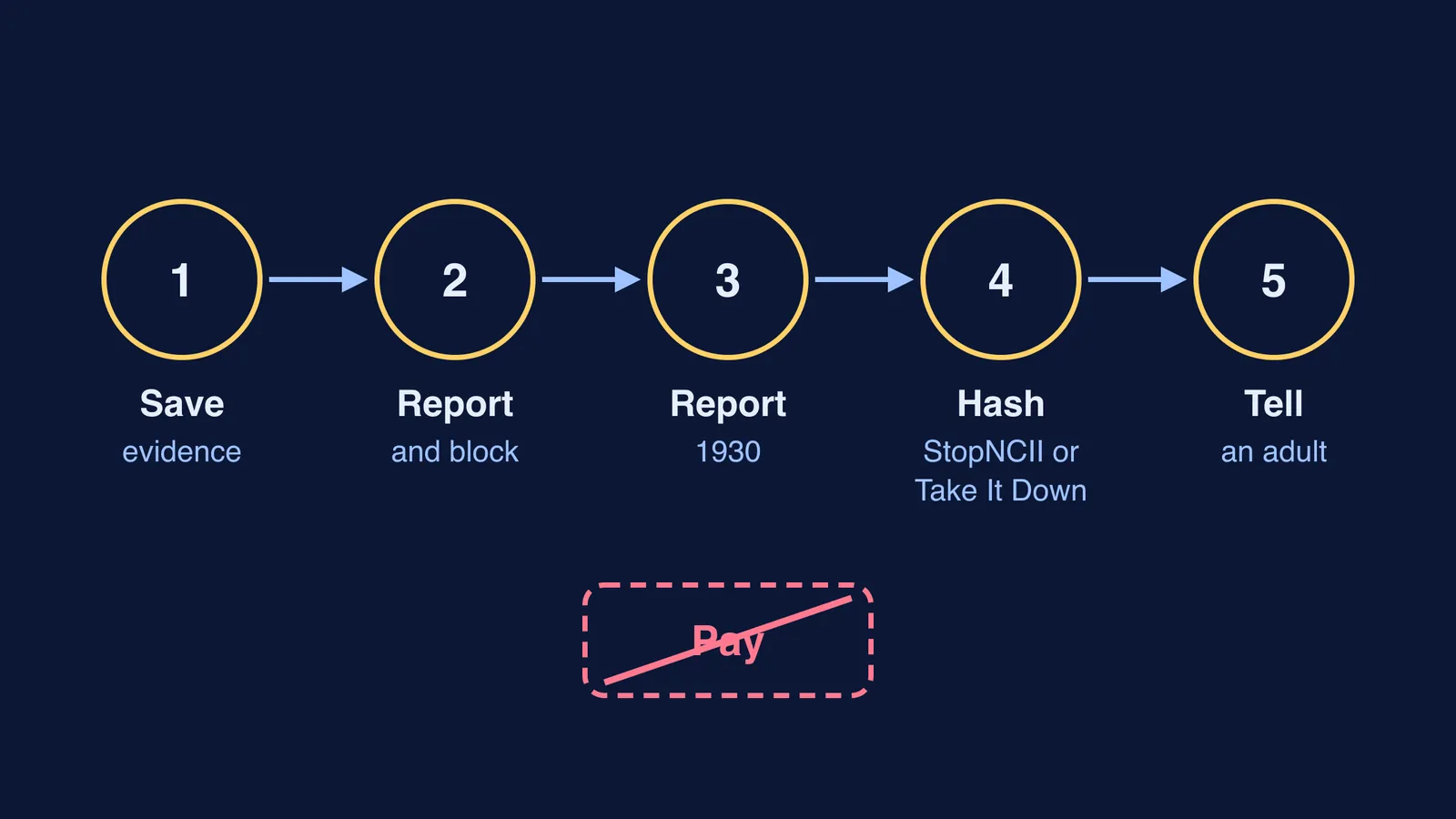
No. NCMEC advises you to "get help before deciding whether to pay money or otherwise comply with the blackmailer", because "cooperating or paying rarely stops the blackmail" (NCMEC).
Once you pay, they know you can be made to pay again. If you send more photos, they have more to threaten you with. And they can never prove they have deleted anything.
Someone is threatening to leak my photos: what do I do right now?
Do these five steps today; step 5 can come first.
Stop replying, but keep everything. Screenshot the chat, every threat, the payment demand (UPI ID, bank details, QR code), and the profile page and username. Note dates and times. NCMEC advises blocking the account without deleting the messages or your own profile (NCMEC).
Report the account on the app, then block it. Report first so the platform has a record, then block so the threats stop reaching you.
Report it at cybercrime.gov.in or call 1930. The Ministry of Home Affairs says the National Cyber Crime Reporting Portal lets the public report all types of cybercrime "with special focus on cyber crimes against women and children", and the toll-free 1930 helpline helps you lodge a complaint (PIB, Ministry of Home Affairs). State or UT police handle the case. If you have already paid, report fast: the same release describes a system for "immediate reporting of financial frauds".
Stop the image spreading with StopNCII or Take It Down. StopNCII makes a digital fingerprint, called a hash, of your image on your own phone; "a hash will be sent from your device, but not the image/video itself", and participating platforms remove matching images that break their rules (StopNCII). StopNCII is for people who were over 18 in the image; if you were under 18, its FAQ points you to Take It Down (StopNCII FAQ), a free NCMEC service where "your image or video remains on your device and is not uploaded" (Take It Down).
Tell an adult you trust. A parent, an older sibling, a teacher or a school counsellor. You do not have to carry this alone.
How do I tell my parents?
The hardest part is the first sentence. You can read this out word for word:
"Something happened online and I need your help, not a lecture."
"Someone has a private photo of me and is threatening to share it unless I pay."
"I have (or haven't) paid. I've saved the chat. Can we report it together tonight?"
For parents: your first words matter most. Try "Thank you for telling me. You are not in trouble. We will sort this out together." Then:
Do not take the phone away as a punishment; it holds the evidence, and your child may stop telling you things.
Do not message or threaten the blackmailer yourself.
Do not delete the chat. Sit together and follow the five steps above.
If you or your child feels overwhelmed, panicky or unsafe, Tele MANAS is a free, 24x7 national mental-health helpline from the Ministry of Health and Family Welfare: call 14416 or 1800-891-4416 (Tele MANAS details).
What if the photo is fake or AI-made?
If the image is an edited version of an ordinary photo, the steps are the same: do not pay, save evidence, report, and tell someone. Our guide on what to do about an AI-morphed photo covers the details. If the same person keeps following you across apps, read how to spot cyberstalking and report it. Parents who want to talk about this before anything happens can start with our post on discussing deepfakes and photo sharing with teens.
When you feel steady enough to study again, Fermi's AI tutor can work out what you already know and build a plan for the session, so you can pick up where you left off.
Your next step is small: take the screenshots, then tell one person today.