
On this page
Ask ten parents how much screen time a teen should get and you will hear ten numbers. No single number has strong research behind it. Expert guidance does support treating a physics lecture differently from a reels feed, and protecting sleep first.
Is there a recommended amount of screen time for teenagers?
No. The American Academy of Pediatrics (AAP) says “there isn’t an exact amount of screen time that is recommended for teens,” and suggests looking at the quality and type of activity rather than only the hours (AAP, Screen time for teenagers).
Its January 2026 policy statement warns that media built to maximise engagement can encourage long use that displaces movement and sleep (Munzer and colleagues, Pediatrics, 2026).
Some guidelines do give a cap. Canada’s 24-Hour Movement Guidelines recommend no more than 2 hours a day of recreational screen time for ages 5 to 17, and 8 to 10 hours of sleep a night for 14- to 17-year-olds (Canadian 24-Hour Movement Guidelines). The cap is for recreational screens, so homework sits outside it.
A 2019 analysis in *Nature Human Behaviour* found the link between digital technology use and adolescent well-being was negative but small, “explaining at most 0.4% of the variation in well-being” (Orben and Przybylski, 2019). An average also hides differences between children. The useful questions are what kind of screen time it is, and what it replaces.
Why split study, social and entertainment screens?
Each needs a different rule.
Study screens: lectures, practice problems, mock tests. The risk is a lecture tab drifting into a feed. These need focus rules, not a cap.
Social screens: chats, reels, posts. The clearest warning sits here. A US study of 6,595 adolescents aged 12 to 15 found that those using social media for more than 3 hours a day were more likely to report internalising problems, such as anxiety and depressive symptoms, than non-users (Riehm and colleagues, JAMA Psychiatry, 2019). That is an association, not proof of cause.
Entertainment screens: shows, games, videos. Cap these by episode or match, not minutes.
A study screen earns its place when it makes you think. Fermi’s AI tutor works out what you already know and builds a plan for the session, so you sit down to a clear next step instead of hunting for a video. More in our plan on whether AI tutor time counts as screen time.
What does a balanced weekday look like for a teen?
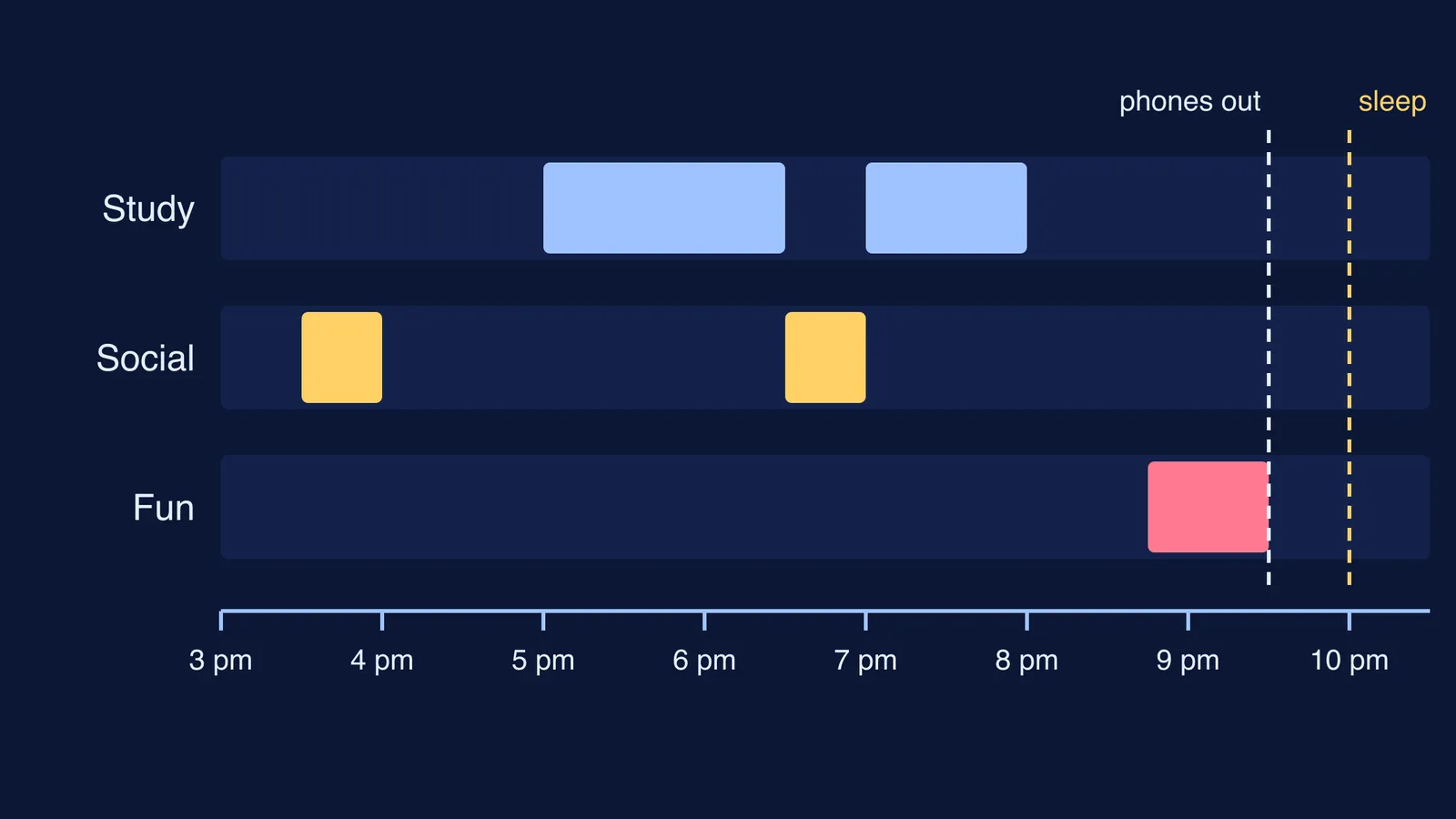
Here is a sample for a Class 11 student home by 3 pm.
3:00 to 3:30 pm: snack, no screens.
3:30 to 4:00 pm: social, 30 minutes of messages and reels.
4:00 to 5:00 pm: sport or a walk, phone at home.
5:00 to 6:30 pm: study block one, device for the lecture or problem set only, notifications off.
6:30 to 7:00 pm: social, a second 30 minutes.
7:00 to 8:00 pm: study block two.
8:00 to 8:45 pm: dinner with the family, no screens at the table.
8:45 to 9:30 pm: entertainment, one episode or two matches.
9:30 pm: phones charge outside the bedroom.
10:00 pm: lights out, about 8.5 hours before a 6:30 am alarm.
Add it up: 60 minutes of social plus 45 minutes of entertainment is 1 hour 45 minutes of recreational screen time, under the 2-hour cap in Canada’s guidelines, with sleep inside their 8 to 10 hour range. Study screens come on top, because they have a job to do.
The AAP’s family media plan suggests screen-free zones “such as the dinner table, during homework and before bed,” turning off autoplay and notifications, and reviewing the plan as children grow (HealthyChildren.org). The sample day keeps meals and the last half hour before bed screen-free. If the bedroom is the battleground, read should a teenager keep the phone in the bedroom at night.
How do you agree a media plan without a fight?
Track one ordinary week using the phone’s screen time report, sorted into study, social and entertainment.
Let your teen propose the social and entertainment limits; people keep rules they wrote.
Agree the fixed points: bedtime, meals, phones out of the bedroom.
Write the plan down where everyone sees it, including parents’ rules.
Review it after two weeks, and again before exams.
A script that keeps it calm: “I’m not taking your phone. I want to protect your sleep and study blocks. What feels fair for social time on a school day, and what happens if either of us slips?”
Before boards the social bucket may shrink; see should your teen quit social media before board exams.
When should screen time worry you?
Watch for screens replacing sleep, falling marks, pulling away from friends and family, or big mood swings when the phone is taken away. If this lasts for weeks, talk to your doctor, the school counsellor or a psychologist. In India, the Tele MANAS mental health helpline runs 24x7 on the toll-free number 1800-89-14416 or the short code 14416 (Ministry of Health and Family Welfare).
Start tonight: the numbers you need are already on the phone.