On this page
A power cable runs 3 km under a busy road, and one of its cores has started leaking current to the earth. Before anyone digs, the engineers need a distance. One of the oldest ways to get it is a Wheatstone bridge, the same circuit you balance in the lab. The trick is called the Murray loop test, and it turns the buried cable itself into two arms of the bridge.
How does a Murray loop turn a cable into a Wheatstone bridge?
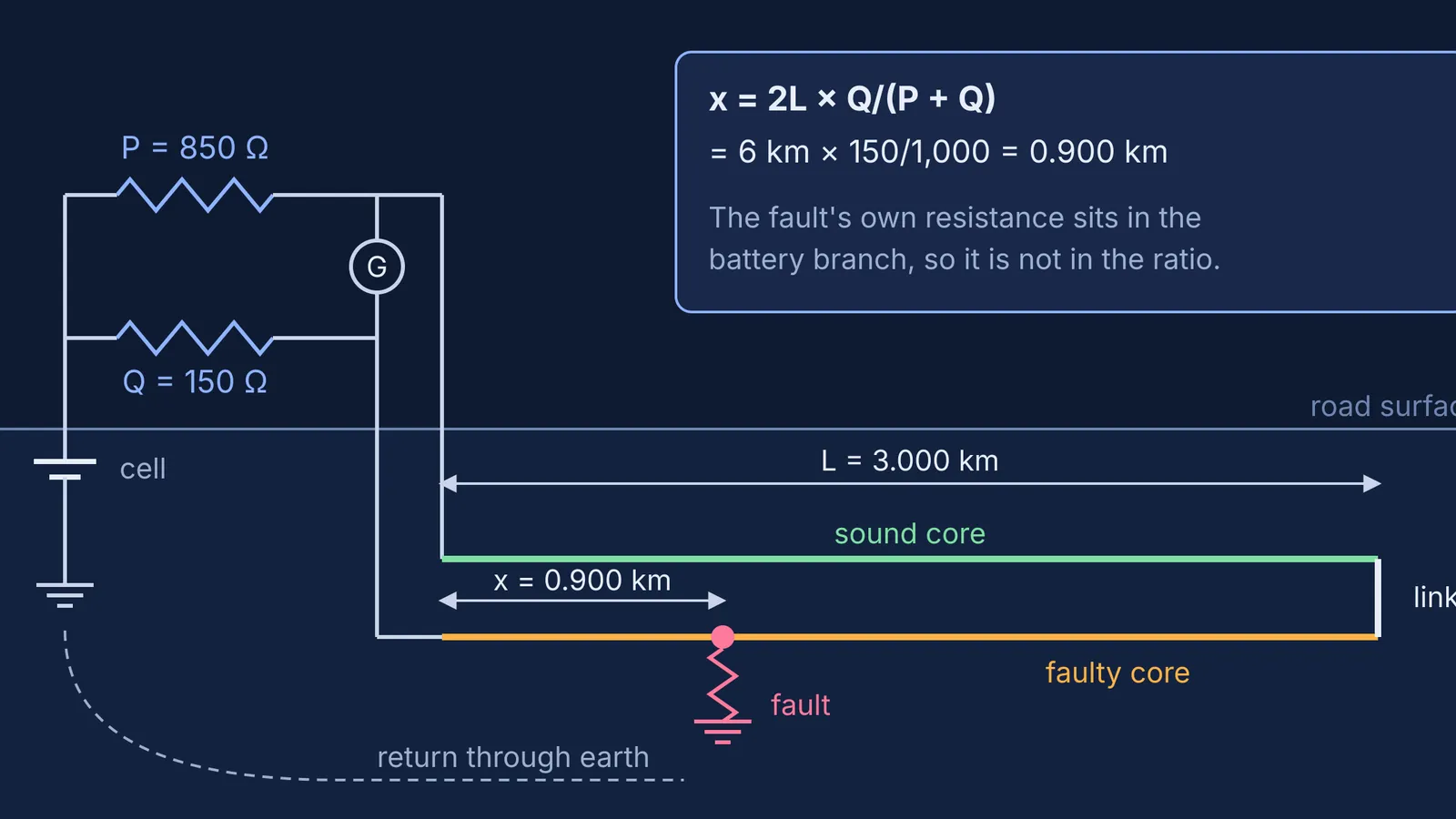
You need the faulty core and a sound (healthy) core of the same size and material in the same cable run. At the far end, the two cores are joined by a short link of almost zero resistance. Now you have a loop of length 2L that starts at the test end on the faulty core, goes out to the far end, and comes back on the sound core.
The fault splits this loop into two parts:
x: the faulty core from the test end to the fault.
2L − x: the rest of the faulty core, plus the whole sound core back to the test end.
At the test end, two known ratio resistances complete the bridge. Call them Q, joined to the faulty core, and P, joined to the sound core. P and Q meet at a common point. The battery goes from that common point to earth. The galvanometer goes across the two cable ends at the test end.
The fourth corner of the bridge is the fault itself. Current from the battery travels through the earth, enters the core at the fault, and splits: part goes back along x, part the long way round along 2L − x.
Because the four arms are Q, P, 2L − x and x, the usual balance condition (derived in the balanced Wheatstone bridge derivation) gives:
Q/P = R(x)/R(2L − x)
If the core has the same resistance per kilometre all along, the resistances are proportional to the lengths, so Q/P = x/(2L − x). Rearranging:
x = 2L × Q/(P + Q)
The manufacturer BAUR gives the same result in its cable fault location application guide: the distance is the bridge reading, as a percentage, times 2l. It also states the conditions: a healthy core of the same diameter and conductor material, and a link at the far end that is close to zero ohms.
Why does the fault's own resistance not matter?
The fault might be a damp patch with a few hundred ohms to earth, and nobody knows its value. Yet it never appears in the formula.
The fault resistance is in series with the battery, in the branch that feeds current into the bridge. A Wheatstone bridge balances when the two cable ends are at the same potential, and that depends only on the ratios of the four arms. Changing the resistance in the battery branch changes how much current flows in total, not how it divides. The same holds for the galvanometer's own resistance.
What a large fault resistance changes is sensitivity: less current flows, so a small imbalance gives a smaller galvanometer kick.
Worked example: where is the fault on a 3 km cable?
A 3.000 km cable has a fault from one core to earth. The bridge balances with P = 850 Ω on the sound core side and Q = 150 Ω on the faulty core side.
Loop length. 2L = 2 × 3.000 km = 6.000 km.
Ratio. Q/(P + Q) = 150/1,000 = 0.150.
Distance. x = 6.000 km × 0.150 = 0.900 km.
Check with real resistances. Suppose the core has 0.6 Ω per km (an illustrative round value). Then R(x) = 0.900 × 0.6 = 0.54 Ω and R(2L − x) = 5.100 × 0.6 = 3.06 Ω. Their ratio is 3.06/0.54 = 5.67, and P/Q = 850/150 = 5.67. The bridge is balanced.
So the fault is about 900 m from the test end, measured along the cable.
What if you use a metre bridge instead?
Replace P and Q with a 100 cm slide wire. If the balance point is 15.0 cm from the end joined to the faulty core, then Q/(P + Q) = 15.0/100 and x = 6.000 km × 0.150 = 0.900 km again. A 1 mm error in reading the jockey position is 0.1/100 of 6 km, which moves the answer by 6 m of street. End errors in the wire, covered in interchanging resistances in the meter bridge, shift the answer in the same way, so they matter here too.
Why do resistivity and temperature cancel out?
You never needed the 0.6 Ω per km in step 4. In the formula, the resistance per kilometre appears on both sides of Q/P = x/(2L − x) and cancels.
The copper's resistivity depends on its temperature, and the cross-section may not be known exactly. None of that matters, as long as both cores are the same size and material and at the same temperature, which they are if they run together in one cable. The Carey Foster bridge uses a similar idea, letting an unknown cancel out of the result.
When does the Murray loop give the wrong answer?
The formula rests on resistance being proportional to length. Anything that breaks that gives an error.
A sound core of a different size. Suppose the sound core is thinner and has 1.2 times the resistance per kilometre. With the true fault at 0.900 km, the bridge balances at Q/P = 0.900/(2.100 + 1.2 × 3.000) = 0.900/5.700. The simple formula then gives 0.818 km, about 82 m short. The BAUR guide handles this by converting each section to an equivalent length of the same material and cross-section.
A poor link at the far end. Its resistance adds to the 2L − x arm and pushes the answer the wrong way.
A clean break with no leak. If the core is broken but not touching earth or another core, no current enters at the fault and the loop is open. The Murray loop needs a leak; breaks need other tests.
Route versus ground. The answer is a length of cable, which can exceed the straight-line distance if the cable bends or has slack.
A very high-resistance fault. The balance point is still right, but the galvanometer barely moves, so it becomes hard to find.
The test is done by trained crews on a cable that has been switched off and isolated. Many crews now also use pulse reflection methods, but the bridge remains a clear example of a balance condition measuring distance.
For more bridge problems with unknown arms, the Fermi Problem Library has a step-by-step solver that explains the reasoning at each line.
Quick checklist
Faulty core and sound core joined at the far end make a loop of length 2L.
The fault is the fourth corner of the bridge; earth and the fault resistance sit in the battery branch.
Balance: x/(2L − x) = (faulty-side arm)/(sound-side arm), so x = 2L × Q/(P + Q).
Resistivity and temperature cancel if both cores match; fault resistance affects only sensitivity.
The answer is distance along the cable, not across the ground.