

On this page
A metre bridge has a hidden flaw. The copper strips, the solder and the contact at each end of the wire add a little resistance that nobody measures. These end errors make an ordinary reading of an unknown resistance a fraction of a per cent wrong. The Carey Foster bridge removes them completely. It does it with one extra pair of resistors and one swap, and it measures the difference between two nearly equal resistances to a few thousandths of an ohm.
All numbers in the worked example below are illustrative values chosen to show the method, not readings from a particular lab.
What is a Carey Foster bridge?
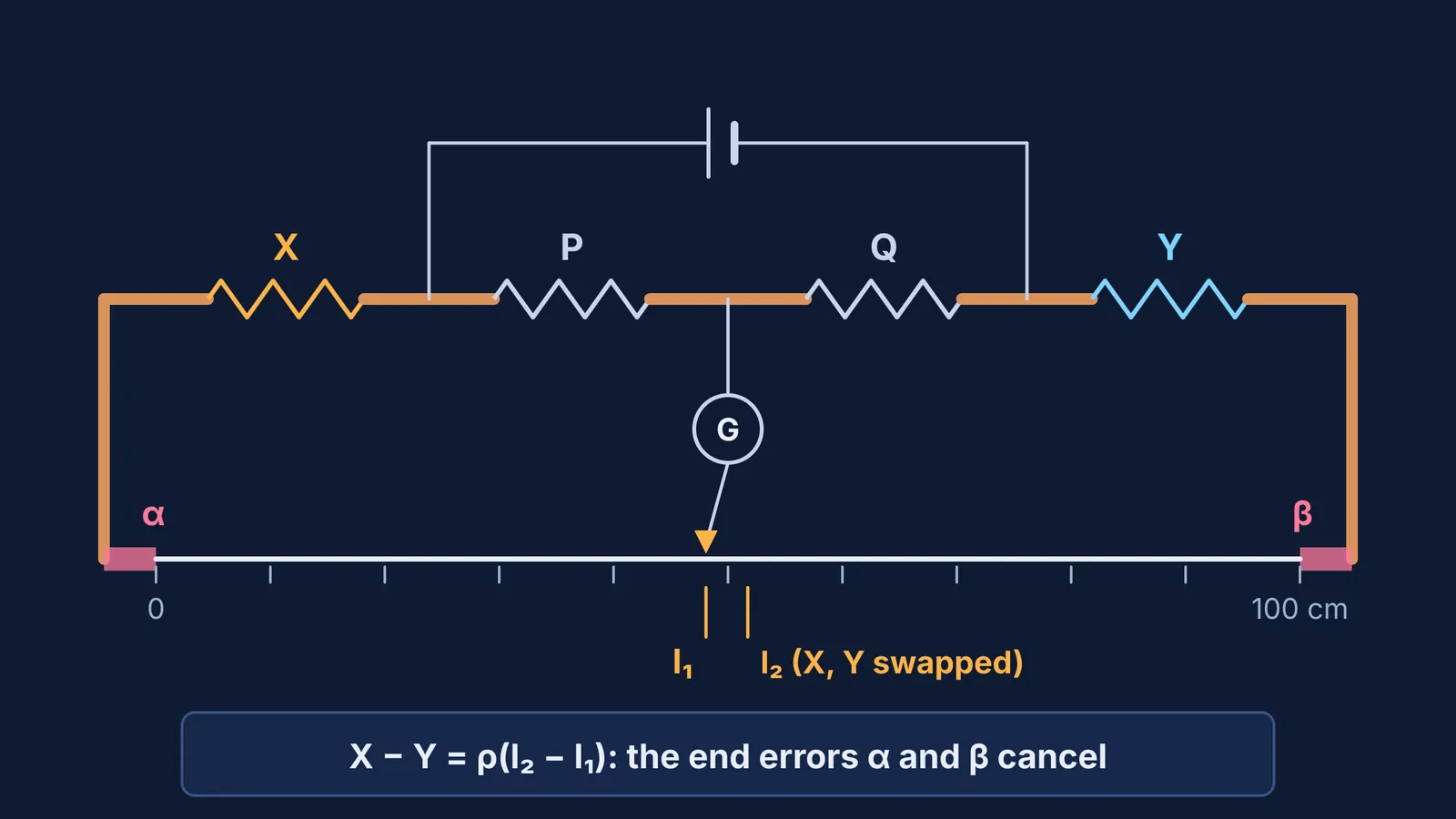
It is a metre bridge with four gaps in the copper strip instead of two.
The two inner gaps hold two nearly equal resistances, P and Q. These are the ratio arms.
The two outer gaps hold the resistances being compared: X (left) and Y (right).
The metre wire runs below, joined to the outer ends of the strip, with uniform resistance ρ per cm.
The cell connects across the ends of the P–Q pair, and the galvanometer runs from the junction of P and Q to a jockey on the wire.
So the four arms of this Wheatstone bridge are P, Q, (X + the left part of the wire) and (Y + the right part of the wire). Call the hidden end resistances ρα on the left and ρβ on the right, where α and β are the extra lengths of wire they are equivalent to.
How does swapping X and Y cancel the end errors?
Find the balance point l₁, measured from the left end. The Wheatstone condition gives:
P/Q = [X + ρ(l₁ + α)] / [Y + ρ(100 − l₁ + β)]
Add 1 to both sides. The top of the right-hand side becomes X + Y + ρ(100 + α + β), the total resistance of the lower path:
(P + Q)/Q = [X + Y + ρ(100 + α + β)] / [Y + ρ(100 − l₁ + β)]
Now swap X and Y and find the new balance point l₂. The same steps give:
(P + Q)/Q = [X + Y + ρ(100 + α + β)] / [X + ρ(100 − l₂ + β)]
The left sides are equal, and so are the tops on the right. So the bottoms must be equal:
Y + ρ(100 − l₁ + β) = X + ρ(100 − l₂ + β), which gives X − Y = ρ(l₂ − l₁).
Look at what has gone. α, β, P and Q have all cancelled. The result is exact, not an approximation, and it does not even need P = Q. It needs only three things: the same P and Q for both balances, both lengths measured from the same end, and a uniform wire.
The ordinary fix, swapping the two resistances in a plain metre bridge and averaging, is explained in why resistances are swapped in the meter bridge experiment. That averaging leaves a small residual error. The Carey Foster swap leaves none.
How do you find the resistance per cm of the wire?
Use the same formula backwards. Put a known resistance in one outer gap and a thick copper strip (resistance close to zero) in the other. Then ρ = (X − Y)/(l₂ − l₁).
Worked example (illustrative values). The wire really has ρ = 0.0200 Ω/cm, with hidden end errors equal to α = 0.6 cm on the left and β = 0.4 cm on the right. The student does not know any of these. P = Q.
First balance: X = 0.100 Ω standard, Y = copper strip. Balance at l₁ = 47.40 cm.
Swap: balance at l₂ = 52.40 cm.
Difference: l₂ − l₁ = 5.00 cm.
Result: ρ = 0.100 / 5.00 = 0.0200 Ω/cm. This is the true value, even though the balance points were shifted by the end errors.
How do you measure a small resistance difference with it?
Keep the same wire. Put the unknown in as X and a 1.000 Ω standard as Y.
First balance: l₁ = 48.075 cm.
Swap X and Y: l₂ = 51.725 cm.
Difference: l₂ − l₁ = 3.650 cm.
Formula: X − Y = ρ(l₂ − l₁) = 0.0200 × 3.650 = 0.0730 Ω.
Answer: X = 1.000 + 0.073 = 1.073 Ω.
Check the units: (Ω/cm)(cm) = Ω.
Now test the claim that P need not equal Q. With P/Q = 1.05 instead of 1, the balance points move to 50.57 cm and 54.22 cm. Their difference is still 3.65 cm, and X is still 1.073 Ω.
Compare a plain metre bridge with the same wire and the same hidden end errors, the unknown against the 1.000 Ω standard. With the unknown in the right gap, the reading comes out as 1.078 Ω, about 0.5% high. With it in the left gap, it comes out as 1.069 Ω, about 0.3% low. Averaging the two gives 1.0738 Ω, still 0.07% high.
How precise is the Carey Foster answer? If each balance point is read to ±0.05 cm, the difference l₂ − l₁ is uncertain by at most ±0.1 cm. That is ±0.0200 × 0.1 = ±0.002 Ω on X.
If you want more bridge and potentiometer problems worked step by step, the Fermi Problem Library has a step-by-step solver that explains the reasoning.
Why should P and Q be nearly equal if the result does not need it?
Accuracy does not depend on P = Q, but sensitivity does. With P ≈ Q and X ≈ Y, both balance points sit near the middle of the wire, where a small move of the jockey gives the clearest change in galvanometer current. The reasons are covered in why the meter bridge null point should be near the middle.
There is also a range limit. The balance point must stay on the wire, so |X − Y| has to be less than about the wire's total resistance, 100ρ. With ρ = 0.0200 Ω/cm that is about 2 Ω. This is why the method is used to compare a resistance with a nearly equal standard, or to measure ρ itself, and not to measure a large unknown from scratch. For the standard metre bridge practical and its viva questions, see meter bridge and potentiometer: principle and practical errors.
Quick checklist
Four gaps: X and Y outside, nearly equal P and Q inside.
Balance at l₁, swap X and Y, balance at l₂, both measured from the same end.
X − Y = ρ(l₂ − l₁). End errors α and β cancel exactly.
The result holds even if P ≠ Q, as long as P and Q are not changed between balances.
Find ρ first with a known resistance against a thick copper strip.
Use P ≈ Q for sensitivity, and keep |X − Y| below the wire's total resistance.


