On this page
If your null point lands at 12 cm, expect to be told to change the resistance box and try again. Where the balance falls decides how much a small reading error grows, and you can work it out.
What does a meter bridge actually measure?
A meter bridge is a Wheatstone bridge in which two of the four arms are the two parts of one uniform wire, 100 cm long. NCERT's Class 12 textbook states the Wheatstone bridge null-point condition as R1/R2 = R3/R4 (NCERT Physics Part I, Chapter 3). On a uniform wire, resistance is proportional to length, so the two segments are in the ratio l : (100 − l).
Put the unknown resistance R in the left gap and the known resistance S in the right gap. If the jockey balances at l cm from the left end, then:
R = S × l / (100 − l)
This is a prescribed board practical. The CBSE physics curriculum for 2026-27 lists "To find resistance of a given wire / standard resistor using metre bridge" among the Class XII Section A experiments, and the two experiments you perform, one from each section, carry 7 marks each in the 30-mark practical exam. For more on the principle, see meter bridge and potentiometer errors.
Why should the null point be near the middle of the meter bridge?
The only thing you read off the bridge is l, to some uncertainty Δl. Since S is fixed, taking logs and differentiating gives:
ΔR/R = Δl/l + Δl/(100 − l) = 100 Δl / [l(100 − l)]
The two terms add rather than cancel. If you read l slightly too large, then 100 − l is too small by the same amount, and both push R in the same direction. The same rule for combining errors appears in our post on why subtraction costs precision.
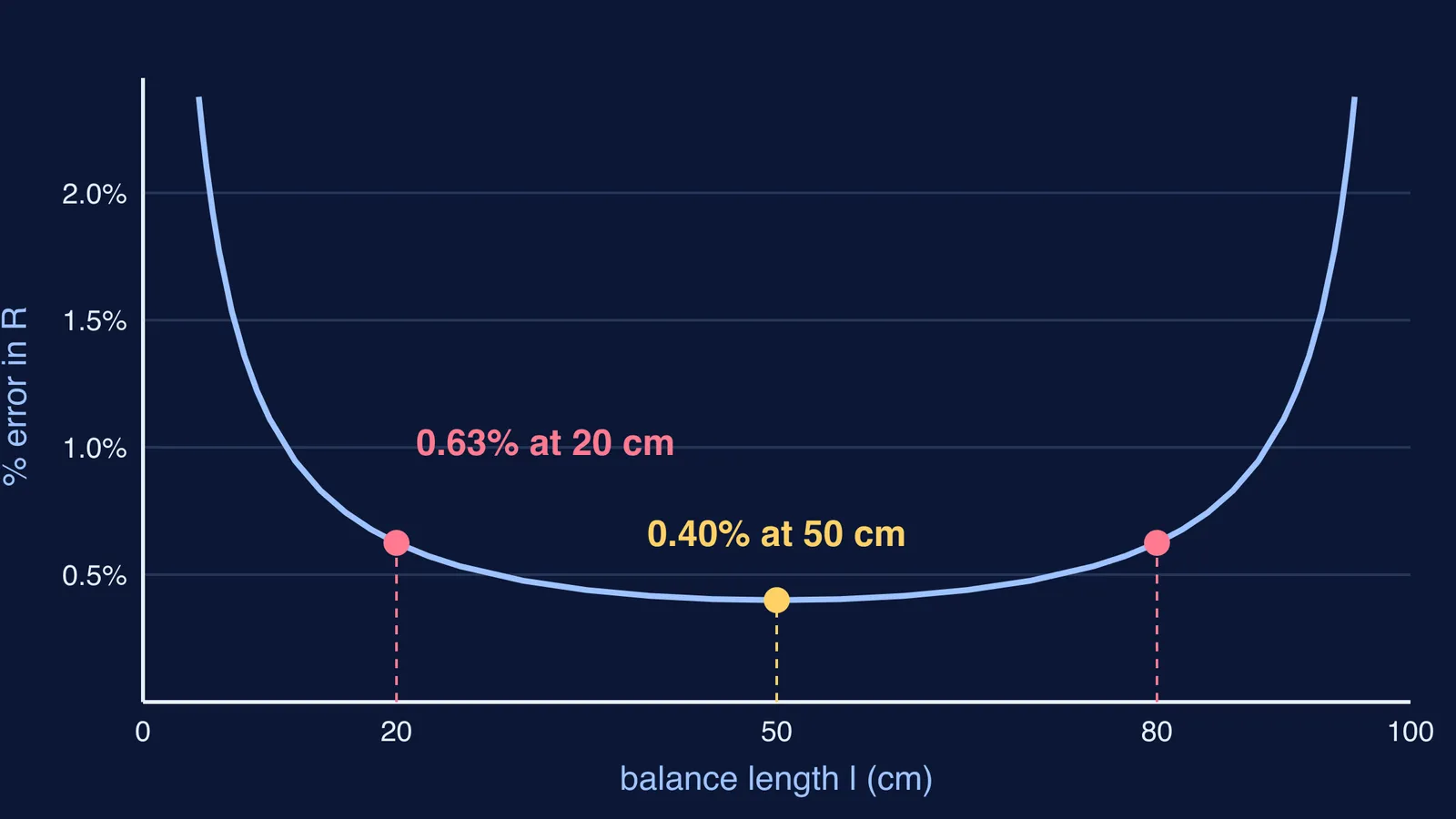
For two numbers that always add to 100, the product l(100 − l) is largest when both equal 50. A bigger denominator means a smaller fractional error, so the percentage error in R is least when the balance point is at 50 cm.
Worked example: percentage error at 20 cm and at 50 cm
Take a reading error of Δl = 0.1 cm (1 mm) and use the formula above.
Balance at l = 50 cm: 100 × 0.1 / (50 × 50) = 10 / 2500 = 0.0040, so the error in R is 0.40%.
Balance at l = 20 cm: 100 × 0.1 / (20 × 80) = 10 / 1600 = 0.00625, so the error in R is about 0.63%.
The 20 cm reading carries about 1.56 times the error. A balance at 80 cm gives the same 0.63%, because the formula is symmetric.
With the same 1 mm reading error elsewhere on the wire:
40 cm or 60 cm: about 0.42%
30 cm or 70 cm: about 0.48%
10 cm or 90 cm: about 1.11%
The curve is flat in the middle, steep at the ends. Anywhere between 40 and 60 cm, the error is at most about 0.42%, barely above the 0.40% minimum, which is why "near the middle" is good enough.
How does NCERT Exemplar question 3.3 test this?
In question 3.3 of the NCERT Exemplar for Class XII physics, Chapter 3, a student uses S = 100 Ω and finds the null point at 2.9 cm. The options are to measure l more accurately, change S to 1000 Ω, change S to 3 Ω, or give up on the meter bridge.
Work it out: R =100 × 2.9 / 97.1, which is about 2.99 Ω. At 2.9 cm the error factor is 100 / (2.9 × 97.1), so a 1 mm reading error becomes about 3.6% in R, roughly nine times the error at the middle. Changing S to 1000 Ω pushes the null point to about 0.3 cm and makes things worse. Choosing S = 3 Ω, close to R, brings the null point near 50 cm. That is option (c).
To check your working on questions like this, the Fermi Problem Library has worked problems with a step-by-step solver that explains the reasoning rather than printing an answer.
How do you get the null point near the middle in the lab?
Take a trial reading with any sensible S and note the rough balance length.
Estimate R = S × l / (100 − l).
Set the resistance box close to that estimate, so R/S is near 1.
Aim for 40 to 60 cm; if you land outside 30 to 70 cm, change S again.
In the viva, say: the error in R is least at l = 50 cm, so I chose S to bring the balance point near the middle.
This only counts the error in reading l; errors in the resistance box and at the wire's ends are separate. For what happens when the cell and galvanometer swap places, see our Wheatstone bridge interchange explainer.
If error propagation itself feels shaky, the Fermi Concept Library gives every physics concept its own lesson and its place in the map.