On this page
You can swap them. If a Wheatstone bridge is balanced with the cell across one diagonal and the galvanometer across the other, it stays balanced when the two change places. The reason fits in one line of algebra, and you can check it with four resistors and a 6 V cell.
What is the balance condition of a Wheatstone bridge?
The bridge is four resistors in a loop, A to B to C to D and back to A, with a cell across one pair of opposite corners and a galvanometer across the other. NCERT's Class 12 Physics textbook (section 3.13) calls these the battery arm and the galvanometer arm. It derives the balance condition R2/R1 = R4/R3 for zero current through the galvanometer, assuming the cell has no internal resistance (NCERT Physics Part I, Chapter 3). Samuel Hunter Christie invented the arrangement in 1833, and Charles Wheatstone improved and popularised it in 1843 (Wheatstone bridge, Wikipedia).
Look at what the condition leaves out: the emf of the cell and the resistance of the galvanometer. That is the first clue.
Can the cell and galvanometer be interchanged in a Wheatstone bridge?
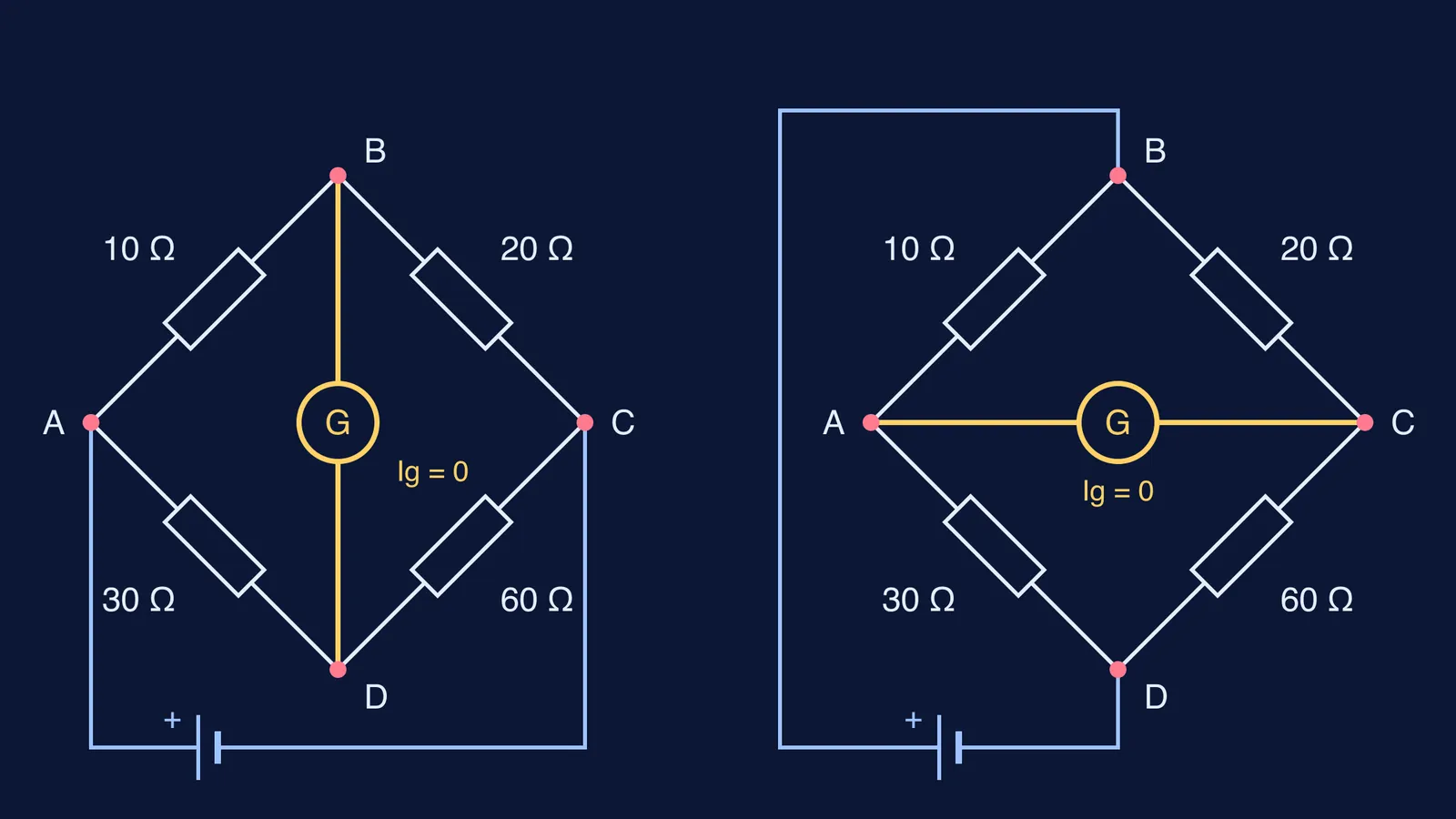
Yes. Name the arms by position: P = AB, Q = BC, R = AD and S = DC.
With the cell across A and C, the galvanometer across B and D reads zero when B and D are at the same potential. B sits on the divider A-B-C and D sits on A-D-C, so equal potentials need P/Q = R/S.
Now put the cell across B and D and the galvanometer across A and C. A sits on the divider B-A-D and C sits on B-C-D. Equal potentials now need P/R = Q/S.
Cross-multiply both and you get P × S = Q × R. It is the same equation. Balance means the products of opposite arms are equal, and that statement does not care which diagonal holds the cell.
Does a numerical bridge really check out?
Take P = 10 Ω, Q = 20 Ω, R = 30 Ω, S = 60 Ω and a 6 V cell with no internal resistance, the same simplifying assumption NCERT makes (NCERT Physics Part I, Chapter 3). Here 10 × 60 = 600 and 20 × 30 = 600.
Cell across AC, with A at 6 V and C at 0 V. Branch A-B-C has 30 Ω, so 0.2 A flows and AB drops 2 V, which puts B at 4 V. Branch A-D-C has 90 Ω, so 1/15 A flows and AD drops 2 V, which puts D at 4 V. No current through the galvanometer.
Cell across BD, with B at 6 V and D at 0 V. Branch B-A-D has 40 Ω, so 0.15 A flows and BA drops 1.5 V, which puts A at 4.5 V. Branch B-C-D has 80 Ω, so 0.075 A flows and BC drops 1.5 V, which puts C at 4.5 V. Again no current.
The potentials at the galvanometer's ends change from 4 V to 4.5 V, but they stay equal to each other, and that is all balance asks.
What changes when the bridge is not balanced?
Change S to 50 Ω, so the products become 500 and 600. Give the galvanometer a resistance of 15 Ω and solve the circuit with Kirchhoff's rules, the kind of calculation NCERT works through for an unbalanced bridge with a 15 Ω galvanometer in its Example 3.7 (NCERT Physics Part I, Chapter 3).
Cell across AC: B is at 3.959 V, D is at 3.866 V, and about 6.19 mA flows through the galvanometer.
Cell across BD: A is at 4.456 V, C is at 4.369 V, and about 5.83 mA flows.
So the swap does not keep every reading the same. It keeps the null. In the lab, that makes the swap a useful check: in principle, the balance point on a meter bridge should not move when you interchange the cell and the galvanometer. If it shifts noticeably, recheck your connections before you trust the reading.
There is a deeper reason behind this, the reciprocity theorem. For a network of linear, passive, bilateral components, the current at one point due to a voltage at a second point is the same as the current at the second point due to the same voltage at the first (Reciprocity in electrical networks, Wikipedia)). Balance is the special case where that current is zero. Our unbalanced readings differ only because the 15 Ω galvanometer moved with the swap, which changed the network itself.
How do you answer this in an exam?
A four-step answer covers a short-answer question:
Write the balance condition in product form: P × S = Q × R.
Show in two lines that both orientations reduce to it.
Point out that the condition contains no emf and no galvanometer resistance.
If the question says the bridge is unbalanced, say the null survives the swap but the deflection generally does not.
If Kirchhoff's rules still feel shaky, the Fermi Concept Library gives every physics concept its own lesson and shows where it fits in the map. To practise more bridge circuits, the Fermi Problem Library has worked problems with a step-by-step solver that explains the reasoning rather than printing an answer.