On this page
Management of Support Services, Institutions and Programmes for Children, Youth and Elderly is Chapter 7 of the NCERT Human Ecology and Family Sciences Part I textbook for Class 12 (reprint 2026-27). It asks why three age groups need help beyond the family, which institutions give it, and what running them takes.
How many marks is this chapter worth in 2026-27?
The CBSE Home Science (064) curriculum for 2026-27 gives Unit III, Human Development and Family Studies, 10 of the 70 theory marks. This chapter shares those 10 marks with Early Childhood Care and Education; there is no separate chapter figure.
Its topic list covers why each group is vulnerable, the named programmes and careers.
What does "vulnerable" mean in this chapter?
NCERT calls a group vulnerable when hard circumstances are more likely to reach it and to hurt it more. A person whose everyday needs go unmet becomes vulnerable. When families cannot cope, the state and voluntary groups step in (NCERT Chapter 7).
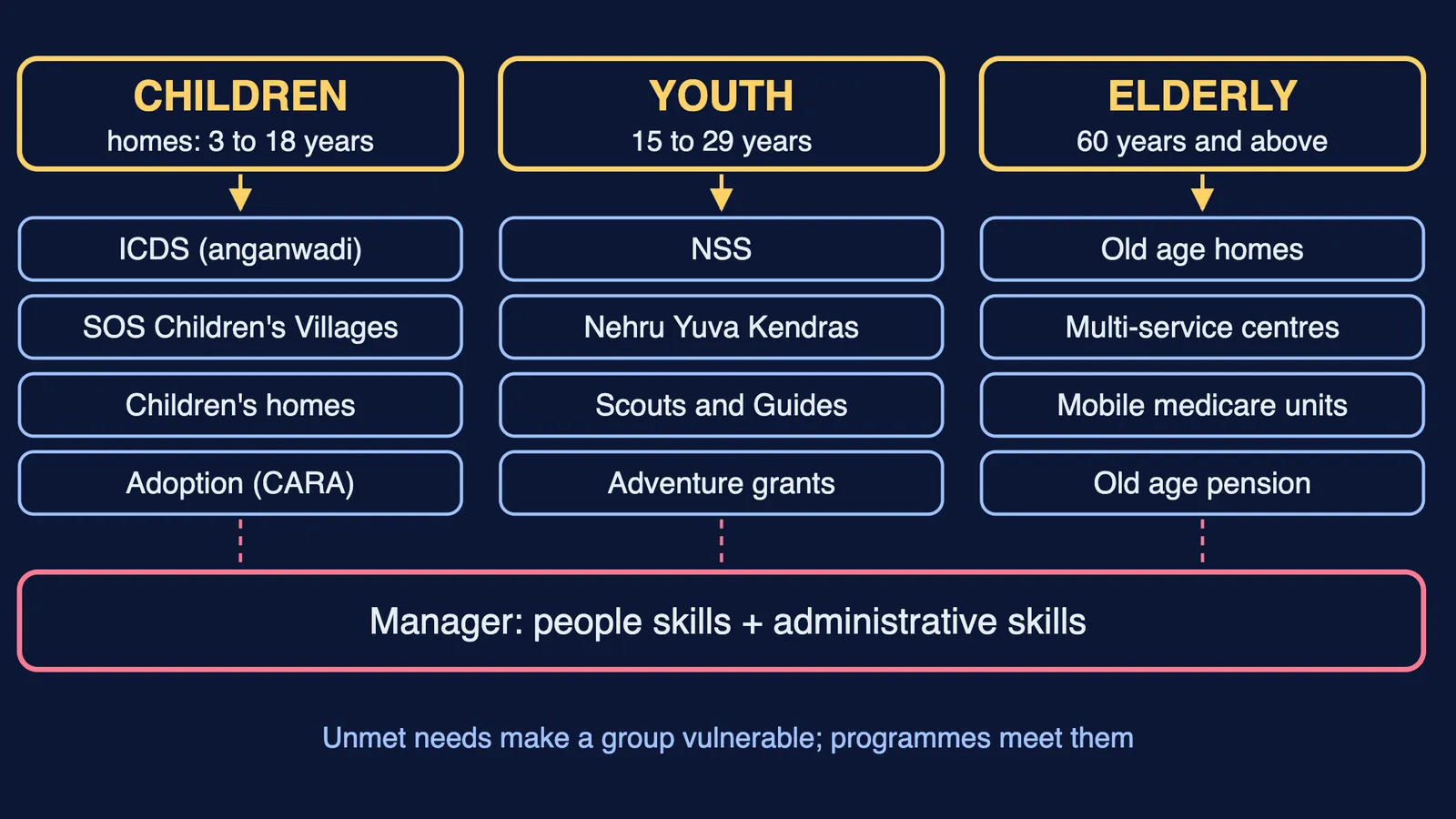
Children: development is rapid and each area shapes the others, so food, shelter, health, love and stimulation must be met together.
Youth: the National Youth Policy, 2014 sets the age band at 15 to 29. Body changes, identity, the move into work and marriage, peer pressure and competition add stress.
Elderly: in India a senior citizen is 60 or older. The book records that about 80 per cent live in rural areas and about 30 per cent are below the poverty line. Health, loneliness and money worries add to the risk; NCERT also calls older people a human resource.
Which institutions and programmes does NCERT describe?
For children:
ICDS serves children under six through the anganwadi: supplementary food, pre-school for ages three to six, immunisation, growth monitoring and health education for mothers. NCERT calls it the world's largest early childhood programme, covering over 41 million children.
SOS Children's Villages give orphaned and abandoned children family-style care, one "mother" for 10 to 15 children. India's first opened in 1964; the book counts about 6000 children in 40 villages.
Government children's homes (ages 3 to 18) come in three kinds: observation, special and children's homes.
Adoption is guided by the Central Adoption Resource Authority (CARA), set up on the Supreme Court's advice.
The book describes the Juvenile Justice (Care and Protection of Children) Act, 2000, which separates children "in conflict with law" from those "in need of care and protection". The 2015 Act repealed it from 15 January 2016.
For youth: the National Service Scheme, the National Service Volunteer Scheme via Nehru Yuva Kendras, adventure grants, Scouts and Guides, the Commonwealth Youth Programme and national integration visits.
For the elderly: old age homes, respite and continuous care homes, multi-service centres, mobile medicare units, dementia day care, helplines, and the National Old Age Pension Scheme, which the textbook describes as for destitute persons above 65. The National Policy for Older Persons dates from 1999.
What skills does a manager of these programmes need?
NCERT names two sets. People skills mean working with the community (involve the people served from the planning stage), the private sector, government officials, and staff and beneficiaries. Administrative skills cover money, hiring, space, equipment, records and stock. A founder also picks a location, target group and services, registers the organisation, evaluates it regularly and keeps a clear vision.
Routes in: a degree in Home Science, Social Work or another social science, or IGNOU's Certificate Programme in NGO Management. Careers run from founding an institution to evaluating programmes.
How to write a 5-mark answer on a vulnerable group
Our suggested frame:
Define: who is in the group (NCERT's age band).
Need: two needs often unmet, and why.
Response: two named programmes, one line each.
Judge: one strength or gap, tied back to the need.
Practice questions
The CBSE 2026-27 sample paper tests this chapter in a 2-mark either/or question and a 3-mark ICDS question. The questions below are ours.
(1 mark, MCQ) A 12-year-old found alone at a railway station stays in a home while police trace her family. Which home? (a) special home (b) observation home (c) old age home (d) SOS village
(2 marks) Give two reasons an elderly widow in a village may be more vulnerable than one in a city.
(3 marks) Compare SOS Children's Villages and government children's homes on who runs them and the care given.
(4 marks) A college wants students to serve a nearby slum. Suggest two youth programmes and what students would do in each.
(5 marks) A mobile medicare unit reaches few older people in a remote block. Suggest three ways its manager could use people skills to raise uptake, and two records it should keep.
Answer to Q1: (b) observation home.
Next, read our Early Childhood Care and Education Class 12 guide and our Class 12 Home Science study plan. For degrees, see BSc Home Science career options.
Short on time this week? Fermi's AI tutor works out what you already know and builds a plan for the session.