On this page
Everything below follows NCERT Class 12 Mathematics Part 2, Chapter 12 (Reprint 2026-27) and the unit text in the CBSE 2026-27 Mathematics syllabus. The simplex method is not included; NCERT mentions it only in its historical note.
For how these questions are marked, see our linear programming Class 12 board exam guide.
What are the key terms in linear programming?
Linear programming problem (LPP): find the maximum or minimum of a linear function whose non-negative variables satisfy linear inequalities (NCERT 12.2.1).
Objective function: Z = ax + by (a, b constants); x and y are the decision variables.
Constraints: the linear inequalities the variables must satisfy; x ≥ 0, y ≥ 0 are the non-negative restrictions.
Feasible region: the common region of all constraints, including x, y ≥ 0; the rest is the infeasible region.
Feasible solution: any point in or on the boundary of the feasible region; a point outside is infeasible.
Optimal solution: a feasible point that gives the maximum or minimum value of Z.
Bounded region: one that can be enclosed within a circle. Otherwise it is unbounded.
Corner point: a point of the feasible region where two boundary lines intersect.
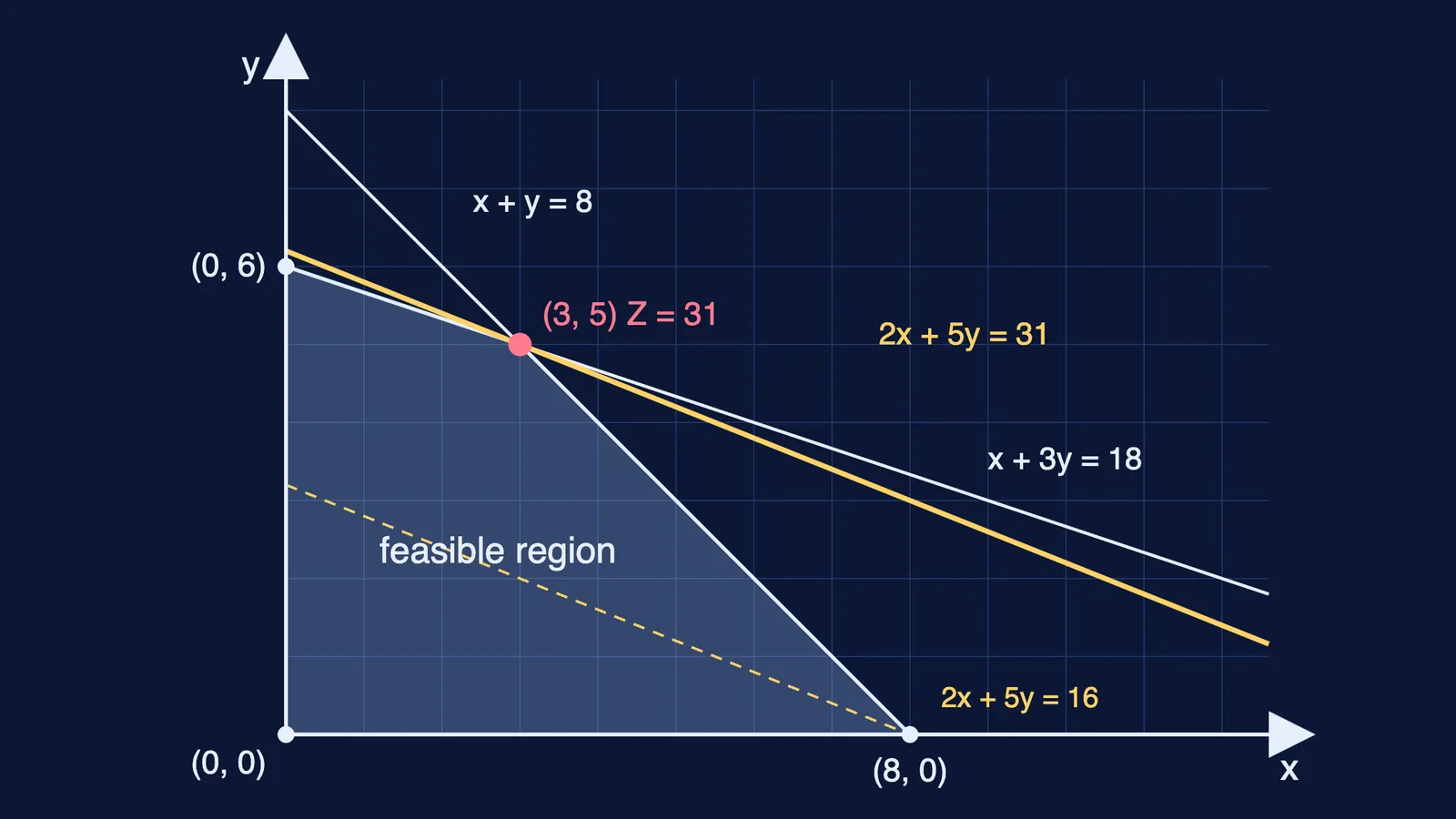
Worked example: a stall makes x batches of idli and y of dosa. Each batch takes 1 hour; idli uses 1 kg of batter, dosa 3 kg. With 8 hours, 18 kg, and ₹200 and ₹500 profit per batch, in hundreds of rupees: maximise Z = 2x + 5y subject to x + y ≤ 8, x + 3y ≤ 18, x ≥ 0, y ≥ 0.
Watch for: "at most" is ≤, "at least" is ≥, and x ≥ 0, y ≥ 0 must be written even when the question omits them.
Formulas for drawing the feasible region
Intercepts of the line ax + by = c: (c/a, 0) and (0, c/b), for a ≠ 0 and b ≠ 0.
Shading test: put (0, 0) into the inequality; if true, shade the origin's side, if false the other side. If c = 0 the line passes through the origin, so test a point not on it, such as (1, 0).
Corner point of a1x + b1y = c1 and a2x + b2y = c2: x = (c1b2 − c2b1) / (a1b2 − a2b1), y = (a1c2 − a2c1) / (a1b2 − a2b1). Condition: a1b2 − a2b1 ≠ 0 (the lines are not parallel).
Worked example: for x + y = 8 and x + 3y = 18, a1b2 − a2b1 = 3 − 1 = 2. So x = (24 − 18) / 2 = 3 and y = (18 − 8) / 2 = 5. The stall's corners are (0, 0), (8, 0), (3, 5) and (0, 6).
Watch for: keep an intersection only if it satisfies every constraint. (18, 0) lies on x + 3y = 18 but breaks x + y ≤ 8, so it is not a corner.
What does the corner point theorem say?
Theorem 1: if R is the feasible region (a convex polygon) and Z = ax + by has an optimal value on R, it occurs at a corner point of R (NCERT 12.2.2).
Theorem 2: if R is bounded, Z has both a maximum and a minimum on R, and each occurs at a corner point.
Remark: if R is unbounded, a maximum or minimum may not exist; if it exists, it is at a corner point.
The feasible region is always a convex region.
Ties: if two corner points give the same optimal value, every point on the segment joining them gives that value too.
Worked example: on the stall's region, Z = 3x + 9y gives 0 at (0, 0), 24 at (8, 0), 54 at (3, 5) and 54 at (0, 6). The maximum, 54, holds on the whole segment from (0, 6) to (3, 5), because 3x + 9y = 3(x + 3y) is parallel to that edge.
How do you solve an LPP by the corner point method?
Draw the feasible region and find its corner points.
Evaluate Z = ax + by at each corner. Call the largest value M and the smallest m.
If the region is bounded, M is the maximum and m is the minimum of Z.
If the region is unbounded, M is the maximum only if the open half plane ax + by > M has no point in common with the feasible region; otherwise Z has no maximum. Likewise, m is the minimum only if ax + by < m has no common point; otherwise Z has no minimum.
Worked example (bounded): for the stall, Z = 2x + 5y.
(0, 0): Z = 0
(8, 0): Z = 16
(3, 5): Z = 31 (maximum)
(0, 6): Z = 30
So 3 idli and 5 dosa batches give the most profit, ₹3,100.
What changes when the feasible region is unbounded?
Use step 4. Worked example: minimise Z = 4x + 3y subject to x + y ≥ 5, x + 2y ≥ 6, x ≥ 0, y ≥ 0. The unbounded region has corners (0, 5), (4, 1) and (6, 0), giving Z = 15, 19 and 24. So m = 15. Since x + y ≥ 5 and x ≥ 0, 4x + 3y = 3(x + y) + x ≥ 15, so the half plane 4x + 3y < 15 has no common point, and the minimum is 15 at (0, 5). There is no maximum: (10, 0) is feasible and gives Z = 40, which is more than 24.
A problem can also have no feasible region: x + y ≥ 6 and x + 2y ≤ 4 (x, y ≥ 0) clash, since x + y ≤ x + 2y ≤ 4.
Watch for: writing "maximum = 24" on an unbounded region because it tops your table. Test the open half plane first.
How to revise this formula sheet
Rework NCERT Exercise 12.1 Q6 (a tie), Q9 (unbounded) and Q10 (no feasible region). If a method keeps failing, the Fermi Problem Library has worked problems with a step-by-step solver that explains the reasoning rather than printing an answer.
For the full paper, see our section-wise CBSE Class 12 maths plan.