On this page
Here are the key terms from Chapter 9 of the NCERT Class 10 Science textbook (Reprint 2026-27), grouped by topic. For the full chapter plan, see our guide to preparing Light: reflection and refraction.
The CBSE Class X Science syllabus for 2026-27 marks the mirror and lens formulas "Derivation not required" and says textbook boxes "would not be assessed in the year-end examination", so the boxed notes on diffraction and lenses in contact are left out.
Reflection and images: what do the basic terms mean?
Ray of light: a straight arrowed line showing light's path.
Reflection: light bouncing back from a surface, as in a polished spoon.
Normal: a line at right angles to the surface where the ray strikes. Angles are measured from it, not from the surface.
Angle of incidence and angle of reflection: the angles the incoming and bounced rays make with the normal.
Laws of reflection: these angles are equal, and the incident ray, normal and reflected ray lie in one plane.
Lateral inversion: in a plane mirror, left and right appear swapped. The image is also virtual, erect, the same size, and as far behind the mirror as the object is in front.
Real image: formed where rays actually meet, so a screen can catch it. Example: the Sun's bright spot from a concave mirror.
Virtual image: formed where rays only seem to come from, so no screen can catch it. Don't confuse with: real image.
What are the parts of a spherical mirror?
Concave mirror: a spherical mirror whose shiny side curves inward; it brings parallel rays together. Example: shaving mirrors, torch reflectors.
Convex mirror: shiny side bulges outward; it always gives an erect, smaller image and a wide view. Example: vehicle rear-view mirrors.
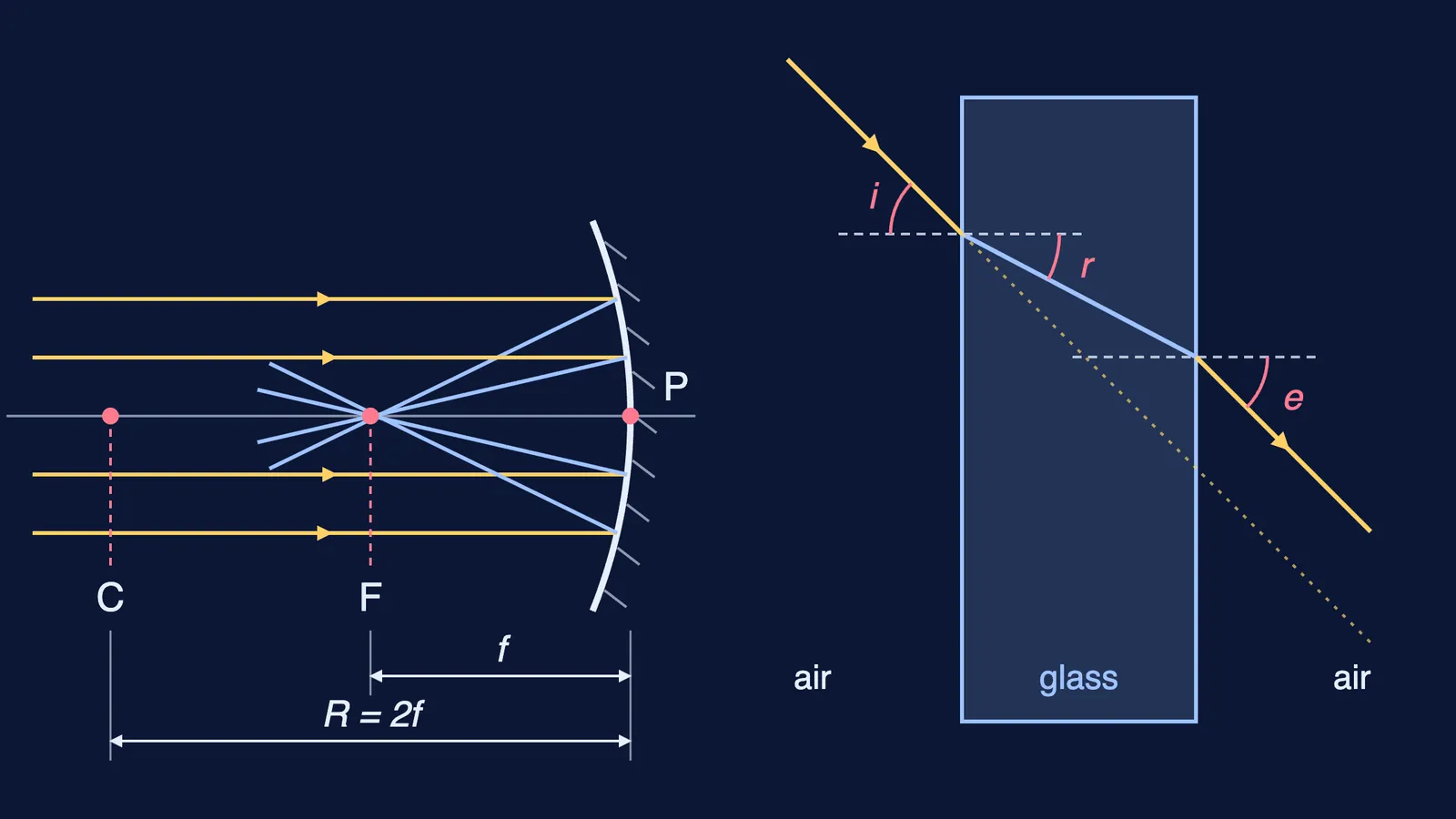
Pole (P): the middle point of the mirror's surface.
Centre of curvature (C): the centre of the sphere the mirror was cut from. It lies in front of a concave mirror, behind a convex one.
Radius of curvature (R): the radius of that sphere, equal to the distance PC.
Principal axis: the straight line joining C and P. It meets the mirror at right angles at P.
Principal focus (F): where rays parallel to the principal axis meet after reflection (concave) or seem to come from (convex).
Focal length (f): the distance from P to F. For mirrors with a small aperture, R = 2f. Don't confuse with: radius of curvature.
Aperture: how wide the mirror's shiny surface is, measured straight across.
Sign convention, mirror formula and magnification
New Cartesian Sign Convention: the pole is the origin and the principal axis is the x-axis; the object sits on the left; distances to the right and heights upward are positive, the opposite ones negative.
Object distance (u) and image distance (v): how far the object and the image are from the pole. With the object on the left, u is negative.
Mirror formula: 1/v + 1/u = 1/f.
Magnification (m): image height ÷ object height, also −v/u for a mirror. Negative m means real and inverted; positive m means virtual and erect.
Worked check: object 30 cm in front of a concave mirror with f = 10 cm, so u = −30 cm, f = −10 cm. Then 1/v = −1/10 + 1/30 = −1/15, v = −15 cm and m = −0.5: real, inverted, half size, between F and C. See all six object positions for a concave mirror.
What happens when light is refracted?
Refraction: light changing direction as it passes at a slant into another transparent medium, because its speed changes. Example: a pencil in water looks broken at the surface.
Angle of refraction: the angle between the refracted ray and the normal.
Laws of refraction: the incident ray, refracted ray and normal lie in one plane; and sin i / sin r is constant for a given colour and pair of media (Snell's law).
Emergent ray: the ray leaving a rectangular glass slab, parallel to the incident ray but shifted sideways. Don't confuse with: refracted ray, the part inside the glass.
Refractive index (relative): the constant in Snell's law; n21 = speed of light in medium 1 ÷ speed of light in medium 2.
Absolute refractive index: n = c/v, comparing with vacuum, where light travels at 3 × 10⁸ m/s (NCERT, section 9.3.2). Example: water 1.33, crown glass 1.52.
Optically denser and rarer medium: the one with the larger refractive index is optically denser; light is slower there. Don't confuse with: mass density. Kerosene (1.44) is optically denser than water (1.33) though lighter (NCERT Table 9.3).
Which lens terms do you need?
Lens: a transparent piece with at least one spherical surface that refracts light to form images.
Convex lens and concave lens: convex is thicker in the middle and converges light; concave is thinner in the middle and diverges it. Don't confuse with: mirrors, where the concave one converges.
Optical centre (O): the lens's central point; a ray through it passes undeviated.
Centres of curvature (C1, C2) and principal foci (F1, F2): a lens has two of each, one per side. Focal length is measured from O to F.
Lens formula: 1/v − 1/u = 1/f; f is positive for a convex lens and negative for a concave lens. Magnification for a lens is m = v/u. Don't confuse with: the mirror formula and −v/u.
Power of a lens (P) and dioptre (D): power is 1/f with f in metres; unit dioptre. Example: a +2.0 D lens is convex with f = +0.50 m, and a −2.5 D lens is concave with f = −0.40 m (NCERT, section 9.3.8).
How to learn these terms
Draw a concave mirror and label P, F, C, R, f and the principal axis from memory. F must sit halfway between P and C.
Learn mirror and lens terms in pairs: pole and optical centre, 1/v + 1/u and 1/v − 1/u, −v/u and v/u.
Treat refraction as a speed story: slower medium, bend towards the normal; faster, bend away.
Test whether you can use the terms with our assertion-reason traps in ray optics.
If an idea stays fuzzy, look it up in the Fermi Concept Library, where each concept in physics has its own lesson.