On this page
Chapter 3(C) of the CBSE Legal Studies Class XII textbook (second edition, 2023) asks how a right in property passes between living persons, and what makes that transfer valid. This is a study summary, not legal advice.
What does the 2026-27 syllabus include?
The CBSE Legal Studies (074) curriculum for 2026-27 places Law of Property in Unit 3, Topics in Law I (Business Laws), with Contract, Torts and Intellectual Property. Unit 3 carries 20 of the 100 marks, shared across those four chapters; CBSE prints no per-chapter figure.
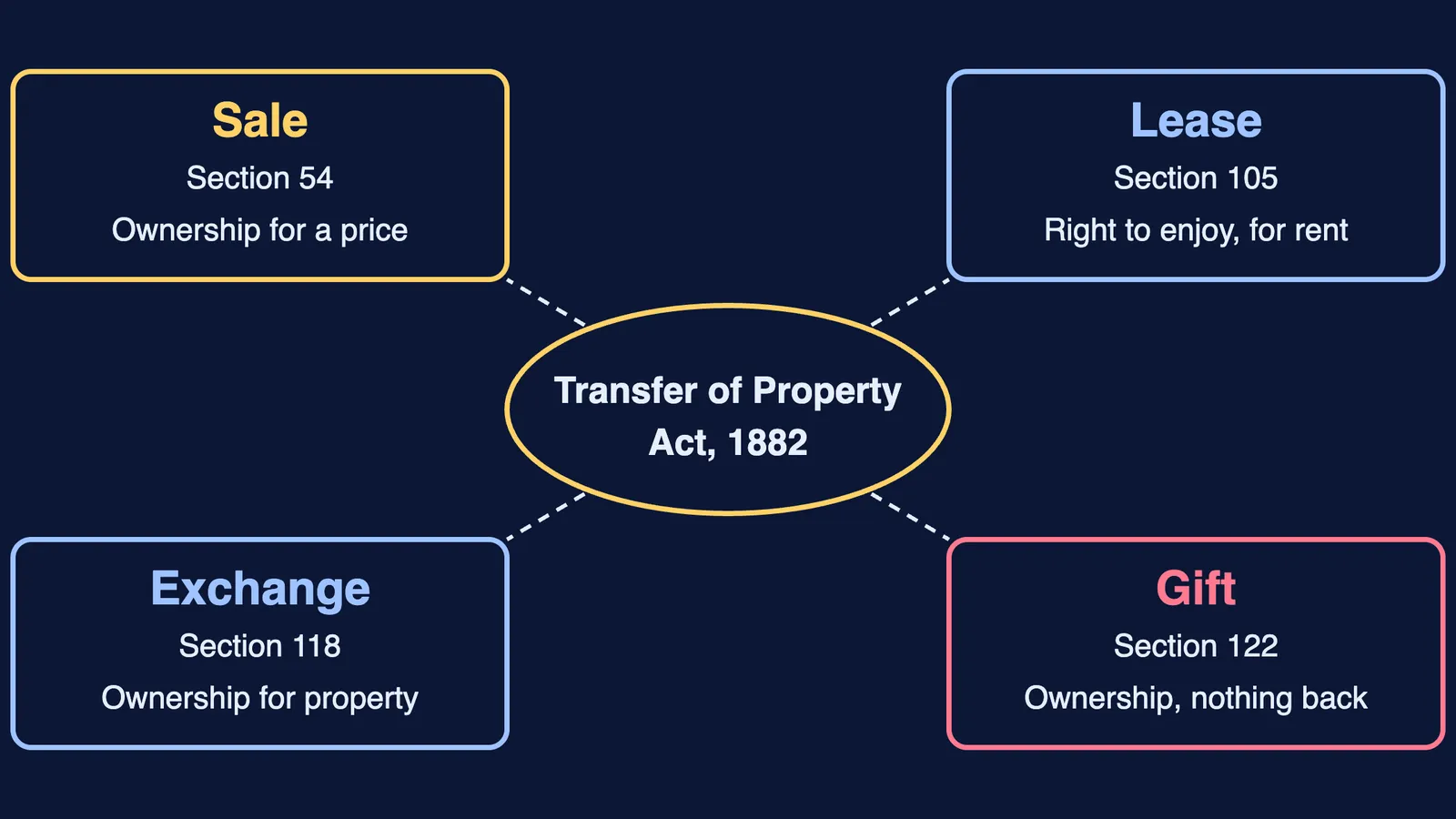
It lists types of property, who can transfer, essentials of a valid transfer, and four types of transfer: sale, lease, exchange and gift. The book notes the Act also covers mortgage but gives it no section; the curriculum does not list it.
What is movable and immovable property?
"Property" is not defined in the Transfer of Property Act, 1882; it covers movable, immovable and intangible things.
Section 3 of the Act leaves standing timber, growing crops and grass out of immovable property.
The General Clauses Act, 1897, Section 3(25), counts land, benefits from land and things attached to the earth as immovable.
A tree kept for fruit stays immovable; one meant to be cut for wood is timber, so movable. Intention decides (Shantabai v. State of Bombay).
Movables pass by delivery (Sale of Goods Act, 1930; the book sometimes misprints 1932). Immovables worth over ₹100 need registration under the Registration Act, 1908.
Who can transfer, and what makes a transfer valid?
Anyone competent to contract (above 18, sound mind, not disqualified by law) who owns the property or is authorised to dispose of it can transfer it; under Section 8, all their rights pass. The essentials:
The transfer is between living persons.
The property is transferable and free from encumbrances.
Object and consideration are lawful; no party is disqualified.
The proper mode is followed: for property worth over ₹100, a registered instrument attested by at least two witnesses, registration (Section 17 of the Registration Act lists compulsory documents), mutation in municipal records and state stamp duty.
Any condition is not illegal, immoral, impossible or against public policy.
Two doctrines follow. The doctrine of election (Section 35) says you cannot take the benefit of an instrument and refuse its burden. The doctrine of lis pendens (Section 52) says property in a pending title suit should not be transferred to defeat the other party; the Supreme Court held such a transfer is not void, but the buyer is bound by the decision (Hardev Singh v. Gurmail Singh).
How are sale, lease, exchange and gift different?
Sale (Section 54): ownership passes for a price paid in money; the sale deed is registered.
Lease (Section 105): only the right to enjoy immovable property passes, for a fixed period, in return for rent. A lessee may sub-let if the lease allows, but stays liable to the lessor.
Exchange (Section 118): ownership of one thing is traded for ownership of another; each side is a seller for what it gives and a buyer for what it gets.
Gift (Section 122): ownership passes voluntarily, with nothing in return. If the donee dies before accepting, the gift is void.
Worked example: testing one transfer
Gurpreet agrees to sell her Ludhiana godown to Abhay for ₹34 lakh. Run the checklist:
Competence: both are adults of sound mind. Passes.
Entitlement: the godown is in her sole name. Passes.
Consideration is money, so this is a sale under Section 54.
Mode: value above ₹100, so a sale deed, two attesting witnesses, registration, mutation and stamp duty.
Twist: her cousin has a pending suit claiming title. Section 52 applies: the sale is not void, but Abhay is bound by the court's decision.
Had she taken Abhay's Patiala flat instead of money, it would be an exchange (Section 118).
Practice questions for the 2026-27 exam
The 2026-27 sample paper and marking scheme test this chapter with 1-mark matching, a 2-mark valid-transfer case and an either-or 3-mark lease case. Our own questions:
(1 mark) Which section does the book link to lis pendens? (a) 35 (b) 52 (c) 105 (d) 122
(1 mark) Assertion: A teak plantation grown to be felled for furniture is movable property. Reason: Section 3 of the Act excludes standing timber from immovable property.
(2 marks) Besides registration, name two formalities in transferring a house and why each matters.
(3 marks) By one deed, Leela gives Farhan a flat in Pune and a garage in Nashik carrying an unpaid ₹2 lakh tax demand. Farhan wants only the flat. Name the doctrine and section, and state his options.
(5 marks) Distinguish sale, lease, exchange and gift on what passes, what comes back and the document needed, with your own example for each.
Answers: 1 (b). 2 Both true; the reason explains the assertion. 4 Election, Section 35: take both with the burden, or neither.
See also what Legal Studies covers from Class 11 and the Class 12 Home Science guide Consumer Education and Protection.
Not sure where to start revising? Fermi's AI tutor works out what you already know and builds a plan for the session.