On this page
NASA's Deep Space 1 probe, launched in 1998, crossed the solar system pushed by a force about equal to the weight of a few coins in your palm. Its engine did not burn anything. It used electric fields to fling charged xenon atoms out of the back at around 40 km/s. The physics is a single step you already know from electrostatics: a charge falling through a potential difference V gains kinetic energy qV. This post works out the exhaust speed, the thrust and the fuel saving with real numbers from that thruster.
How does an ion thruster work?
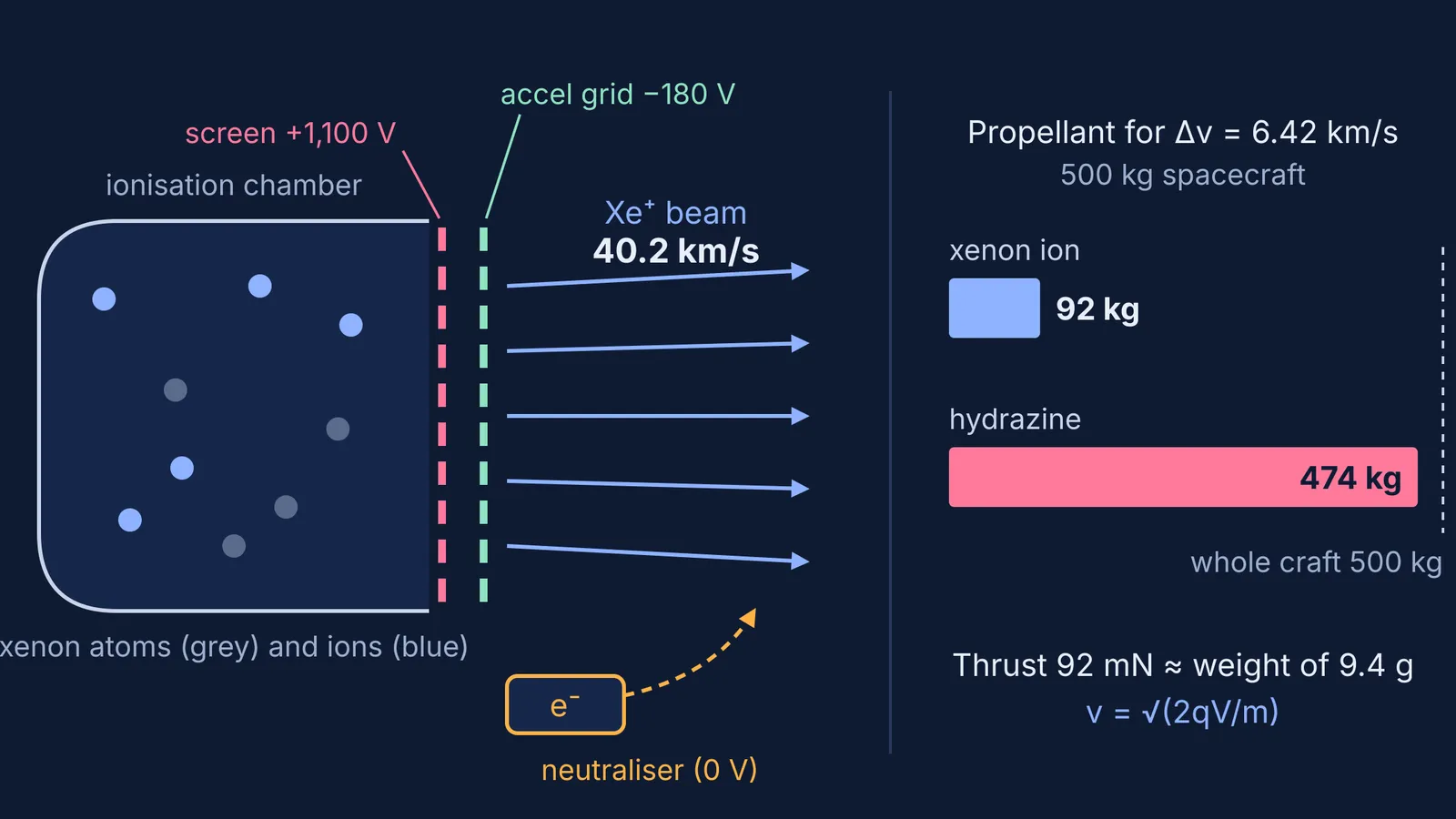
A gridded ion thruster has three parts.
Ionisation chamber. Xenon gas flows in. Electrons from a cathode collide with the atoms and knock one electron off each, making Xe⁺ ions.
Grids. Two closely spaced metal grids with thousands of matching holes sit at the open end. The inner (screen) grid is held at a high positive voltage and the outer (accelerator) grid at a small negative voltage. The strong field between them pulls the positive ions out through the holes.
Neutraliser. A second cathode outside the thruster sprays electrons into the departing beam.
The neutraliser is not optional. If the spacecraft threw out only positive charge, it would build up a negative charge of its own, and that charge would pull the ions back. The beam leaves as a neutral mix of ions and electrons, so the craft stays uncharged.
Xenon is used because it is heavy (131.29 u), inert and easy to store.
What sets the exit speed of the ions?
Energy conservation. An ion of charge q = e moving through a potential difference V gains kinetic energy:
½mv² = qV, so v = √(2qV/m)
It is the same step as for an electron in a cathode ray tube, but a xenon ion is about 240,000 times heavier, so it is far slower for the same voltage.
Which voltage do you use?
In the NSTAR thruster flown on Deep Space 1, NASA's test report lists the full-power setting as a beam voltage of 1,100 V, an accelerator grid voltage of −180 V and a beam current of 1.76 A (NASA TM-2000-210382, Table I). An ion leaving the screen grid falls through 1,100 + 180 = 1,280 V to reach the accelerator grid, then climbs back 180 V as it moves out to the neutraliser and spacecraft potential. Its final energy is set by the net 1,100 V, not the 1,280 V total. Using 1,280 V would give 43.4 km/s instead of 40.2 km/s.
Worked example: speed, thrust and power of an NSTAR-type thruster
Data: m(Xe⁺) = 131.29 u = 2.180 × 10⁻²⁵ kg, e = 1.602 × 10⁻¹⁹ C, V = 1,100 V, beam current I = 1.76 A.
Ion speed. v = √(2 × 1.602 × 10⁻¹⁹ × 1,100 / 2.180 × 10⁻²⁵) = 4.02 × 10⁴ m/s, or 40.2 km/s. Check units: J/kg = m²/s², so the square root is in m/s.
Ions per second. Each ion carries charge e, so the number leaving per second is I/e = 1.76 / 1.602 × 10⁻¹⁹ = 1.10 × 10¹⁹ ions/s.
Mass flow of ions. ṁ = 1.10 × 10¹⁹ × 2.180 × 10⁻²⁵ = 2.39 × 10⁻⁶ kg/s, or 2.39 mg of xenon a second.
Thrust. From F = ṁv (the formula derived in rocket thrust and relative exhaust speed): F = 2.39 × 10⁻⁶ × 4.02 × 10⁴ = 0.096 N, or 96 mN.
Compare with a weight. F/g = 0.096 / 9.81 = 9.8 × 10⁻³ kg. The push equals the weight of a 9.8 g object.
Beam power. P = VI = 1,100 × 1.76 = 1,936 W, about 1.94 kW, so the thruster gives about 50 mN per kilowatt of beam power.
How close is this to the real engine? NASA's NSSDC record for Deep Space 1 gives 0.09 N of thrust at a maximum power of 2,300 W. The measured figure is a little below 96 mN because some ions leave at an angle and a few are doubly charged. The extra input power goes into making the ions and running the cathodes.
Why is an ion thruster worth such a tiny push?
Because of the rocket equation, Δv = vₑ ln(m₀/m₁). The change in speed depends on the exhaust speed vₑ and on the ratio of starting to final mass. A faster exhaust means less propellant for the same Δv.
The effective exhaust speed for the whole engine is lower than 40.2 km/s, because not all the xenon fed in is ionised and the unionised gas drifts out with almost no speed. The NSSDC record puts the real figure at about 31.5 km/s. Use that for fuel.
One year at full thrust. ṁ = F/vₑ = 0.092 / 31,500 = 2.92 × 10⁻⁶ kg/s. Over 3.16 × 10⁷ s, that is 92.2 kg of xenon.
Δv for a 500 kg spacecraft. Δv = 31,500 × ln(500/407.8) = 6.42 km/s.
The same Δv with hydrazine. A hydrazine thruster has a specific impulse of about 200–235 s (NASA Small Spacecraft Technology report, in-space propulsion). Take 220 s, so vₑ = 220 × 9.81 = 2.16 km/s. The mass ratio needed is e^(6.42/2.16) = 19.6, so the propellant is 500 × (1 − 1/19.6) = 474 kg.
Hydrazine would use 474 kg of the 500 kg craft; xenon needs 92 kg. Deep Space 1 itself launched at about 486 kg carrying 81.5 kg of xenon, which matches this scale.
The catch is time. At 0.092 N on 500 kg, the acceleration is 1.84 × 10⁻⁴ m/s², so gaining 1 km/s takes 63 days. Hydrazine thrusters, like those in Yvonne Brill's satellite thruster story, give quick, strong pushes for orbit changes. Ion thrusters give a weak push that runs for months.
Can an ion thruster lift off from Earth?
No. To lift itself, an engine needs thrust greater than its weight. A 92 mN thruster could not lift a 10 g object, let alone itself. Ion thrusters work only in orbit, after a chemical rocket has done the launch. They also need kilowatts of electricity from solar panels.
Do not mix it up with other electric engines. VASIMR, covered in Franklin Chang-Díaz's plasma rocket, heats plasma with radio waves instead of using a qV drop across grids.
If you want more problems where energy conservation and charge combine like this, the Fermi Problem Library has a step-by-step solver that explains the reasoning at each stage.
What mistakes cost marks here?
Using the total grid voltage instead of the net beam voltage.
Forgetting to convert the ion mass from u to kg.
Writing thrust as qV or as power. Thrust is ṁv; power is VI.
Leaving out the neutraliser when asked why the spacecraft does not charge up.
Quick checklist
Ion energy: qV, so v = √(2qV/m).
Xe⁺ through 1,100 V: 40.2 km/s.
Ions per second = I/e; mass flow = (I/e) × m.
Thrust F = ṁv, about 96 mN ideal and 92 mN measured for NSTAR.
The rocket equation turns a fast exhaust into a large fuel saving: 92 kg of xenon against 474 kg of hydrazine for 6.42 km/s.
Tiny thrust, so ion engines work only in space and need months of firing.