

On this page
Former NASA astronaut Franklin Chang-Díaz holds the all-time record of seven spaceflights, logging 66 days, 18 hours, and 16 minutes in space. But his most significant contribution to space exploration is not how many times he left Earth; it is the engine he designed to take humanity further.
Chang-Díaz is the inventor of the Variable Specific Impulse Magnetoplasma Rocket (VASIMR), an electrothermal thruster that uses radio waves to heat plasma and magnetic fields to accelerate it. Developed over four decades at NASA and later at his own Ad Astra Rocket Company, VASIMR addresses the fundamental limitation of traditional chemical rockets: they run out of fuel too quickly.
What makes a plasma rocket different?
Chemical rockets burn fuel in a massive, short-lived explosion, producing high thrust but low efficiency. For deep space missions, a spacecraft needs continuous acceleration, unlike the brief ballistic burns seen in early orbital spaceflight.
VASIMR achieves this by using an inert gas, such as argon or xenon, rather than explosive chemical propellants. It operates at an optimal specific impulse of approximately 5,000 seconds, ejecting plasma at an exhaust velocity of 50,000 m/s (180,000 km/h). Because it uses electricity to generate thrust, its speed is limited only by its power source.
How does VASIMR heat plasma with radio waves?
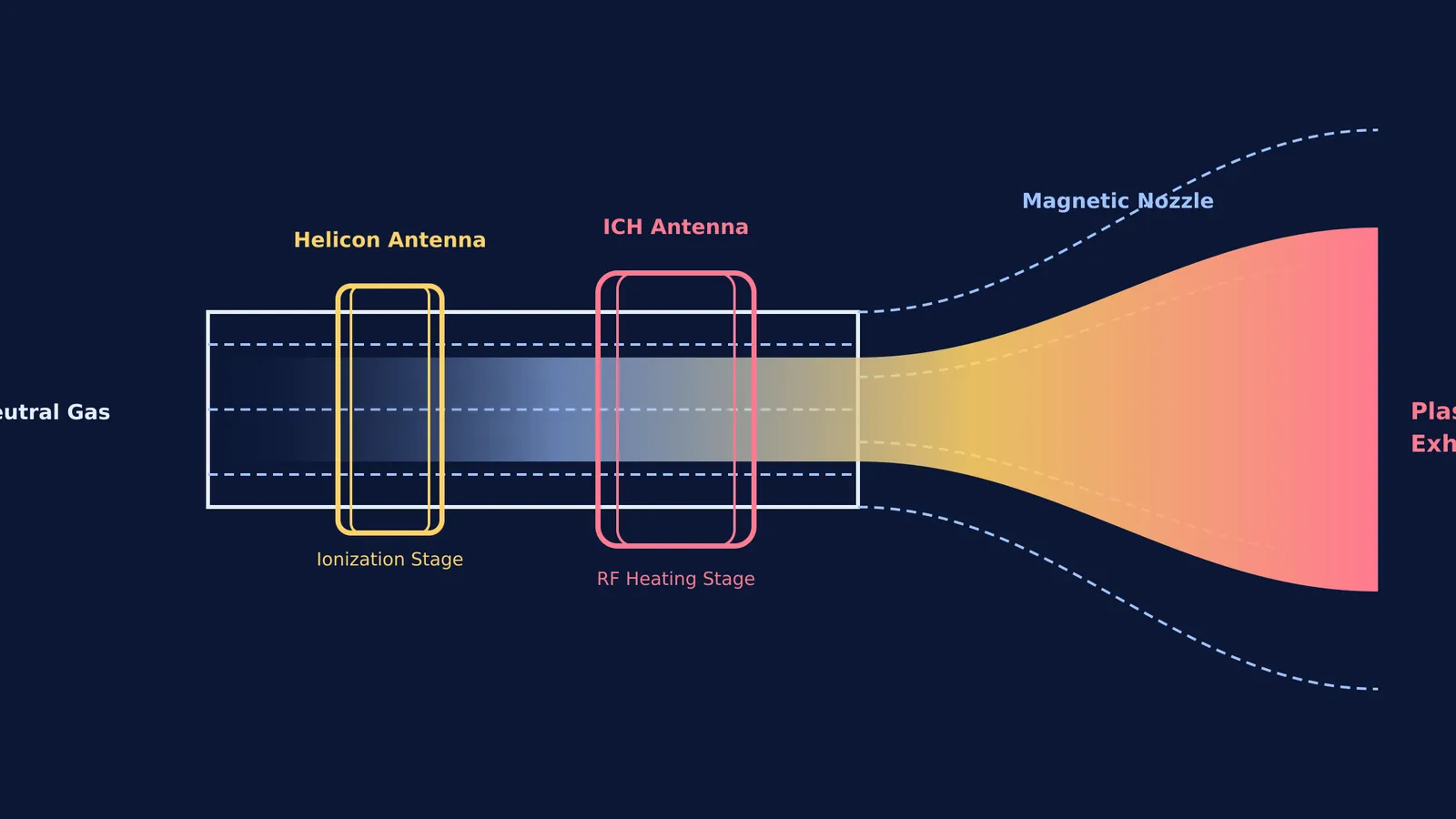
The VASIMR engine has no moving parts and no electrodes in direct contact with the propellant. Instead, it relies on electromagnetic fields across three distinct stages:
Ionization: Neutral gas is injected into the front of the engine. A helicon antenna bombards the gas with radio frequency (RF) waves, stripping electrons from the atoms to create a "cold" plasma.
Heating: The plasma flows into the Ion Cyclotron Heating (ICH) section. Here, a second set of RF waves is tuned to the exact frequency at which ions naturally spiral around the magnetic field lines. This resonance heats the plasma to over 1,000,000 K—about 173 times hotter than the surface of the Sun.
Acceleration: The superheated plasma must be expelled to generate thrust.
If you find it hard to picture how ions spiral along a magnetic field, the Fermi Simulation Lab provides interactive simulations for the ideas that are easier to see than to read.
How does a magnetic nozzle work?
No physical material can contain a plasma heated to one million degrees. To solve this, VASIMR uses superconducting electromagnets to generate Tesla-range magnetic fields that confine the plasma, keeping it away from the engine walls.
At the rear of the engine, the magnetic field diverges, much like the bell shape of a traditional rocket nozzle. This magnetic nozzle guides the plasma outwards, converting its immense thermal energy into directed kinetic energy. If you are calculating the kinetic energy and velocities of such systems, you can review the rules for orbital speed and energy, and the Fermi Problem Library has worked problems with a step-by-step solver that explains the reasoning rather than printing an answer.
A forty-year vision for space
Developing a fundamentally new method of propulsion takes time. Chang-Díaz first began conceptualizing the engine while working as a researcher at MIT in the late 1970s, well before his first shuttle flight in 1986. He continued refining the design throughout his time as a NASA astronaut. After retiring from the agency in 2005, he founded the Ad Astra Rocket Company to build and test the physical hardware.
His persistence over more than forty years highlights how aerospace engineering requires long-term vision. Chang-Díaz has argued that for humanity to truly expand into the solar system, we must move beyond the gravitational limitations of Earth and the chemical rockets that constrain us. By harnessing electromagnetic fields and nuclear power, the VASIMR engine offers a realistic pathway to becoming a multi-planetary species.
How fast could we reach Mars?
The primary challenge for VASIMR is power. The VX-200 prototype operates at 200 kilowatts, which is sufficient for robotic missions and maintaining satellite orbits, but human exploration requires much more.
To achieve its full potential, VASIMR requires a space-rated nuclear reactor. With a 200-megawatt nuclear power source providing continuous electrical energy, a VASIMR-powered ship could theoretically reduce the travel time to Mars to just 39 days. A chemical rocket takes much longer to make the same journey, relying on precise transfer paths like those computed for India's Mangalyaan mission. By drastically cutting transit time, this technology would limit astronauts' exposure to cosmic radiation and the degrading effects of microgravity, making deep space exploration a practical reality.
To explore the physics principles that will take us to Mars, the Fermi Concept Library has every concept in physics, chemistry, biology, mathematics and computing.


