

On this page
India makes more direct-reduced iron, also called sponge iron, than any other country, and most of it is made with coal. Swapping that carbon for green hydrogen would turn the waste gas from CO₂ into water. On paper you just replace CO with H₂. In practice the heat of reaction changes sign, the gas must be recycled, and the hydrogen bill is large. All three follow from Class 11 thermochemistry and equilibrium.
How is sponge iron made in India today?
Sponge iron is iron ore reduced to metal without melting, which leaves a porous solid. The Ministry of Steel puts India's sponge iron output at 60.30 million tonnes in 2025-26, up from 24.24 million tonnes in 2014-15.
The Midrex World DRI Statistics for 2025 again lists India as the largest producer. Of the 58.8 Mt it counts for India, 49.9 Mt came from coal-based rotary kilns and 8.9 Mt from gas-based plants. That is about 85% from coal. (Its figure is for the calendar year, so it differs a little.)
In a coal kiln the real reducing agent is still CO. Coal burns to CO₂, the CO₂ meets hot carbon and becomes CO, and CO strips oxygen from the ore. That carbon chemistry is the same as in the CO and CO₂ equilibrium over hot coke.
What changes when hydrogen replaces carbon monoxide?
The two overall equations look alike:
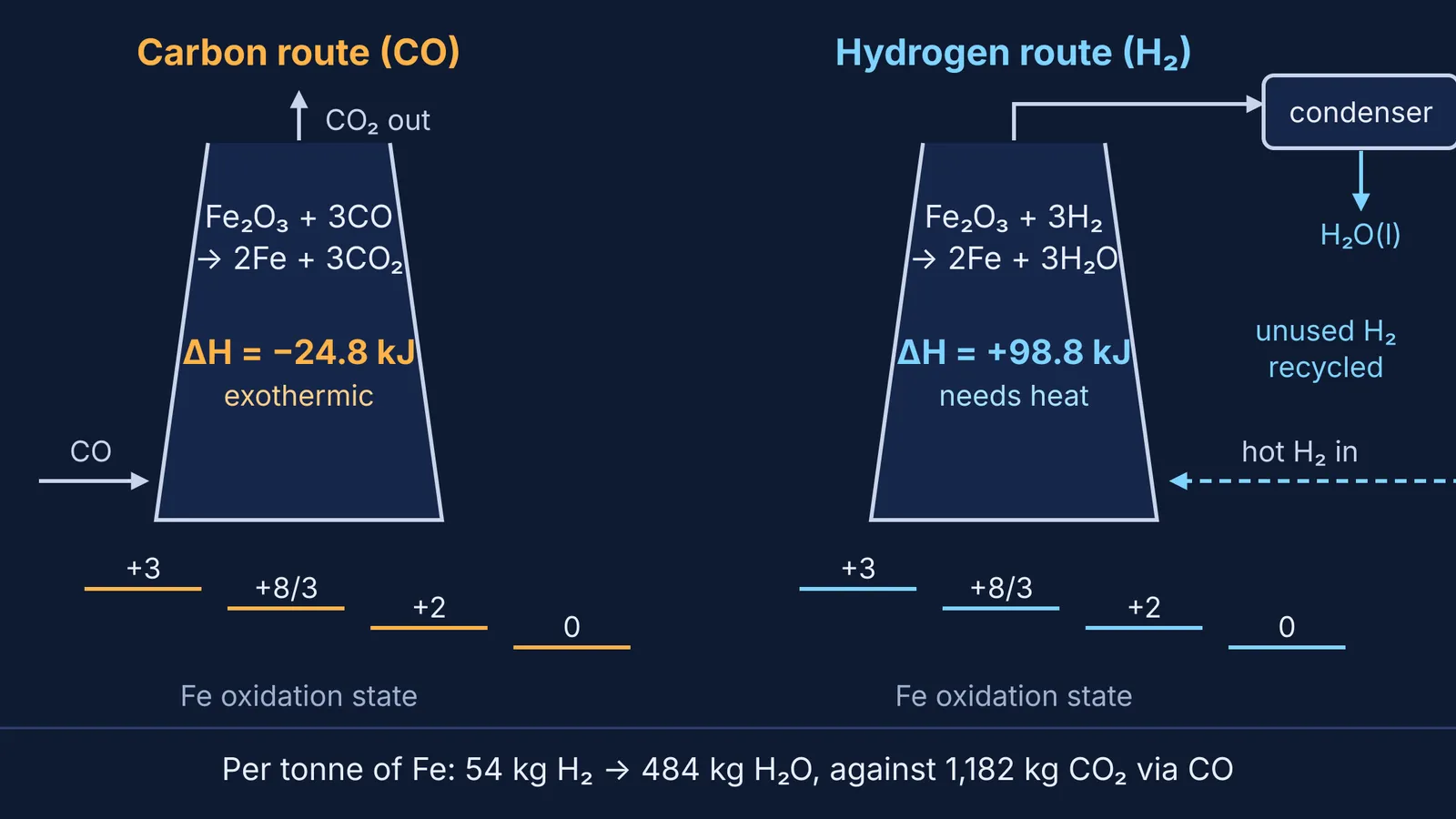
Fe₂O₃ + 3CO → 2Fe + 3CO₂
Fe₂O₃ + 3H₂ → 2Fe + 3H₂O
In both, iron goes from +3 to 0. Each CO is oxidised from carbon +2 to +4, and each H₂ from hydrogen 0 to +1. Both reductants give away 2 electrons per molecule, so both need 3 molecules per Fe₂O₃.
The ore does not lose its oxygen in one step. Iron passes through +3 in Fe₂O₃, +8/3 in Fe₃O₄, +2 in FeO and 0 in the metal, as in the blast furnace zones. With hydrogen the same staircase is followed above about 570 °C, according to a laboratory study of hematite reduction by hydrogen (Wagner and co-workers). Below that, FeO is not stable and Fe₃O₄ goes straight to iron.
The real difference is what leaves the top: water vapour, which can be condensed, instead of CO₂.
Why is reduction by hydrogen endothermic when reduction by CO is exothermic?
Use Hess's law with standard enthalpies of formation in kJ mol⁻¹: Fe₂O₃ −824.2, CO −110.5, CO₂ −393.5, H₂O(g) −241.8. Elements are zero.
CO route: ΔH = 3(−393.5) − [(−824.2) + 3(−110.5)] = −24.8 kJ per mol Fe₂O₃.
H₂ route: ΔH = 3(−241.8) − (−824.2) = +98.8 kJ per mol Fe₂O₃.
The reason is in the products. Burning CO to CO₂ releases 283.0 kJ per mole; burning H₂ to water vapour releases only 241.8 kJ. The oxide broken is the same, so the gap is 3 × (283.0 − 241.8) = 123.6 kJ, exactly the distance from −24.8 to +98.8.
The Wagner study says the same: reduction with hydrogen is endothermic, with carbon monoxide exothermic. So a hydrogen shaft furnace cannot keep itself hot; the incoming gas must be preheated to carry in the heat the reaction absorbs.
If it is endothermic, why does hydrogen work better when hot?
Two things change with temperature. The equilibrium constant of an endothermic reaction rises as temperature rises (Le Chatelier), so the hotter the shaft, the further FeO + H₂ ⇌ Fe + H₂O can go. For the exothermic CO reaction, the opposite happens.
That is why the curves cross. The Wagner paper notes that thermodynamics are more favourable with hydrogen than with carbon monoxide above about 800 °C. On an Ellingham diagram you see the same thing as the H₂/H₂O line crossing the CO/CO₂ line. Different data tables put the crossing a little differently, so treat 800 °C as approximate.
The second point is that the reaction is an equilibrium, not a one-way step. At any temperature, only part of the H₂ can turn into H₂O before the gas stops reducing FeO. The same paper says the gas flow must be higher than stoichiometric. The remedy follows from Le Chatelier: cool the top gas, condense the water, and send the unused hydrogen back to the bottom. Removing a product pulls the equilibrium forward on the next pass.
Worked example: hydrogen for one tonne of iron
Use Fe = 55.845, Fe₂O₃ = 159.69, H₂ = 2.016 and H₂O = 18.015 g/mol. Assume pure Fe₂O₃ and complete reduction.
Moles of iron. 1,000,000 g ÷ 55.845 = 17,907 mol Fe.
Ore. Fe₂O₃ is half of that: 8,953 mol × 159.69 = 1,430 kg.
Hydrogen. 3 H₂ per 2 Fe, so 1.5 × 17,907 = 26,860 mol × 2.016 = 54.1 kg of H₂.
Water out. 26,860 mol × 18.015 = 484 kg. Mass check: 1,430 + 54 = 1,484 kg in, 1,000 + 484 = 1,484 kg out.
Compare with CO. The same balance with CO makes 26,860 mol of CO₂, which is 1,182 kg, as in the blast-furnace post.
Electricity for the hydrogen. Commercial electrolysers need about 50 to 55 kWh per kg, as worked out in what green hydrogen is and how electrolysis makes it. 54.1 kg × 50 to 55 kWh = about 2.7 to 3.0 MWh per tonne of iron, for the hydrogen alone.
Heat to supply. 8,953 mol Fe₂O₃ × 98.8 kJ = 0.88 GJ per tonne of iron, before heating the ore and gas to furnace temperature.
Recycling (illustrative). Suppose K for FeO + H₂ ⇌ Fe + H₂O were 0.7 at the furnace temperature. At equilibrium p(H₂O)/p(H₂) = 0.7, so at most 0.7 ÷ 1.7 = 41% of the hydrogen reacts per pass. The gas must carry at least 1 ÷ 0.41 = 2.4 times the stoichiometric hydrogen, and the rest is recycled. The K here is a round number for the arithmetic, not a measured value.
If a step trips you up, the Fermi Problem Library has a step-by-step solver that explains the reasoning.
Is hydrogen-reduced iron already green steel?
Not yet. Sponge iron still holds some FeO and the rock (gangue) from the ore, and it carries almost no carbon. It is melted in an electric arc furnace, where slag removes the gangue and the carbon content is adjusted. That electricity must also be low-carbon.
India's Green Steel Taxonomy from the Ministry of Steel counts steel as green only when the plant's emission intensity is below 2.2 tonnes of CO₂e per tonne of finished steel, with five-star steel below 1.6. The National Green Hydrogen Mission set aside ₹455 crore up to FY 2029-30 for pilot projects using green hydrogen in steel, under guidelines MNRE released in February 2024. The guidelines give weight to blending small amounts of hydrogen into existing processes. These are pilots, not commercial hydrogen-only steelworks.
Quick checklist
Fe₂O₃ + 3H₂ → 2Fe + 3H₂O(g): ΔH = +98.8 kJ, endothermic. With CO: −24.8 kJ.
Iron goes +3 → +8/3 → +2 → 0 with either reductant.
Hot is good for hydrogen: K rises with T, and H₂ beats CO above roughly 800 °C.
FeO + H₂ ⇌ Fe + H₂O is an equilibrium, so excess H₂ is fed, water is condensed and H₂ recycled.
Per tonne of iron: 54 kg H₂ in, 484 kg water out, against 1,182 kg CO₂ by the CO route.
Sponge iron is not steel; it still goes through an electric arc furnace.


