

On this page
Most hydrogen gas used in industry today does not come from water. Chemical plants extract roughly 99% of it from fossil fuels, as reported by the International Energy Agency, releasing carbon dioxide in the process. Green hydrogen changes that equation: it uses electricity from solar or wind to split water into hydrogen and oxygen, producing a versatile, zero-carbon fuel.
Why is hydrogen coloured grey, blue, and green?
Hydrogen gas is naturally colourless. The industry uses colour labels to describe the carbon footprint of each production method.
According to the IEA report on The Future of Hydrogen, natural gas accounts for roughly 75% of global hydrogen production, coal supplies most of the remainder, and conventional water electrolysis accounts for less than 0.1%. Together, fossil-fuel hydrogen emits 830 million tonnes of carbon dioxide each year.
Grey hydrogen: Produced by steam methane reforming. The U.S. Department of Energy notes that reacting methane with steam releases 9 to 10 kg of carbon dioxide for every 1 kg of hydrogen produced.
Blue hydrogen: Uses steam reforming with carbon capture, sequestering 60% to 90% of emissions underground.
Green hydrogen: Produced by water electrolysis using renewable electricity, generating zero direct emissions.
How does water electrolysis split water into fuel?
Water is chemically stable. Splitting its covalent O–H bonds requires driving electrons through an electrochemical cell.
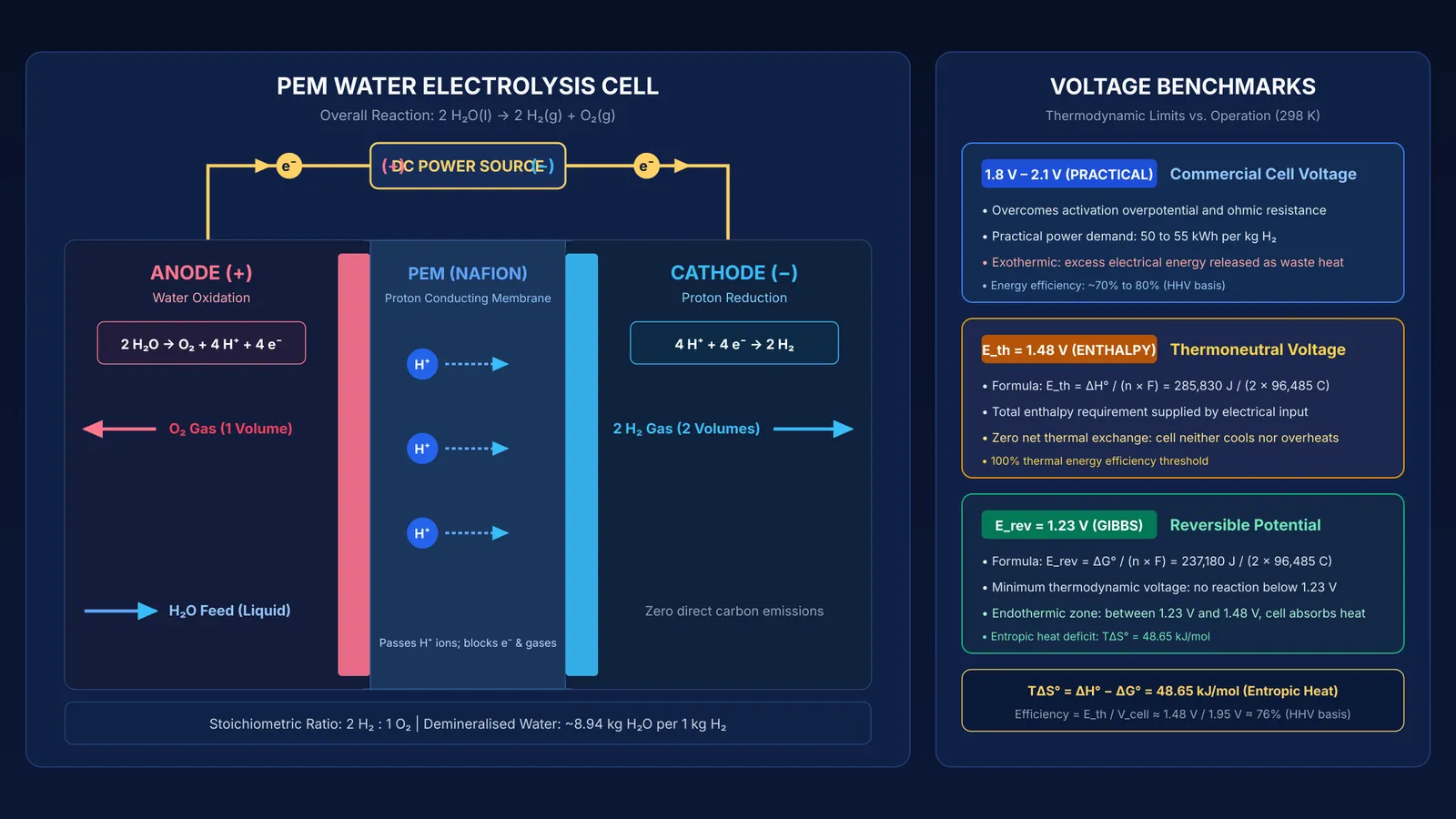
As detailed by the U.S. Department of Energy's overview of water electrolysis, an electrolyser consists of an anode, a cathode, and an electrolyte. In a proton-exchange membrane (PEM) electrolyser:
Anode (Oxidation): Water gives up electrons, releasing oxygen gas and protons:
2 H2O(l) → O2(g) + 4 H+(aq) + 4 e-
Cathode (Reduction): Protons cross the membrane and combine with electrons to generate hydrogen gas:
4 H+(aq) + 4 e- → 2 H2(g)
The overall reaction is 2 H2O(l) → 2 H2(g) + O2(g). By stoichiometry, the cathode yields two volumes of hydrogen for every one volume of oxygen. Making 1 kg of hydrogen gas requires splitting roughly 8.94 kg of demineralised water. As shown in our guide to electrolysis and Faraday's laws, the mass of hydrogen produced is directly proportional to the total electrical charge transferred.
What is the minimum voltage needed to make green hydrogen?
Splitting water is non-spontaneous. In a review of green hydrogen systems in *Renewable and Sustainable Energy Reviews* (DOI 10.1016/j.rser.2019.05.007), researchers describe the two fundamental voltage benchmarks at 298.15 K:
Reversible cell voltage (1.23 V): The standard Gibbs free energy change of water splitting is ΔG° = +237.18 kJ/mol. With two electrons transferred per molecule of H2 (n = 2), the minimum potential is E_rev = ΔG° / (n × F) = 237,180 J / (2 × 96,485 C/mol) ≈ 1.23 V. Connecting cell EMF to Gibbs energy shows why no current can split water below this voltage.
Thermoneutral voltage (1.48 V): The total reaction enthalpy is ΔH° = +285.83 kJ/mol. The difference ΔH° − ΔG° = TΔS° = 48.65 kJ/mol is entropic heat. Below 1.48 V, the cell must absorb heat from its surroundings. At 1.48 V, electrical energy supplies the entire enthalpy change.
Commercial electrolysers operate at 1.8 V to 2.1 V to overcome internal resistance and electrode overpotentials. Consequently, commercial systems require 50 to 55 kWh of electricity per kilogram of hydrogen, as reported by the International Renewable Energy Agency.
How does green hydrogen store and return energy?
Green hydrogen acts as a zero-carbon energy carrier. It can be stored in pressure tanks, liquefied at −253 °C, or synthesised into green ammonia for shipping.
When electricity is needed, hydrogen can be fed into a fuel cell. In a fuel cell, hydrogen recombines with oxygen to regenerate water and produce electricity. As documented by the U.S. Department of Energy's overview of fuel cells, fuel cells can achieve electrical efficiencies exceeding 60%, substantially outperforming internal combustion engines. Our guide to batteries and fuel cells explores how these electrochemical systems operate without Carnot-cycle thermodynamic limits.
When studying how electric potentials drive chemical reactions across membranes, interactive visualizations make the physics intuitive. The Fermi Simulation Lab provides interactive simulations for ideas that are easier to see than to read.
Where does green hydrogen fit in India's clean energy goals?
Decarbonising heavy industries like steel, refining, and fertilisers requires a clean chemical reducing agent.
To establish large-scale manufacturing, India approved the National Green Hydrogen Mission with an initial outlay of ₹19,744 crore. The mission targets 5 million metric tonnes per annum of green hydrogen and 125 GW of associated renewable capacity by 2030.
To maintain environmental integrity, the Ministry of New and Renewable Energy issued the Green Hydrogen Standard for India, setting a well-to-gate limit of no more than 2 kg of CO2 equivalent per kilogram of hydrogen.
When working through electrochemical cells and thermodynamics calculations, understanding each derivation step prevents wrong-method mistakes. The Fermi Problem Library has worked problems with a step-by-step solver that explains the reasoning rather than printing an answer.


