On this page
Which few measurements prove that two figures are exact copies? Chapter 1 of the Class 7 maths book answers with five tests for triangles, one test that fails, and a quick route to isosceles and equilateral angles.
What is Geometric Twins in Class 7 maths?
It is the first chapter of NCERT's Ganita Prakash for Grade 7, Part II (book code gegp2, First Edition, October 2025). Its subject is congruence of plane figures. The later chapters are Operations with Integers, Finding Common Ground, Another Peek Beyond the Point, Connecting the Dots..., Constructions and Tilings, and Finding the Unknown.
CBSE's 2026-27 curriculum page begins at Class IX, so there is no separate CBSE curriculum for Class 7. The class follows the NCERT book, and the chapter is assessed by the school.
What does congruent mean?
In the chapter text, two figures are congruent when they have the same shape and size, so one can be laid exactly over the other. You may rotate or flip a figure first. The chapter starts with a signboard symbol made of two arms: knowing only the arm lengths is not enough, because the arms can open to different angles. Fix the angle between them too, and the copy is exact.
Which conditions prove two triangles congruent?
The book works through each case in this order, mostly by trying to construct a second, different triangle:
SSS: all three sides equal.
SAS: two sides and the angle between them.
ASA: two angles and the side between them.
AAS: two angles and a side that is not between them. Use the angle sum of 180° to find the third angle, and it becomes ASA.
RHS: in right-angled triangles, the right angle, the hypotenuse and one more side.
Two cases fail. Three equal angles give the same shape but not always the same size. SSA (two sides and an angle that is not between them) can give two different triangles.
Why does SSA fail? A worked example
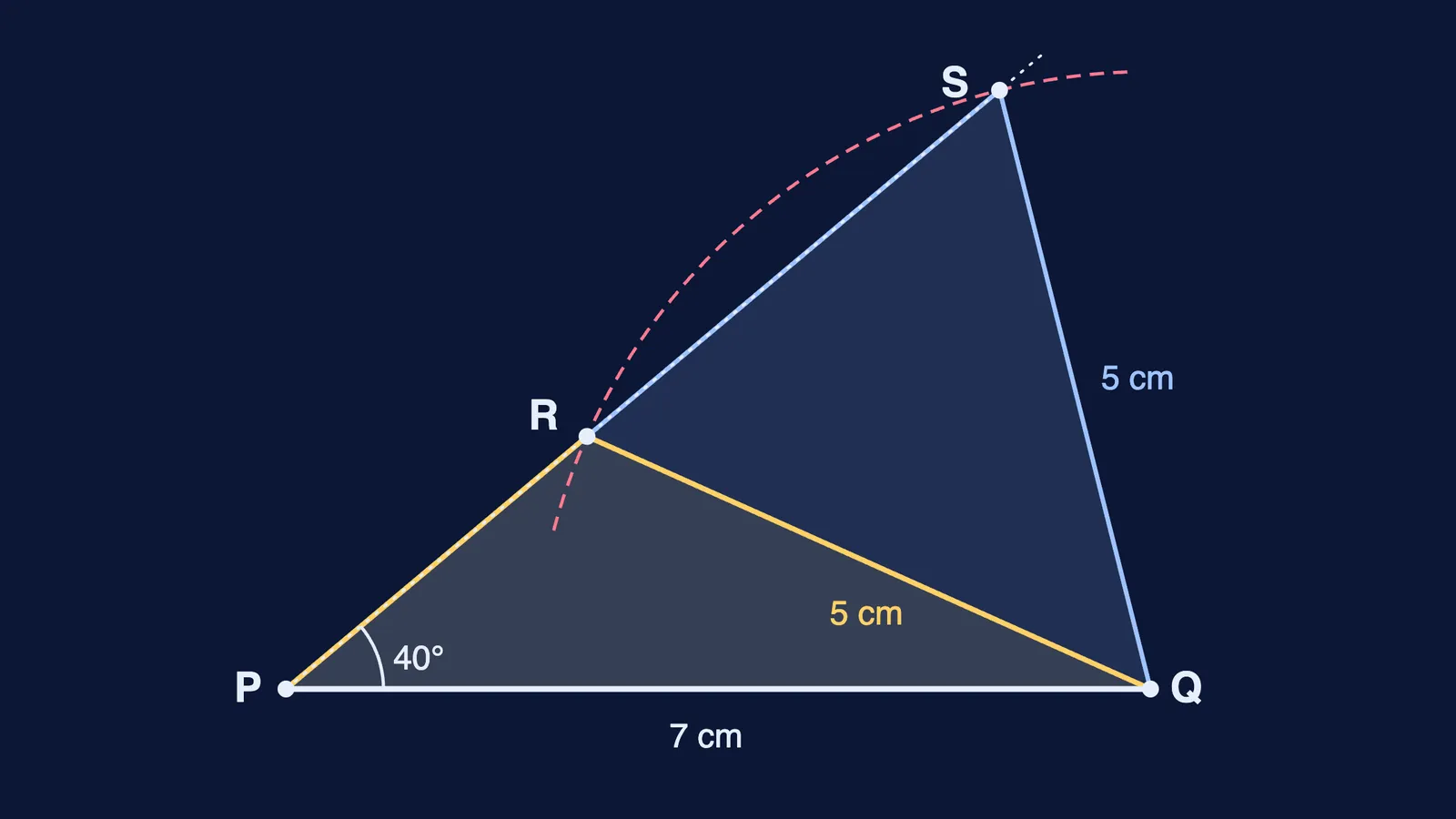
Take PQ = 7 cm, ∠P = 40° and QR = 5 cm. Draw PQ, a ray from P at 40°, and an arc of radius 5 cm from Q. The arc cuts the ray twice, at R and S, as in the diagram above.
In ΔPQR, PR ≈ 3.18 cm and ∠R ≈ 115.9°.
In ΔPQS, PS ≈ 7.54 cm and ∠S ≈ 64.1°.
Both triangles fit the same three facts but differ in size, so SSA cannot prove congruence. Measure your own drawing to see it.
Now a test that works. In ΔDEF and ΔKLM, ∠D = ∠K = 40°, ∠F = ∠M = 85°, and EF = LM = 6 cm. The side is not between the given angles. The third angles are 180° − 40° − 85° = 55°, so ∠E = ∠L = 55°. Now ∠E, EF and ∠F match ∠L, LM and ∠M, which is ASA. So ΔDEF ≅ ΔKLM, by AAS.
How does congruence give the angles of an isosceles triangle?
The book draws the altitude from the top vertex of an isosceles triangle. The two halves share it, have equal slanting sides and right angles, so they are congruent by RHS. That proves the angles opposite equal sides are equal.
So if AB = AC and ∠A = 50°, each base angle is (180° − 50°) ÷ 2 = 65°. Apply the same fact to every pair of sides in an equilateral triangle and all three angles are equal, so each is 180° ÷ 3 = 60°.
The chapter uses vertically opposite and alternate angles from parallel and intersecting lines and the 180° angle sum from the Class 7 triangles chapter, both in Part I. In Class 9, our guide to Ganita Manjari's Propositions and their Converses chapter uses SAS to show that a rectangle's diagonals are equal.
Practice questions
Marks are our suggestion.
ΔKLM ≅ ΔTUV. Which side equals UV, and which angle equals ∠M? (1 mark)
Two triangles both have angles 50°, 60° and 70°. Must they be congruent? (1 mark)
In right-angled ΔGHI and ΔWXY, ∠H = ∠X = 90°, GI = WY = 7 cm and HI = XY = 5.5 cm. Are they congruent? Name the condition. (2 marks)
Find the base angles of an isosceles triangle with top angle 36°, and the top angle when the base angles are 47°. (2 marks)
AB = 8 cm and ∠A = 30°. How many different triangles ABC can you draw if BC is (a) 5 cm, (b) 4 cm, (c) 9 cm? (3 marks)
Answers: 1. LM and ∠V. 2. No, equal angles fix only the shape. 3. Yes, RHS. 4. 72° each; 86°. 5. (a) two, (b) one, a right triangle, (c) one.
Stuck on which test fits a figure? Fermi's AI tutor works out what you already know and builds a plan for the session.