On this page
Squash a rubber ball or stretch it into an egg, and one number stays the same: its total curvature. Here are three pencil checks of why: a triangle on a globe, a doughnut and a cube.
What does the Gauss–Bonnet theorem say?
Gaussian curvature K measures how a surface bends at a point, and a sphere of radius R has Gaussian curvature 1/R² everywhere (Wikipedia: Gaussian curvature). K is positive on a dome and negative on a saddle-shaped region such as the inside of a doughnut, according to the same page.
The Gauss–Bonnet theorem states that the total curvature of a closed surface M equals 2π times its Euler characteristic: ∫∫ K dA = 2πχ(M) (Wikipedia: Gauss–Bonnet theorem; Wolfram MathWorld).
The Euler characteristic of a surface cut into vertices, edges and faces is χ = V − E + F, and the surface of every convex polyhedron has χ = 2 (Wikipedia: Euler characteristic). For a closed orientable surface with g holes (its genus), χ = 2 − 2g, so a sphere has χ = 2 and a torus has χ = 0 (Wikipedia: Gauss–Bonnet theorem). The theorem is named after Carl Friedrich Gauss and Pierre Ossian Bonnet.
How can a triangle on a sphere have three right angles?
On a globe of radius R:
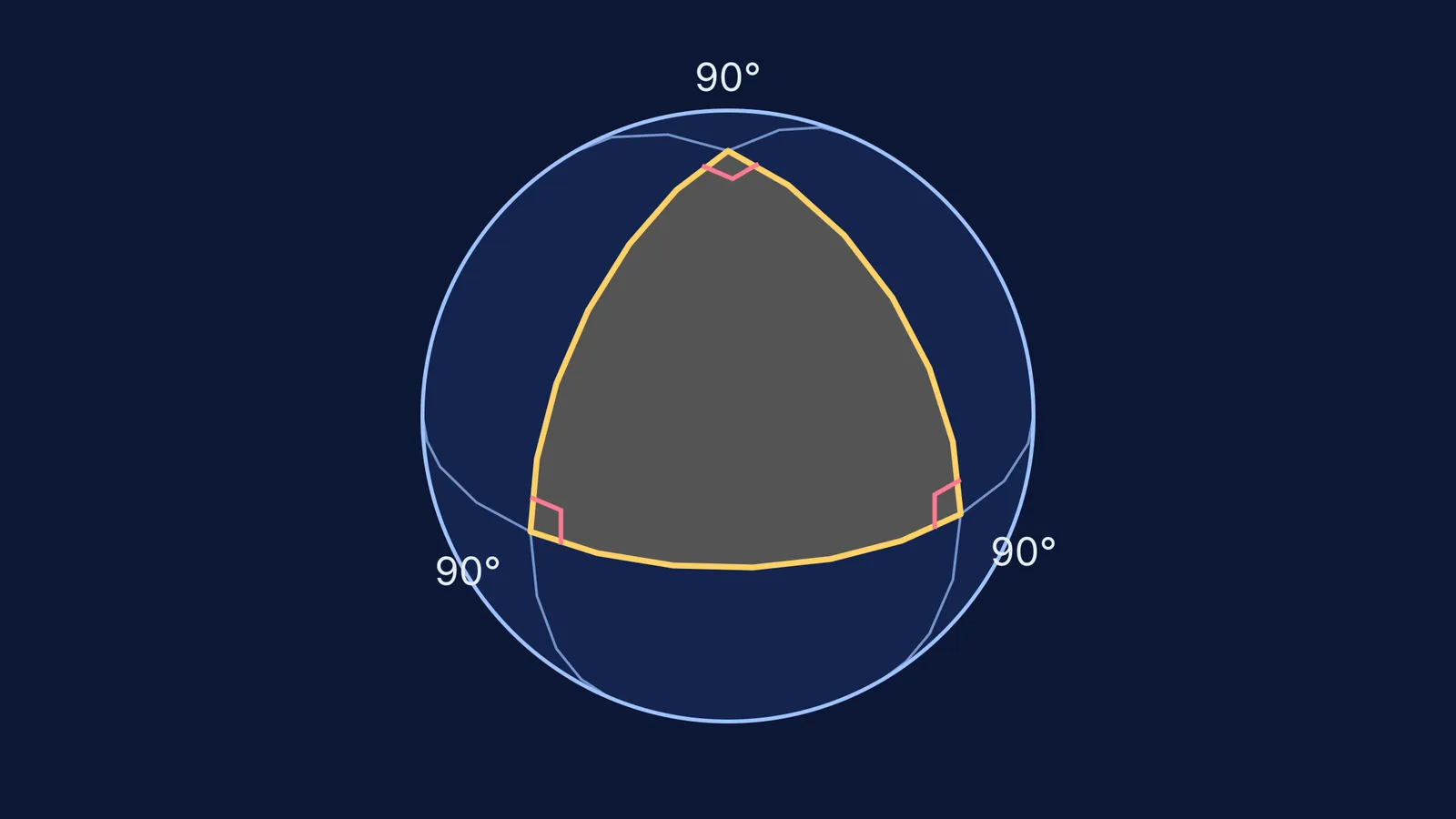
Start at the North Pole and walk due south along a meridian to the equator.
Turn 90° left, so you face east, and walk a quarter of the way round the equator.
Turn 90° left again, so you face north, and walk back to the pole, where the two meridians meet at 90°.
The angles add up to 270°, which is π/2 more than a flat triangle's π. That extra, the angle excess, is the curvature trapped inside: the angles of a geodesic triangle add up to π plus the total curvature it encloses (Wikipedia: Gauss–Bonnet theorem).
Now check it the other way. Your route encloses an octant, a spherical triangle with three right angles (Wikipedia: Spherical trigonometry). Its area is 4πR²/8 = πR²/2. Multiply by K = 1/R² and you get π/2, the angle excess again. The radius cancels.
Where K is negative, as on a saddle, the angles add up to less than π: the geometry of János Bolyai and the parallel lines that multiply.
Why is the total curvature of a torus zero?
For a sphere, K = 1/R² times area 4πR² gives 4π, which is 2π × 2. Dent it and some parts curve more, others less, but any sphere-shaped surface keeps total curvature 4π (Wikipedia: Gauss–Bonnet theorem).
On an ordinary doughnut-shaped torus, the outer part curves like a ball (K positive) and the inner part, around the hole, curves like a saddle (K negative), as the same page explains. A torus has Euler characteristic 0, so its total curvature must be zero: the two parts cancel exactly, however fat or thin the doughnut. Counting holes is the same idea you meet in why a coffee mug equals a doughnut in topology.
How does Gauss–Bonnet work for a cube?
A polyhedron's flat faces carry no curvature; it all sits at the corners. The angular defect at a vertex is 2π minus the sum of the face angles meeting there, and Descartes' theorem says the defects of a convex polyhedron add up to 4π, or 720° (Wikipedia: Angular defect).
Worked example for the cube:
Three squares meet at each corner, so the angles there add to 3 × π/2 = 3π/2.
The defect at each corner is 2π − 3π/2 = π/2.
A cube has 8 corners, so the total defect is 8 × π/2 = 4π.
Check with Euler: V − E + F = 8 − 12 + 6 = 2, and 2π × 2 = 4π.
In general, the total defect counted in full turns of 2π equals the Euler characteristic, the same page notes. New to V − E + F? See why the three-utilities lines must cross.
How do you check you really understand it?
Without notes:
Show that the octant's angle excess and its K × area both give π/2.
Explain in one sentence why a bigger sphere still has total curvature 4π.
Mark where a torus curves positively and negatively, and say why they cancel.
Find the total curvature of a two-holed surface (answer: χ = −2, so −4π).
If curvature or the Euler characteristic still feels shaky, the Fermi Concept Library covers every concept in mathematics, physics, chemistry, biology and computing. To check your defect sums line by line, the Fermi Problem Library has a step-by-step solver that explains the reasoning.